The ground in 1591: a foundation, not a capture — and not an empty plain either
Hyderabad was a foundation, not a conquest, and that is the single fact that does most damage to the claim as it usually circulates. But the ground was not empty, and this page said it was. Sherwani's account — still the standard narrative reconstruction — has Muhammad Qulī Quṭb Shāh laying out the city in 999/1591 on the plain south of the Mūsī, where his father had already thrown a bridge across the river in 1578, and where the Muslim divine Shāh Chirāgh "had already made his home in the predominantly Brahmin locality of Chichlam where he was later buried and where grew the great necropolis named after Mir Mu'min." There was also already a road: "a road running from Golkonda eastward as far as Masulipaṭam and the east coast towns of the kingdom, and this road was made to intersect a new road running north and south at the place where the Chārmīnār now stands." The order was to prepare plans for a city that would be "unequalled the world over and would be the replica of paradise itself"; it was built on a gridiron in the form of a giant double cross, and the Chārmīnār at the crossing was completed in 1000/1592 6. Moreland's editorial note of 1931 gives the foundation year as 1589 18, and the Hadā'iqu's-Salāṭīn of 1092/1681 gives 1004/1595, "which is probably the date of the completion of the scheme of construction" 11. The dates in circulation span 1589 to 1595.
So there was a village, a river crossing, a trunk road and a resident population on the site. What there was not is an earlier name for the city. Chichlam is a village toponym adjacent to a new foundation, and no source on any side of this dispute — including the sources most favourable to the claim — gives Chichlam, or anything else, as the city's own earlier name. What follows from this is narrower than the sweeping version this page carried before. It is not that nothing was there. It is that the claim's usual framing — an older Indic city displaced by incoming Muslim rulers — has nothing to attach to, because both contested names arise inside the reign of the man who built the place, between roughly 1591 and 1608. Read literally, though, the claim as quoted at the head of this page says only that the original name was Bhagyanagar and that it was afterwards changed to Hyderabad. That much is precisely what Firishta and the Briggs appendix say happened, and this page no longer refutes a conquest that the claim as worded does not assert.
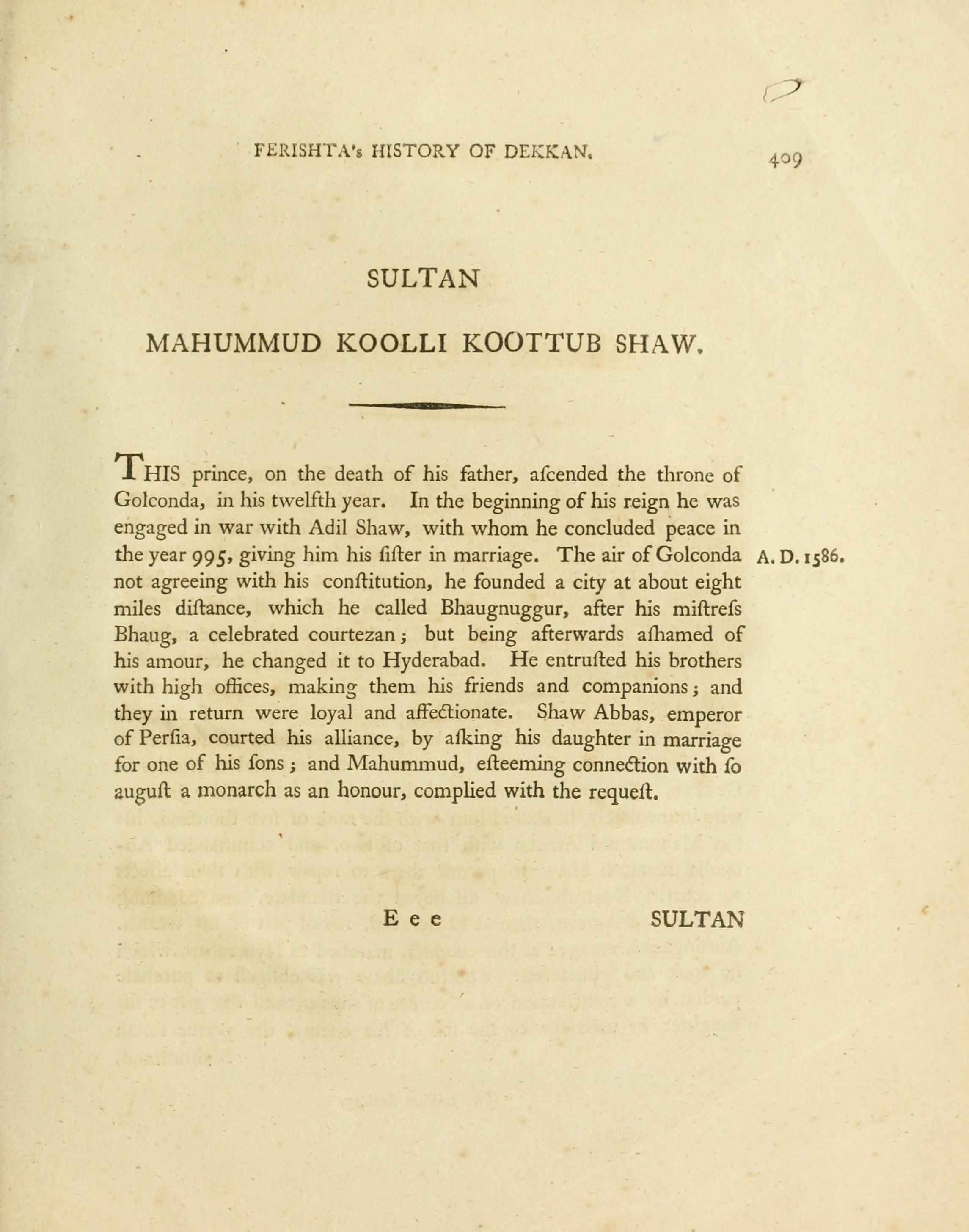
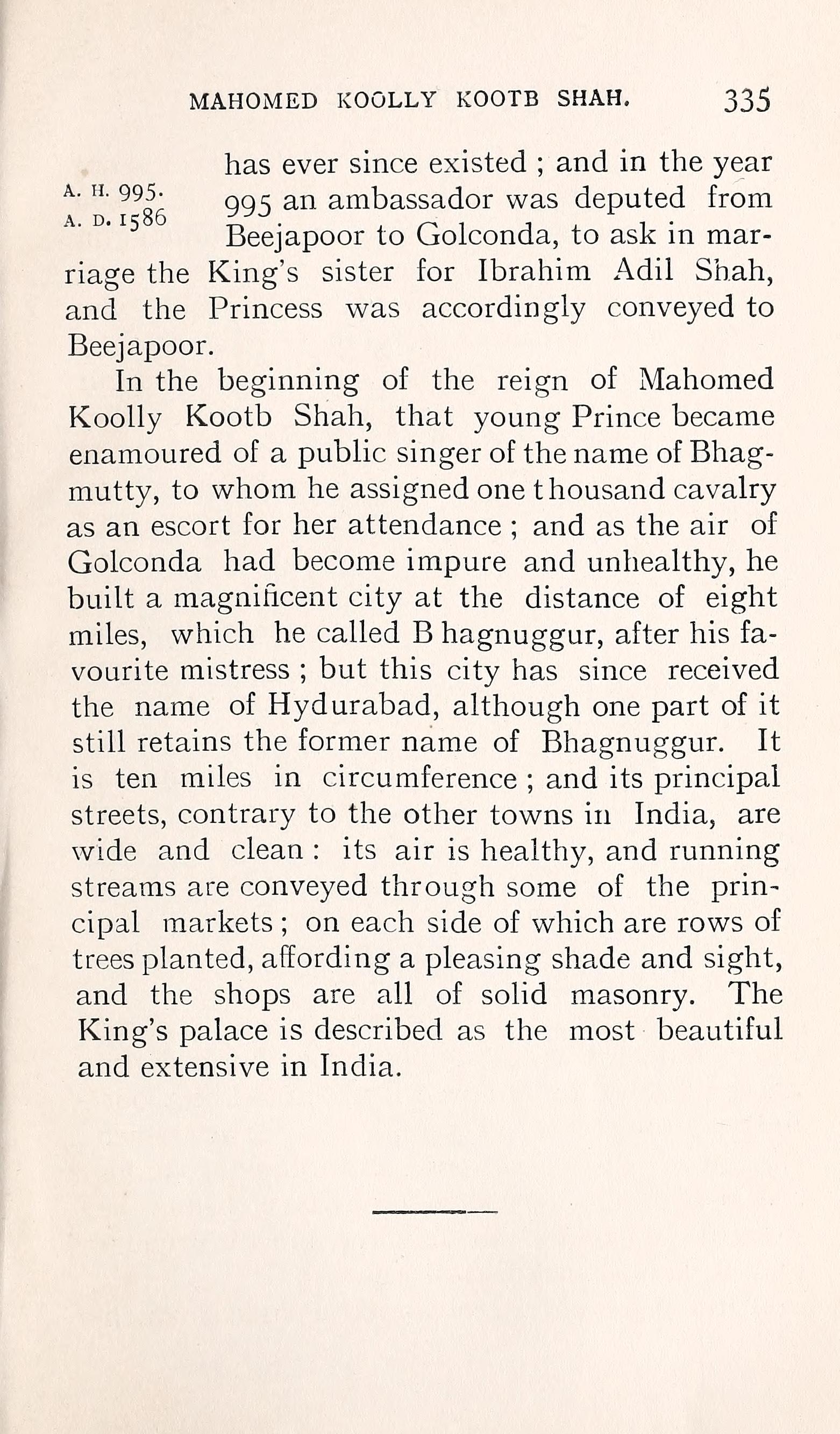
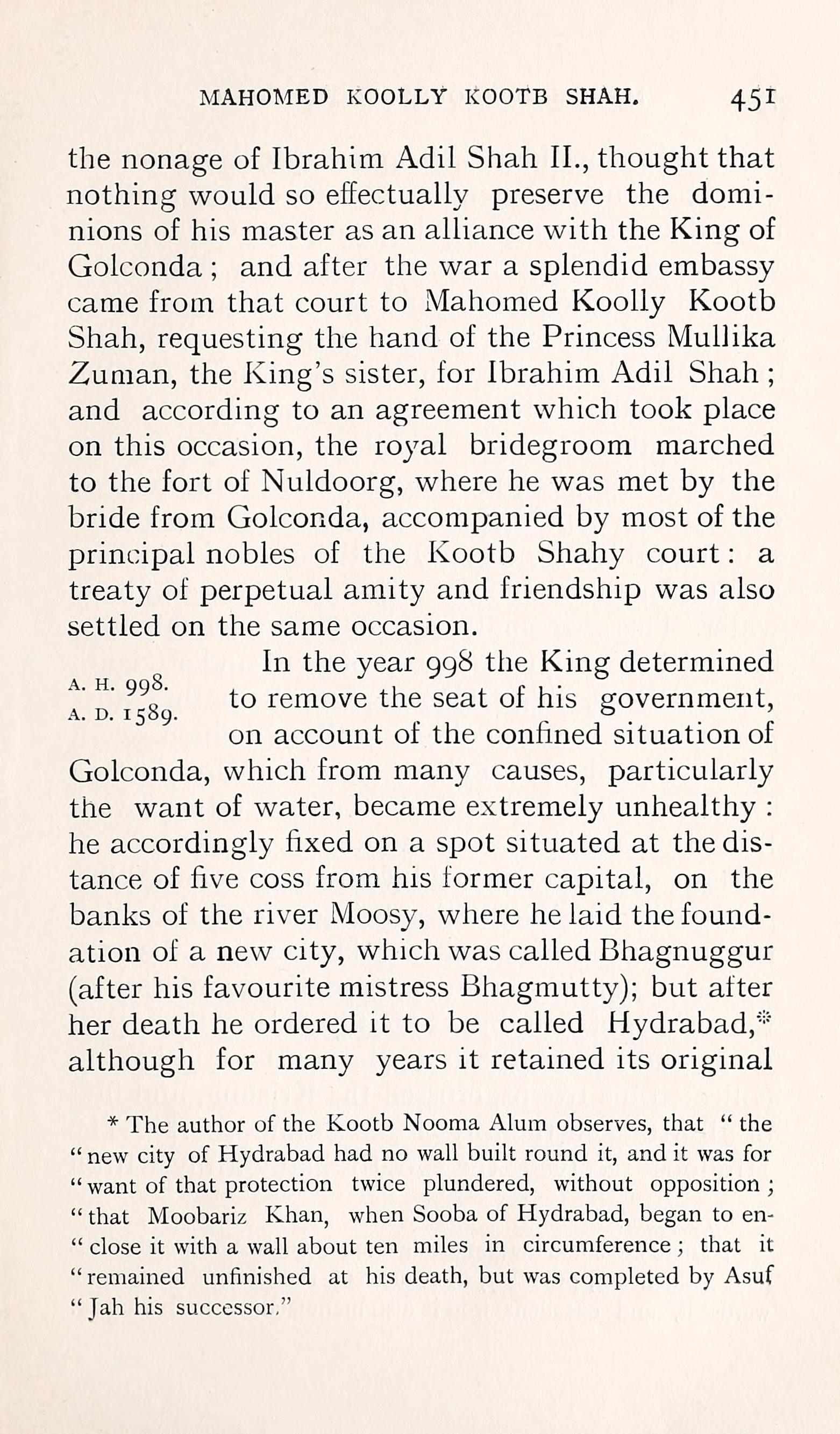
The period sources agree on why the move was made and disagree on the year. Firishta says "the climate of Golkonda had become so bad that it had been telling on the health of its inhabitants" 9. Scott's Firishta has "The air of Golconda not agreeing with his constitution" 2; Briggs's has "as the air of Golconda had become impure and unhealthy" 3. The anonymous chronicle in Briggs's appendix is the most specific and dates the decision to 998 A.H.: "on account of the confined situation of Golconda, which from many causes, particularly the want of water, became extremely unhealthy: he accordingly fixed on a spot situated at the distance of five coss from his former capital, on the banks of the river Moosy" 4. Distances given for the new site range from Firishta's four kroh through five coss to Scott's and Briggs's "eight miles"; Moreland puts the new city five miles east of Golconda 18.
The three earliest witnesses — the sentence that may not be in the manuscript, and the standard being applied
Everything in the Bhāgmatī–Bhāgnagar tradition descends, on the sceptical reading, from three Persian texts of the 1590s and 1600s. It is worth setting out exactly what each says, because the popular version of the claim is incompatible with all three of them, and because the weight they can bear has to be fixed once and applied in both directions.
The earliest is a petition of Abū'l-Faiz 'Faizī', Akbar's poet laureate and Imperial Resident in the Deccan, undated but written between 999/1591 and 1002/1594. Sherwani prints it: "Aḥmad Qulī (sic) is steeped in Shī'ism, and has built a city Bhāgnagar by name, after Bhāgmatī, the old prostitute (fahisha-i kuhnā) who has been his mistress for a long time (ma'shūqa-i qadim)" 8. Two things about this are usually left out. First, the writer had never been near the city: Sherwani states that Faizī "never set his foot beyond Ahmadnagar" 10, several hundred miles away, so the report is contemporary but second-hand. Second, and more serious, the sentence is not textually secure. Sherwani's own footnote records that he is quoting the Tabāshiru's-Subh manuscript in the Salar Jang Library, and adds: "It may be mentioned that the particular sentence quoted here is not found in the Asafiya manuscript, Insha-i Farsi, 80, which was written down at Ahmadnagar and completed on the 4th of Muharram in the fiftieth year of Akbar's reign" 8. The foundation stone of the whole tradition is absent from one of the two manuscripts of the collection that contains it, and is treated on this page as provisional pending collation — the same status given below to the untraced documents cited on the other side.
The second witness is Niẓām-ud-dīn Aḥmad Bakhshī's Ṭabaqāt-i Akbarī, closed at 1002 A.H. In B. De's Bibliotheca Indica translation the entire notice of the reign is four sentences: "Muhammad Qulī succeeded his father. He became the lover of a prostitute of the name of Bhāgmatī ; and having laid the foundation of a city, called it Bhāgnagar. He had one thousand horsemen, as the retainers of that woman ; and they always attended at her stirrups. He is ruling the country up to the present day which is in the year 1002 A.H." The translator's own note on the passage is dry: "Niẓām-ud-dīn does not give any account of the events of the reign ; and merely refers to a scandalous matter of a more or less personal nature" 5. Here too the name is unstable across manuscripts. De's second footnote reports: "One MS. calls her a زنان پاتری, the other simply زنان, while the lith. ed. has only پاتری. In the text-edition the name is بهاگ متی" 5. Sherwani, working from a different Persian text, read the name as "Bhāmgasi (sic)" and the descriptor as pātarē 9. Two editors, two readings of the woman's name.
The third is Firishta, at Bijapur, writing in 1018/1609 — the only near-contemporary chronicler working in the Deccan who mentions either name. Sherwani translates: "The Sulṭān was greatly fascinated by a prostitute (fāhishā) named Bhāgmatī… He called it Bhāgnagar at first but later he was sorry for what he had done and changed the name to Haidarabad" 9. Firishta's testimony carries the sequence the claim needs. It also carries a disclaimer he supplies himself: he tells his readers that a history of the Qutb Shahi house had been compiled by one Shāh Khurshāh, "but this work was not before the author of these pages when he wrote them down, and he had to be satisfied with only a short account of the great House" 10. Briggs, translating the same passage in 1829, reproduces the confession: "as I have been unable to obtain a copy of it, I am obliged to content myself with such details of the history of that dynasty as have been procurable" 3.
How independent are the three? Less than the pro-claim case usually assumes, and less than the sceptical case usually asserts. Faizī and Niẓām-ud-dīn were both Akbar's officers writing within about a year of each other, which is the weakest possible showing of independence; Firishta wrote at a rival Deccan court under Ibrāhīm 'Ādil Shāh II, and is therefore not simply a Mughal echo. Downstream, however, the dependency is explicit and documented: Sherwani notes that 'Abdu'l-Bāqī Nihāwandī (Ma'āthir-i Raḥīmī, 1025 A.H.) and Khāfī Khān (Muntakhabu'l-lubāb, after 1687) "say in so many words that they have relied on Ferishta so far as the history of the Deccan is concerned, and so they cannot be regarded as having the value of an independent authority" 9. Nihāwandī, indeed, garbles it so badly that he takes Bhāgnagar and Haidarābād to be two different cities founded at different ends of the reign 10.
A word now on the standard, because the same one has to hold in both directions and this page previously did not hold it. These three reports are hostile, second-hand and textually unstable. That is a reason to discount them as evidence that Bhāgmatī existed, and it is exactly as much a reason to discount them as evidence of what the name meant. A source too weak to establish the woman cannot be strong enough to establish the etymology, and the sentence this page used to run — that in every one of the earliest witnesses the name is derived from a woman, therefore not from fortune — was leaning on witnesses it had just finished dismantling. What survives their weakness is narrower and firmer: by the mid-1590s the name Bhāgnagar was current enough that two officers of Akbar's court and, fifteen years later, a chronicler at a rival Deccan court all knew it and all felt obliged to explain it. The explanations are Mughal and Bijapuri court explanations, and their unanimity is a fact about the explainers. The currency of the name is a fact about the name.
Bhāg, bāgh, and what the spellings can carry
The aspirate is the crux of the modern argument and the point on which this page's predecessor failed, so it is worth being exact — about the vernacular lexicon as well as about the scripts.
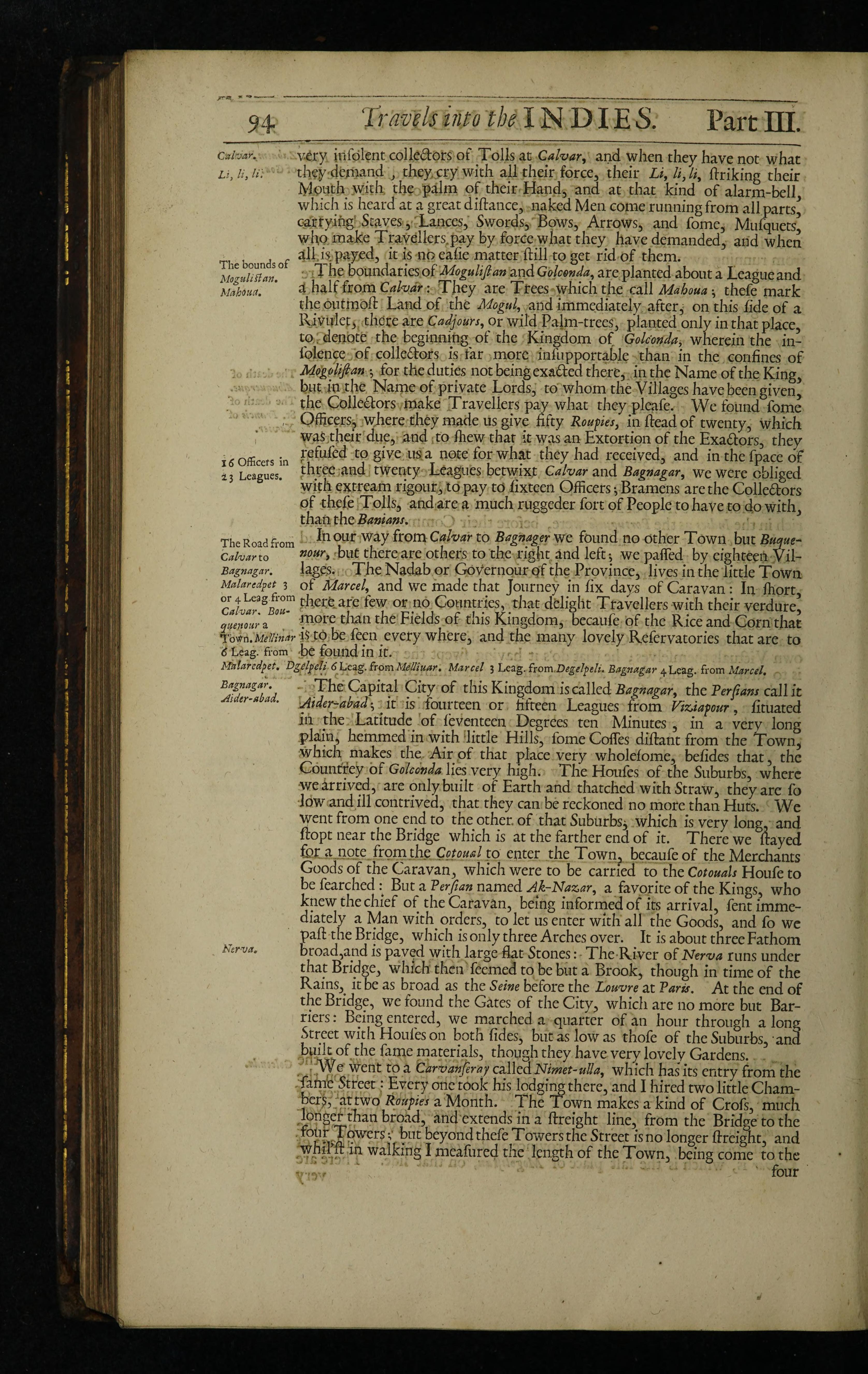
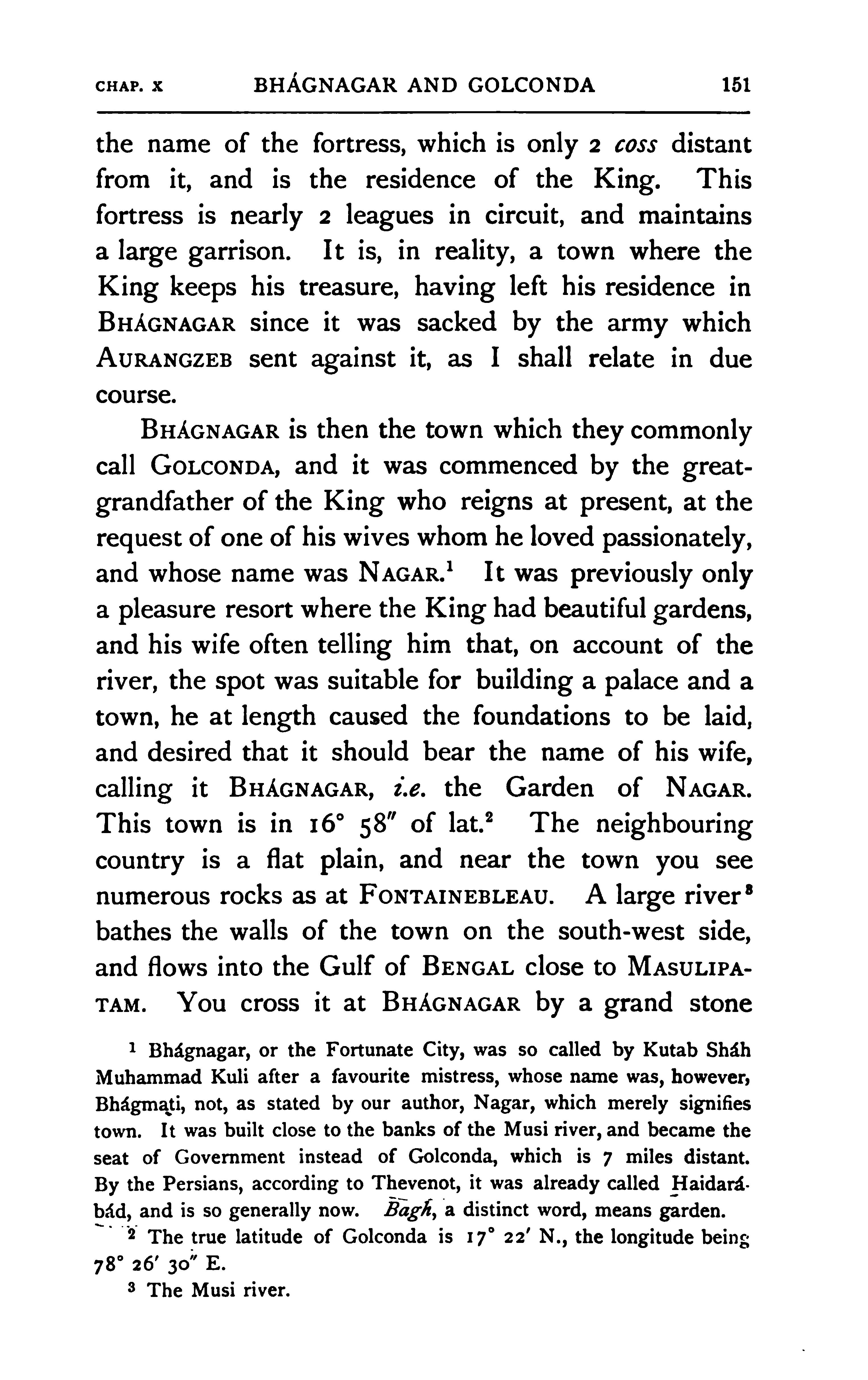
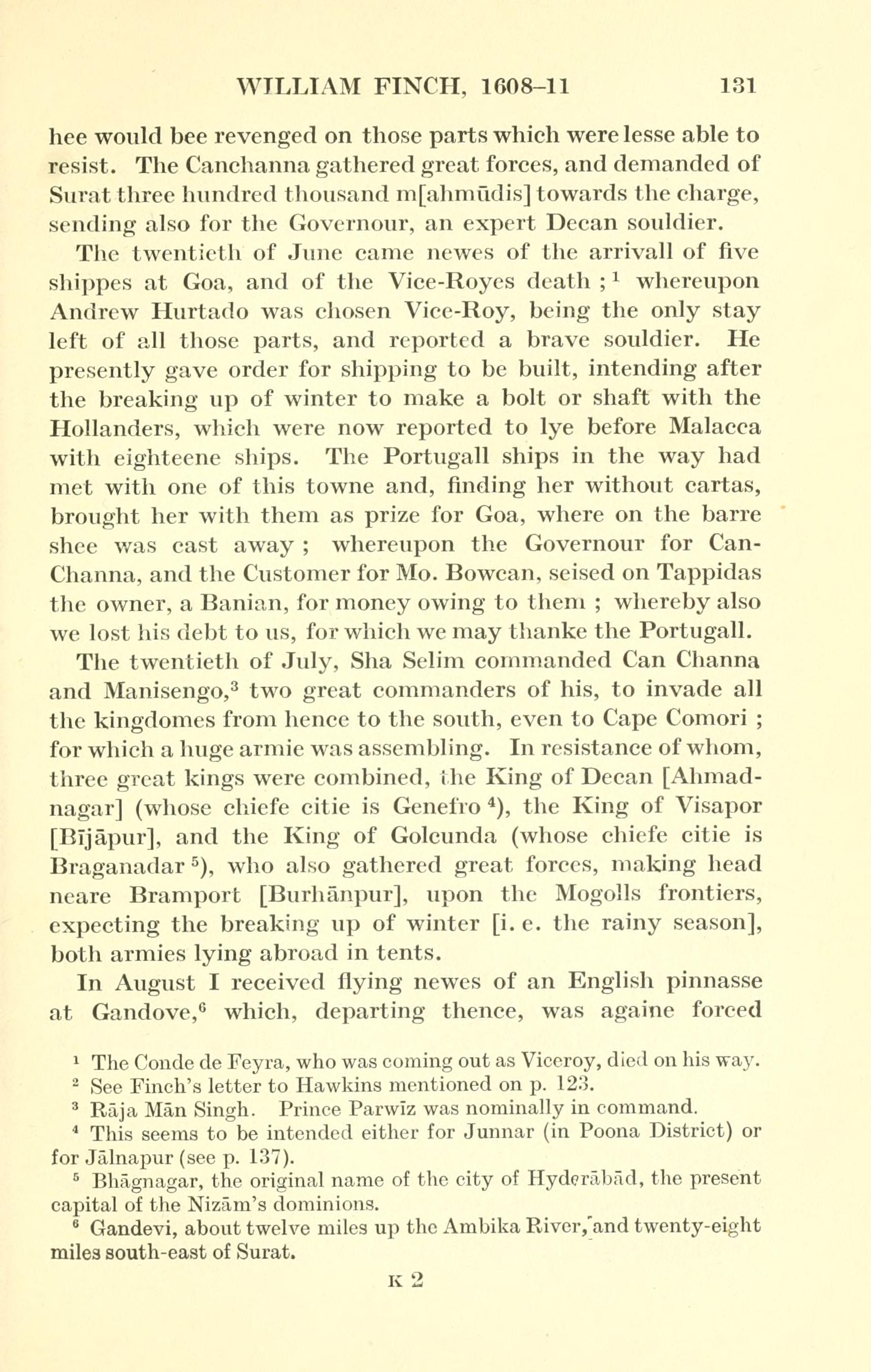
Start with the European column, in order. William Finch, the earliest English witness, in India from 1608 to 1611, wrote that the King of Golcunda's "chiefe citie is Braganadar"; the identification with Bhāgnagar is Foster's editorial note of 1921, not Finch's 17. The anonymous Dutch relation of the latter part of 1614 has "Bāgnagar," with Moreland's footnote "I.e., Hyderābād, the new capital of Golconda" — though the long ā is Moreland's romanisation, not the Dutch writer's, and the underlying text was first printed in a Dutch collection of 1644–6 19. William Methwold, resident on the coast and printed by Purchas in 1626, does not use the name at all: "This Kingdome (as most others in India) receiveth its denomination from the chiefe city or residence of the King, called by the Natives Golchonda, by the Moores and Persians Hidraband" 18. Tavernier, in V. Ball's 1889 English, is rendered "Bhágnagar" throughout, in small capitals and with an acute accent 16. Thévenot, in the kingdom in 1666–67, has at Part III page 94, with the marginal gloss "Bagnagar. Aider-abad.": "The Capital City of this Kingdom is called Bagnagar, the Persians call it Aider-abad" 1. Sherwani quotes the same sentence as "Bāgnagar… Aider-Abad" and adds Bernier using "Bāgnagar" twice in 1667 15. Unaspirated across the board, from writers whose own languages have no aspirated stops.
The Marathi column has to be added to that picture now, and it does not behave like the European one. Sen's 1920 romanisation of the 1697 Sabhasad Bakhar gives "Bhaganagar", with the aspirate, eighteen times and gives no other name for the Qutb Shahi capital 20. That is an Indic-language writer, in a language that distinguishes bh from b, writing the aspirate. The caveat travels with it: the aspirate here is Sen's transliteration of the Marathi and has not been collated against the manuscript, which is the same caveat this page attaches to Moreland's macron.
Methwold deserves a sentence of his own, because he is routinely cited on the pro-claim side and does not support it. He is the earliest sustained English account of the kingdom, he lived at Masulipatam, and his sentence gives the city two names that are both wrong for the claim: Golchonda for the natives, Hidraband for the Moors and Persians. Thévenot's split — vernacular Bagnagar against Persian Aider-abad — is not a stable seventeenth-century pattern but one witness's report forty years later. The passage about an annual gathering of courtesans at Bāgnagar that circulates under Methwold's name is not Methwold's: it is in the anonymous Dutch relation, and the dance it describes is "in celebration of the death of the first Moslem king," not of Bhāgmatī 1918.
Now the other column. In the Persian tradition the aspirate is routinely present. De's edition of the Ṭabaqāt gives the Persian text-edition reading as بهاگ متی, with the he that marks aspiration, and romanises Bhāgmatī 5. Sherwani romanises Bhāgnagar and Bhāgmatī throughout, Scott in 1794 printed Bhaugnuggur and Bhaug, Briggs in 1829 printed Bhagnuggur and Bhagmutty 923. The convenient claim that Perso-Arabic script simply cannot distinguish b from bh is not true of Indo-Persian usage, and the readings that reach us from the Persian side carry the aspirate. Rahul Shastri, who argues the case for Bhagyanagar most systematically, presses the point — "There is no way that native speakers or 'common people' could have confused 'bhag' with 'bag'" — and it is a fair hit on Sherwani 34. It means the derivation from bāgh is a conjecture imposed on the Persian evidence rather than a recovery of it. It does not refute the conjecture: Sherwani has an early Persian witness of his own in Rafi'ud-dīn Shīrāzī's "the whole city is just one large garden," and Tavernier's informants plainly did read the first element as garden 15.
The dichotomy this page previously drew from the aspirate is where it went wrong, and the correction is the most consequential one on this page. It ran: the manuscripts write bhāg, bhāg belongs to a woman's name, therefore the aspirate does nothing for bhāgya. That is not an available inference. Bhāg is the ordinary vernacular reflex of Sanskrit bhāgya in Dakhni, Hindavi and Marathi — fortune, share, luck, as in bhāgwān, badbhāgī, bhāg jāgnā — and the founder's own court knew it in that sense. The Kullīyāt's editor Zore says so of the sultan's own verse, in a passage Sherwani quotes to embarrass him: "The Sultan has used the word bhag in a number of his poems, but the word has been used in all these places in its literary meaning, i.e. for 'share' or 'fortune' and this connotation fits well with the context" 11. Ball's footnote glosses the city's name the same way, "Bhágnagar, or the Fortunate City" 16. And Bhāgmatī is itself "fortunate lady," built on the same root — so even on the courtesan reading the name runs through bhāgya. It follows that "Bhagyanagar" is not a different name from Bhāgnagar but a Sanskritising respelling of the same word, of the kind that turns a vernacular form into a tatsama one. Demanding a period attestation of the exact string "Bhagyanagar" while treating Bagnagar, Braganadar, Bhaugnuggur and Bhagnuggur as one name would be a standard applied to one side only. This page does not apply it. What remains as a negative finding, and it is a much narrower one than this page made before, is that no period source derives the city's name from the goddess Bhagyalakshmi.
The silence on the Qutb Shahi side, and what it does and does not prove
Against the Mughal, Dutch, English, French and Marathi testimony stands a body of negative evidence from inside the kingdom, and it is substantial.
Coinage first, with the two figures kept apart, because they are on different scales and the page previously let them sit together. Sherwani's survey of Muhammad Qulī's own coins finds four types: an undated one, one bearing only the date '89, one dated 991/1583 with the mint name "Dāru's-Salṭanat Kolkunda," and one dated 1012/1603-4 with "Dāru's-Salṭanat Haidarabad." "Up to the present, no coins have been unearthed bearing dates other than these" — a sentence written in 1967, and now rechecked against later numismatic publication, with results in both directions set out in the paragraph that follows 7. Sherwani's footnote then reports a published count from Abdul Wali Khan's catalogue: of 202 Qutb Shahi coins listed, 50 belong to the Golkonda mint and "all the remaining 152 belong to the Haidarabad mint" 13. Those 202 are dynasty-wide, running down to 1687. They are not 152 coins of Muhammad Qulī's reign, and they are one early-twentieth-century catalogue of one corpus in which much Qutb Shahi copper is undated and carries no mint name at all. The same discount is owed to figures on both sides of this argument, and is applied here in both directions: a count drawn from a single catalogue is evidence of what that catalogue holds, whichever way it points, and neither the 202 nor any rival tally can be treated as a census of what was struck. What the coins do carry at reign level is that a Haidarābād mint is striking by 1012/1603, which is enough on its own to sink the specific story that the name was changed in 1017/1608 12.
What they do not carry is any evidence at all from the years in dispute, and this page previously let the silence pass for a full register. The numismatic leg of the sceptical case can now be assessed properly, and the result cuts both ways at once. Take Sherwani's own list first: an undated type, one bearing only '89, one dated 991/1583 from the Golkonda mint, and one dated 1012/1603-4 from the Haidarabad mint 7. There is nothing in it between 1583 and 1603. A 2022 doctoral survey of Deccan sultanate coin legends adds three dates and does not close the gap: the Golconda copper with the warning couplet is reported at 1583, 1584 and 1586, and the Hyderabad-mint type "were minted in 1603 and 1608" 23. So there is no dated Qutb Shahi coin at all between 1586 and 1603 — that is, none from the foundation year of 1591 and none from the whole period before the reported change of name. The register is not a full ledger in which Bhāgnagar fails to appear; it is empty. And it is empty for a structural reason a peer-reviewed article makes explicit: the sultanates that succeeded the Bahmani kingdom "did not strike their own coins for almost a century after they had declared sovereign status", and the handful of pre-Muhammad-Quli Qutb Shahi issues are "extremely rare", suggesting "that these coins were not meant for circulation, but were novelty issues" 22. A dynasty that had barely begun minting, with a blank two decades across the years in dispute, is a weak witness to what the city was not called. Now the other direction, because the same evidence has to be reported whichever way it points. The negative itself is no longer a 1967 statement: the 2022 survey works through the whole published Qutb Shahi series and the string 'bhag' does not occur anywhere in it 24. Sherwani's strongest single item has survived sixty years of further publication. It is confirmed and it is worth much less than he made of it, and this page previously reported neither half.
The sultan's own writing next. Muhammad Qulī's Kullīyāt runs to a large body of Dakhni verse in which, on Sherwani's account, he names seventeen mistresses "by real or pet names, each of whom has odes ranging from one to five composed by the Sulṭān. And yet there is not one ode in favour of Bhāgmatī who is supposed to have been the most favoured of all!" 11. Manu S. Pillai reports the same in the same terms: "Muhammad Quli, who catalogued the names of his 17 beloved ladies, himself evidently makes no mention of Bhagmati, and in the Kulliyat, the city he founded is always referred to as Hyderabad" 35 — though Sherwani's own index of the three passages gives them as "My City," "City of Haidar" and "Haidarnagar," which is not quite the same thing as Hyderabad throughout 12. One further correction is owed on the sceptical side, at exactly its weight and no more: the Metropolitan Museum of Art holds a Golconda painting of about 1650, "Wedding Procession of Sultan Muhammad Quli Qutb Shah", whose own published catalogue says that "The pair is thought to be Muhammad Quli Qutb Shah (r. 1580–1612) and Bhagmati, Golconda's legendary lovers" and reports no inscription naming her 28. It is a real mid-seventeenth-century court object with a traditional rather than a documentary identification. It does not touch the five things the sceptical sentence quoted on this page actually denies — manuscript, stone inscription, grave, coin, Kullīyāt 36 — and it is not evidence that Bhāgmatī existed; it does mean that any wider absolute of the form "no image of her exists" should not be repeated unqualified.
The Deccan chronicles next. The semi-official Tārīkh-i Muhammad Quṭb Shāh, completed 1017/1608, describes the new capital, the Chārmīnār, the fourteen thousand shops, the hospitals and squares — and does not mention Bhāgmatī or Bhāgnagar. Nor does the Hadīqatu's-Salāṭīn of 1054/1644, nor Bustāmī's Hadā'iqu's-Salāṭīn of 1092/1681 1011. That negative is the load-bearing one in Sherwani's case, and it is now under a specific and unresolved challenge, set out in the open questions below. Sherwani also disposes of the suppression hypothesis on its own terms: if the peshwā Mīr Mu'min had wanted the courtesan written out, "why was it necessary for him to wait for a change of names for two decades?" 11.
How much does this silence carry? Chanceries, mints and court chronicles record official nomenclature; they are exactly the registers in which a vernacular by-name would be invisible, and Thévenot's sentence describes precisely that split 1. Sherwani himself concludes in those terms: "while the common people called the city 'Bagnagar', the ruling aristocracy and government officers (i.e. those who carried on their official correspondence in Persian) called it Haidarabad" 15. Applying that principle consistently costs this page two of its own arguments, and they are surrendered here.
"No Bhāgnagar mint" is a chancery register by definition and cannot be both discounted as a register and cited as a finding. That defence has to be run at its true strength and not above it, and this page previously ran it above. The 2022 survey lists the attested Qutb Shahi mint names as "Golkonda: Dar-ul-Sultanate, Golkonda: Mohammad Nagar, Hyderabad, Dar-ul-Sultanate (Shahr), Ibrahimpattan, and Mukundnagar" 24. Mukundnagar is a fully Indic toponym and it is on the coins; Muhammadnagar is a Persian name in an Indic compound, and the founder wrote Haidarnagar in his own verse 12. The Qutb Shahi mint register was therefore not closed to Indic-form place-names, and this page cannot say that such a name would have been invisible in it as a matter of course. The defence is narrower than that and should be stated narrowly: what a mint register records is the official name of the striking city, so a second, unofficial name for the same city has no place to appear in it. Mukundnagar is a different town, not an alternative name for the capital. The register argument survives in that reduced form; it does not survive in the form the page previously used. And the Archaeological Survey's statement that it holds no information on the city having been named Bhagyanagar is institutional silence from an agency with no remit over toponymy at all — it is used below only for the Chārminār structure, where the ASI does have remit.
But the Kullīyāt is not a chancery document. It is intimate, indiscreet verse in the vernacular by the man who built the city, and if a Bhāgmatī existed and the city bore her name in the street, her absence from it is the hardest single fact for the Bhāgmatī romance to absorb. That is not the same as the hardest fact for the claim under examination, and this page previously conflated the two. The claim does not need Bhāgmatī. If she never existed — and Sherwani's own apparatus is the best case that she did not — then the derivation of the city's name from a courtesan is a hostile Mughal back-formation from a name that was already current in the street, and the ordinary lexical value of bhāg is left in sole possession of the field. That reconstruction is supported by this page's own evidence, it is what an informed defender of the claim actually holds, and it is set out below as a position in its own right rather than left unstated.
From Bhāgnagar to Bhagyanagar to Bhagyalakshmi
The claim under examination does not use the form the sources use. Every seventeenth-century attestation traced above is short: Bhāgnagar, Bāgnagar, Bagnagar, Bhágnagar, Bhaugnuggur, Bhagnuggur, Braganadar, and in Marathi Bhaganagar. The Sanskritised Bhagyanagar, with the -ya-, does not appear in that record, and no period attestation of it surfaced in any language reached here. That is a finding about orthography rather than about the word. As set out above, bhāg and bhāgya are the same lexical item in two registers, and the absence of the tatsama spelling from a Persian, Dutch, English, French and Marathi record is close to what one would predict whether or not speakers of Telugu and Dakhni understood the name as "city of fortune." The honest statement is that the modern campaign spelling is modern; the modern campaign meaning may not be.
On Telugu and Sanskrit the negative report is explicit, comes from the scholar with the best access to the material, and is limited by its own author in terms that travel with it everywhere on this page: "Lastly, to the present author's knowledge, no contemporary Telugu work contains the names either of Bhāgmatī or of Bhāgnagar" 14. To the present author's knowledge, in 1967, without a systematic search of the Andhra Pradesh Oriental Manuscripts Library or the Telangana State Archives. Sherwani then reports the one near miss: a palm-leaf Sanskrit manuscript in Telugu characters by Sarangu Tamayya, karnam of Golkonda, in which the author "calls himself a resident of 'Bhāgīratīpaṭṭanam'. Even in the manuscript the name, Bhāgnagar is not mentioned" 14. Bhāgīratī is a woman's name, and Sherwani suggests it may point to a wife of Ibrāhīm Quṭb Shāh rather than to the city's name at all. What it is not is Bhāgyanagaram. A deliberate search for a pre-twentieth-century Telugu attestation was run again for this revision and produced nothing older than a film lyric of 1972 37.
The goddess derivation is a separate proposition from the Bhāgmatī story and rests on the shrine at the south-eastern foot of the Chārminār. Here the documentary position is unfavourable, and the reporting has to be attributed exactly because it is the material evidence on the point. The Archaeological Survey's own words are on record and this page previously used a paraphrase of them. Replying to a Right to Information application in 2021, the ASI stated: "The Bhagyalakshmi Temple came into existence after taking over of Hyderabad by the Govt. of India adjacent to South Eastern minaret of the Centrally Protected Monument. No records are available in this office about the Chilla adjacent to Charminar (sic)". Answering an earlier application of December 2012 it had stated that "the construction of temple adjacent to the south eastern minar of the Charminar has considered by the Archaeological Survey of India as an unauthorised construction (sic)". The correspondence runs back further than this page said: in December 1968 the Superintending Archaeologist M. Idrisullah wrote to the Commissioner of the Municipal Corporation of Hyderabad seeking help in removing "unauthorised brick construction on the south-eastern side of the monument, Charminar, which has abutted and to some extent encroached into the monument itself"; the May 1977 letter this page previously treated as the start of the series is a later item in it 26. Dated photographs from two archives point the same way: The Hindu holds images of 1957 and 1962 showing no structure and of 1990 and 1994 showing it, and the Aga Khan Visual Archive at MIT holds one of 1986 27. All of this is inside the agency's statutory remit over a protected monument, and it is factual about a structure and about nothing else. The Siasat report remains on this page for the 2012 High Court proceeding and for the ASI's statement about the city's naming, which is outside its remit and is given no weight here 38. The ASI's silence on toponymy is given no weight for the same reason Qutb Shahi chancery silence is discounted above. What does carry is the narrower architectural point: no evidence places a Bhagyalakshmi shrine at the Chārminār in 1591, and the earliest secure material evidence for the present structure is of the twentieth century.
The transmission of the romance in the other direction is easier to date, and Sherwani dates it with unusual bite. After Āsaf Jāh I, he writes, "the erotic part of the story came to have a special appeal to the chroniclers. Quite against the old adage that a rolling stone gathers no moss, much moss was gathered round the small sneering sentence of Faizī, and soon the sentence grew into a paragraph, the paragraph into a section, and the section into chapters at the hands of the courtesan's panegyrists." Bhāgmatī was identified with the Haidar Mahal of the poems, made the mother of Hayāt Bakhshī Begam, given a tomb — all, on Sherwani's showing, without material evidence, and the tomb identification contradicted by the inscription on the only female grave in the chamber 131412. It is worth noting that the counter-current is as old as the current: the Māhnāmah of 1225/1810, quoting Mun'im Khān Hamdānī's Sawāniḥ-i Dakan, records the story and rejects it — "But the whole of the story is utterly baseless" 13.
A dossier of further attestations of Bhāgnagar circulates in the public argument and was assembled in one place by the Deccan Chronicle in February 2023: Finch; a 1601 reference in Yazdani's Antiquities of Bidar; a Shah Jahan letter printed in Islamic Culture in April 1934; a 1067 A.H./1656 manuscript notice; the 1708 Shah 'Alam coin legend "Farkhunda Buniyad-i-Hyderabad"; a 1951 statement by the Osmania vice-chancellor that the city "was originally named 'Bhagnagar'"; a report of Bernier quoting a letter of the Golconda vazir Mir Jumla to Aurangzeb asking him to attack Bhagnagar; a report of Thomas William Beale's Oriental Biographical Dictionary (1881) quoting Khafi Khan that after Bhagmati's death the name was changed to Haidarabad "but that in the vernacular language of the people it continued to be 'Bhagnagar'"; and, most consequentially, a sentence attributed to the Tarikh-i Sultan Muhammad Kutbshahi that the sultan "built Bhagnagar or Haidarabad" 37. This page's earlier summary of that dossier omitted the last three items, including the one that bears hardest on the authority this page leans on most; they are restored here, and the Tarikh-i sentence is carried at the newspaper's report only, unverified in any edition, and is now an open question below. That dossier is largely sound on Bhāgnagar, which is the proposition it actually supports. None of it is evidence for the goddess.
Where the argument now stands
Four findings survive on the documents.
First, the city was built new in 1591 and both names belong to its builder's reign 6. Anyone defending the claim has to abandon the conquest framing that usually travels with it — but only that framing. The claim as quoted at the head of this page does not say conqueror, and read as written its first and third components are what Firishta, the anonymous Qutb Shahi-era appendix and Foster's Hakluyt footnote all say 9417. This page previously refuted a stronger claim of its own authorship and no longer does.
Second, Bhāgnagar was a real name that the city really carried: in Mughal report from the 1590s, in Deccan report from 1609, in English report from 1608–11, in Dutch report from 1614, in French report to 1667, and in Marathi report of 1697 591719120. Anyone denying the claim has to concede this, and the flat denial that Hyderabad "was never Bhagnagar" is not supportable — it is least supportable against the Marathi witness, who is writing in an Indic language and uses no other name. Against it stands one significant counter-witness who is rarely cited on this side: Methwold, who lived in the kingdom, printed in 1626, and gives the two names as Golchonda and Hidraband 18.
Third, the earliest surviving explanations of the name are hostile Mughal and Bijapuri ones deriving it from a woman the sources call a prostitute: Faizī's fahisha-i kuhnā, the Ṭabaqāt's pātarē, Firishta's fāhishā 89. That is a fact about the explainers, and it is stated here at exactly the weight those explainers can bear — which, given that the same page dismantles their independence, their access and their textual security, is not much. Whether the woman existed is genuinely open, and if she did not, the derivation from her is a back-formation and the claim is helped rather than hurt.
Fourth, what actually fails. The goddess Bhagyalakshmi appears in none of the period sources traced here, in any language — and that now includes Marathi, where the one Indic-language tradition demonstrably using the name derives it, in its 1920 editor's report of later chroniclers, from a Brahman lady and not from a deity 21. Four explanatory traditions are now on this page and not one of them is the goddess. No specialist historian of the Qutb Shahi period was traced holding that derivation in print. The Sanskritised spelling is modern. Everything else is contested between competent readings of real evidence: Foster and Ball on one side saying original name and Fortunate City, Sabhasad's bakhar behind them, Sherwani on the other with the coins, the chronicles and the Kullīyāt, and Methwold sitting awkwardly for both. This page does not think the documents currently settle it, and says so rather than picking a side and dressing the pick as a finding.