Claim examined

Was Padmini a historical queen?

Open Amir Khusrau's own account of the siege — he marched with the army — and the story runs: drums, a march from Delhi, a fort taken on 11 Muharram 703 (August 1303), the Rai's flight and surrender, a massacre of thirty thousand, and the place renamed Khizrabad. No queen, no name, no beauty appear in that text. Ziauddin Barani, writing within the following generation, gives the whole siege one sentence and no queen either. The Rai himself, though, is not solely a literary figure: a Dariba temple inscription of 1302 CE independently attests a 'Maharajakula Ratnasimha' ruling at the time, and a 1460 CE Kumbhalgarh eulogy — the earliest Hindu record of the siege, raised by a rival branch of his own dynasty — records his 'departure' from the field in language one respected epigraphist, G. H. Ojha, read as a hero's death. The queen first has a name in the sources this page opened in 1540, in a Sufi allegorical poem composed 600 miles away in Awadh, where Jayasi introduces 'Padmini' as a category — the supreme class of beautiful women — before she becomes his poem's princess. The name migrates from allegory to genealogy over the following century and a half: Abu'l Fazl's Ain-i-Akbari retells a version of the siege on the authority of 'ancient chronicles' in the 1590s but still does not name her; Munhata Nainsi's Khyat, a Marwar state chronicle rather than court poetry, does name her by the 1660s; and the name gathers a Rajasthani bardic tradition before arriving at James Tod's desk in 1829 as if it had always been history. This page tracks that migration and states, at each step, exactly what the page it opened actually says — and this page opened, for the first time, the two sources most likely to settle the question either way: the Ain-i-Akbari (which does not name her) and G. H. Ojha's own history of Udaipur, which states flatly, and without citing a source, that she was Ratnasimha's queen. Against that, Aziz Ahmad argues the poem's title character reflects a wholly different, 16th-century Rana of Chitor — a complication this page's own epigraphic evidence for the king's identity does not resolve. The historians this page could locate genuinely disagree, more sharply on this reading than the last: from Ojha's unhedged affirmation, through Lal's 'perhaps' and S. Roy's open agnosticism, to Ahmad's argument that the epigraphy answers a question about the wrong man (see whatIsTrue, historiography and openQuestions).

The claim, as it circulates

Padmini (Padmavati) was the historical queen of Chittor whose beauty drew Alauddin Khalji's siege of the fort in 1303, and who died in jauhar rather than be captured.

Contested

The 1303 siege is documented by Amir Khusrau, who marched with the army, and by Barani, and neither names a queen or a motive of beauty; a 1302 inscription independently attests Ratnasimha ruling Mewar 5. A beauty motive is told independently of Jayasi in the Ain-i-Akbari, on the authority of 'ancient chronicles' 3, but the name Padmini first appears in Jayasi's poem of 1540, and outside poetry only in Nainsi's Khyat of the 1660s 30. Historians who read these sources disagree about the facts, not only the telling — Ojha states the queen as fact 28, Lal allows her only as a possibility 12 — so the page rests at contested.

Draft. This entry is an unreviewed first draft. It has not yet been checked by a subject reviewer — see sources and method.

What is true here

The part of the claim the record does support, stated before the part it does not.

The siege is real, dated, and described in detail by an eyewitness — this is the load-bearing fact the whole legend is built on top of.
Amir Khusrau, who 'accompanied the expedition', writes that 'the fort was taken on Monday, the 11th of Muharram, A.H. 703 (August, 1303 A.D.)', that the Rai fled and then surrendered, and that Alauddin 'order[ed] a massacre of thirty thousand Hindus' before bestowing the government of Chitor on his son Khizr Khan and renaming it Khizrabad 1.
Jauhar as a Rajput response to an unwinnable siege is independently attested and not invented for this story — and even K. S. Lal, whose overall reading of the sources is unfavorable to the legend, concedes a queen may genuinely have died in it.
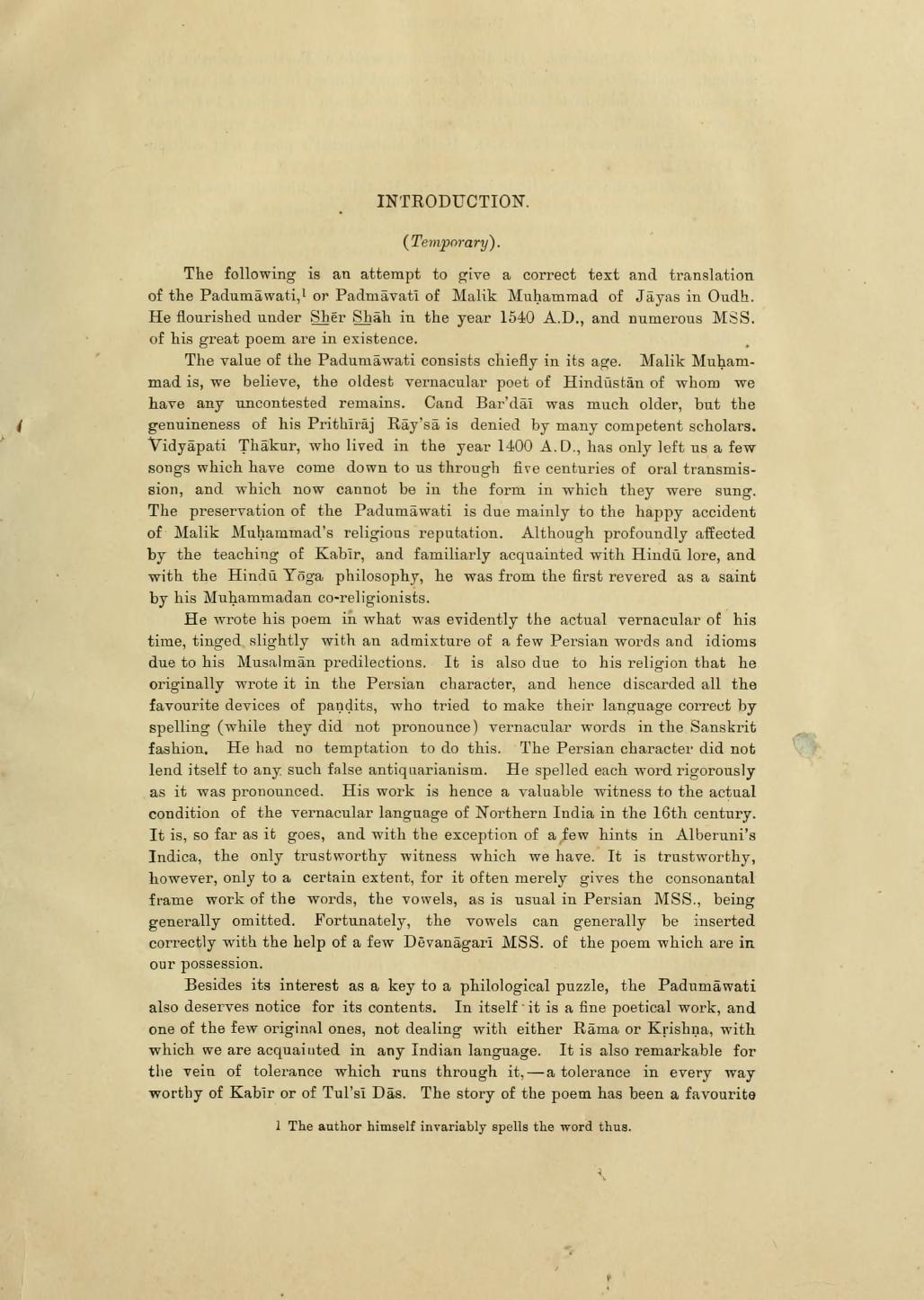
K. S. Lal's verdict, after weighing the sources, is: 'Setting aside the traditional narratives of the story the true facts are that Sultan 'Alauddin invaded Chittor in the year 1303 and after a hard fight of about eight months captured it. The brave Rajput warriors died fighting the invaders; the brave Rajput women perished in the flames of Jauhar. Among those who perished was perhaps a queen of Ratan Singh whose name was Padmini. Except these bare facts all else is a literary concoction and lacks historical support' 12. That is a real concession, not a rhetorical one: it allows a queen, allows her possible name, and allows her death by jauhar — while refusing everything Jayasi built on top of that kernel.
The king the legend calls Ratan Singh is not only a figure inherited from Firishta, Jayasi and Tod — he is independently attested epigraphically, before the siege and outside any of their chains of transmission, and a rival branch's own near-contemporary eulogy bears directly on how he met his end.
A Dariba temple inscription dated V.S. 1359 (1302 CE) records the gift of 16 drammas to the temple 'when the Maharajakula Ratnasimha was ruling over Medapata', and the same ruler is named with the title Maharajakula (colloquially Maharawal) on record independently of any bardic or Persian retelling; a few coins issued in his name have also been found 5. That is stronger-tier evidence for the identity of Khusrau and Barani's unnamed 'Rai' than anything else this page cites for the point. Separately, a 1460 CE Kumbhalgarh prashasti — a Sanskrit eulogy raised by Kumbhakarna of the rival Rana branch of Ratnasimha's own dynasty, and reported in the secondary literature as 'the earliest Hindu record of the siege' — states that after Ratnasimha 'had departed' (tasmin gate), Lakshmasimha of the Khummana family defended the fort and died in the attempt 6. The word for 'departed' is read two ways in the secondary literature: the epigraphist G. H. Ojha read it as meaning Ratnasimha 'bravely fought till death', a reading Kalika Ranjan Qanungo and R. B. Haldar are both reported to have accepted, while Akshay Kirti Vyas, R. C. Majumdar and Subimal Chandra Datta read the same verse as flight and surrender, the last drawing a contrast with the inscription's separate, unambiguous statement that Lakshmasimha 'departed for heaven' 6. Neither inscription names a queen or a Padmini; what they establish is that the historical kernel under the legend — a real Ratnasimha, ruling at the right moment, whose fate at the siege a rival dynasty's own near-contemporary stonework treats as a live and disputed question — is more solid than a page built only from Firishta's, Jayasi's and Tod's literary chain would suggest.
The historian who corrected Tod's epigraphy and chronology, working from Ratnasimha's own Mewar records, states without hedging — more confidently than K. S. Lal's 'perhaps' — that Padmini was Ratnasimha's queen; but his own next page treats most of the rest of the legend as invented, and this specific sentence carries no citation of its own.
G. H. Ojha's Udaipur Rajya ka Itihas states plainly: 'Ratnasimha's chief queen was Padmini, whose vast ancient palace… still stands' at Chittorgarh, and that the palace and an adjoining lake are still known by her name 28. Two pages later, in the same book, Ojha calls Padmavat 'a poeticised tale like today's historical novels' whose historical kernel is only 'that Ratnasen (Ratnasimha) was the king of Chittor, Padmini or Padmavati his queen, and Alauddin the sultan of Delhi who fought him and seized Chittor's fort' — and rejects the Ceylon journey, Devpal, Kumbhalgarh (which he dates after 1303) and the second siege as invented for effect 29. Ojha is this page's strongest single voice for the queen's historicity, precisely because he is also its harshest critic of the poem's other details — but neither passage cites a source for the queen's name specifically, and the palace/lake toponym he leans on could as easily be named after the legend as evidence of the woman. That toponym caveat is this page's own uncited inference, weighed no more heavily than the comparably uncited or unopened speculation this page also reports on the other side of the ledger (Aziz Ahmad's redating, S. Roy's skeptical half).
A 17th-century Rajasthani administrative chronicle — not bardic poetry, and 170 years before Tod — already ties the name 'Padmani' to the deaths of Ratnasimha's line at the siege, resolving a gap this page's own reviewers had flagged: that its Rajasthani sources were all poetic epic, none archival.
Munhata Nainsi's Khyat (compiled c. 1660s by Marwar's own chief record-keeper) states in its own 17th-century Marwari, not a modern editor's gloss: 'Ratnasi, son of Ajasi, brother of the warrior Lakhamsi. In the matter [मामलै] of Padmani, Lakhamsi and Ratnasi died fighting against Alauddin… having performed jauhar, Rana Lakhamansi and Ratnasi died' 30. This is 120 years after Jayasi — too late to prove the name predates Padmavat — but it is a genealogical and administrative record, a different genre from bardic poetry, and it treats 'Padmani' as the named cause of a dynastic death, not as a poem's allegorical figure. It also states, unlike the disputed Kumbhalgarh prashasti reading, that Ratnasimha (not only Lakshmasimha) died at the siege rather than fled. The chronicle's modern editor, Badriprasad Sakaria, goes further in his own footnote 3 to this passage, glossing it without hedging as: 'the supremely beautiful queen of Maharana Ratnasimha, Padmini, whom Alauddin Khilji, from an intense desire to obtain her and make her his begum, attacked Chittor to seize' 30 — an unhedged statement of the claim's exact causal mechanism, a named queen desired for her beauty as the reason for the siege. That statement is the editor's own 20th-century interpretive addition, not Nainsi's 17th-century text, which says only that the deaths occurred 'in the matter of Padmani' and states no motive of its own; this page reports the gloss as the editor's reading rather than as an independent primary attestation of the beauty-motive, but it is evidence in the page's own citation block that belongs beside the main-chronicle line, not left out of the synthesis.
The page's own primary-source reading of the epigraphy identifies the unnamed Rai of Khusrau and Barani with the 1302 CE Dariba inscription's Ratnasimha; Aziz Ahmad, in the one journal-published historiographical argument this page has located that engages the dating question head-on, argues instead that Jaisi's 'Ratan Sen' was a 16th-century Rana of Chitor — a serious complication this page's earlier round did not disclose.
Aziz Ahmad writes that 'Ratan Sen (1527–32), the Rana of Chitore, was a contemporary not of Ala al-din Khalji but of Jaisi himself and Sher Shah Suri', and proposes that the litter-and-palanquin rescue motif echoes Sher Shah's own capture of Rohtas fort by the same ruse, while a mass Rajput sati in 1531 — nine years before Padmavat was composed — supplied another near-contemporary element folded into the poem 23. If Ahmad is right that the poem's 'Ratan Sen' reflects Ratna Singh II of Mewar (a real ruler of roughly 1528–1531, killed defending Chittor against Bahadur Shah of Gujarat, not Alauddin), then this page's own whatIsTrue #3 — which treats the 1302 CE epigraphic Ratnasimha as confirming the unnamed Rai's identity — answers a question Ahmad's reading holds to be the wrong one: the epigraphic Ratnasimha of 1302 may simply be a different man from Jaisi's 'Ratan Sen', sharing a common Mewar regnal name two centuries apart. This page has not opened Ahmad's JAOS article itself and reports his argument only via a newspaper's quotation of it (tier C), so it is disclosed here as a live complication rather than adopted. Per that same doctrine, a claim resting on tier C alone cannot be load-bearing: an unread secondary quotation does not, by itself, carry enough evidentiary weight to overturn the tier-A epigraphic identification above, and this page does not treat it as having done so — it is weighed here as a disclosed possibility, not as a finding this page endorses or as the reason its own verdict holds at 'contested'.
The near-contemporary Persian record is not merely silent by omission — it actively tells a different, less romantic story of the siege's aftermath, one with a captive Rai and a rescue, but no queen at all.
Firishta's account (Briggs's 1829 translation), written roughly three centuries after the siege, has Rai Ratan Sen surviving as Alauddin's prisoner; the sultan, 'having received an extravagant account of the beauty and accomplishments of one of the Raja's daughters, told him, that if he would deliver her over to him, he should be released.' The daughter — unnamed — organises the same litter-and-armed-men ruse later versions give to Padmini's rescuers, and escapes with her father, who 'continued to ravage the country' until Khizr Khan was ordered to evacuate Chitor 4. No queen, no Padmini, and the beauty in question belongs to a daughter, not a wife.
Where the legend's core motif — a queen's beauty drawing a siege — genuinely predates 1540, it is a literary type-name, not a proper name attached to a historical individual.
In Jayasi's own poem as edited by Grierson and Dvivedi, before the princess of Ceylon is ever named, the poet writes: 'Happy is that land where the women are lights, and where God created that (famous) Padmini (Padmavati)', with the editors' footnote explaining 'A Padmini is one of the four classes of women and is supremely the best. The Singhalese women are all supposed to be Padminis' 14. Aziz Ahmad, writing in the Journal of the American Oriental Society, draws the same conclusion from a different angle: Ghiyath al-Din Khalji of Malwa (r. 1469–1500) 'had a roving eye, and is reported to have undertaken the quest of Padmini, not a particular Rajput princess, but the ideal type of woman according to Hindu erotology', and Ahmad suggests Jayasi may have confounded this later Khalji with Alauddin 23. Either way, 'Padmini' starts as a category of ideal beauty, not a queen's name — though that does not by itself rule out a real queen having been given, or later remembered under, this honorific type-name; praise-epithets of this kind are commonly attached to real historical women in this literary tradition, and the earliest attestation being generic is evidence about the name's origin, not proof against any historical bearer of it.
Jayasi himself frames his poem as invented allegory rather than reported history — this page did not open the specific self-referential couplet, and states only what it can verify.
Aziz Ahmad, again via the same secondary report, quotes Jayasi as writing at the poem's end: 'I have made up the story and related it' 23. This page has not opened the couplet itself in Grierson's edition to confirm the line, and flags it as such; it is consistent with the allegorical apparatus that is confirmed directly, Sufi poems of this genre elsewhere on this page (see the Dakhni claim's 'premakhyan' note), and with the fact that this page's own reading of the surviving Grierson volume (1896, covering roughly the poem's first half) never once treats the events at Chitor as reportage.
The Rajasthani bardic and courtly tradition that later insists on Padmini's historicity does not appear until the very end of the sixteenth century — after Jayasi, not before him — which undercuts the claim that Jayasi merely wrote down an existing Rajput memory.
Sreenivasan's chapter on 'Rajput Kings and their Pasts in the Mughal Period' is reported to open: 'Several poetic accounts about Padmini circulated in Rajasthan from the late sixteenth century onward: Hemratan's Gora Badal Padmini Chaupai (c. 1589) was followed by Jatmal Nahar's Gora Badal ki Katha (c. 1623), Labdodhay's Padmini Charit (c. 1645), and Bhagyavijay's Gora Badal Chaupai (c. 1702)' 20 — but this page flags that citation as unverified: the publisher's page it was drawn from is a paywalled abstract that does not serve the chapter's body text (confirmed against a Wayback Machine snapshot), so this sentence has not actually been read off the page cited. If the dates hold, forty-nine years would separate Jayasi's poem from the earliest Rajasthani retelling; but per this page's own doctrine, that gap is reported here as unverified and not load-bearing on its own, and no Rajasthani text or bardic chronicle naming Padmini earlier than Jayasi's 1540 poem was found by any source this page could actually open. Epigraphy was searched as a separate source class, not only bardic and chronicle text: the 1460 CE Kumbhalgarh prashasti (see above) predates Jayasi by eighty years and is a stone inscription, not a bardic retelling — but it does not name Padmini either, and bears only on Ratnasimha's fate, not on any queen. Its silence on a named queen is consistent with the 49-year gap argument rather than closing it: eighty years before Jayasi, the fort's own rival dynasty had a reason to eulogise Ratnasimha's fate and did not mention a wife by any name.
Tod, the source that fixed the story as 'history' for two centuries of readers, did not know Jayasi's poem existed and worked entirely from later Rajput bardic and genealogical material — his own modern editor says so on the very page that tells the story.
William Crooke's 1920 footnote to Tod's own text reads: 'Ferishta in his account of the siege says nothing of Padmini (i. 353 f.). Her story is told in Ain, ii. 269 f.' 19. Sreenivasan independently confirms the larger point about Tod's method: 'he seems to have been unaware of Jayasi or of any Sufi adaptation of the Padmavat' and instead 'relied on the Khumman Raesa as a source for half his version of the Padmini legend', collating the rest 'from his other (genealogical and chronicle) sources' 21. Tod was reconstructing from three-century-old bardic verse and Rajput chronicle, in the belief he was recovering an eyewitness record; he was not.

1303: what the eyewitness and his generation actually wrote

Amir Khusrau was Alauddin Khalji's court poet and 'accompanied the expedition' to Chitor; his Tarikh-i 'Alai, also called the Khazain-ul-Futuh, covers events 'from his accession to the throne in 695 h. (1296 a.d.) to his conquest of Ma'bar at the close of 710 h. (1310 a.d.)' on its own 19th-century translators' account — seven years after the siege at the latest 1; Sreenivasan separately dates its completion to 1311–12 31, which this page has not independently verified against the text itself. His account of 'the Conquest of Chitor' runs: the march from Delhi began on a named day in A.H. 702; 'the fort was taken on Monday, the 11th of Muharram, A.H. 703 (August, 1303 A.D.)'; 'the Rai fled, but afterwards surrendered himself'; Alauddin then ordered 'a massacre of thirty thousand Hindus' and 'bestowed the Government of Chitor upon his son, Khizr Khan, and named the place Khizrabad' 1. There is no queen in this passage, named or unnamed; no mention of beauty, a mirror, or a motive beyond conquest.

Ziauddin Barani's Tarikh-i Firoz Shahi, from the following generation, disposes of the entire siege in one sentence: 'The Sultan then led forth an army and laid siege to Chitor, which he took in a short time, and returned home' 2. Barani's interest in the campaign is almost entirely military-logistical — the passage that follows is about the Mongol raid on Delhi that the Chitor siege's length exposed the capital to, not about the fort itself. Again: no queen.

This page could not open Isami's Futuh-us-Salatin directly; K. S. Lal, who did, reports that Isami 'corroborates' Khusrau on the Rai's survival and gives the Rai's name as 'Sonarsia (Samar Singh)' rather than Ratan Singh, adding that '"Isami" did not even know of the unfortunate Ratan who had only ascended to be de-throned by 'Alauddin' 8. That is a third near-contemporary Persian source, at one remove, confirming the same pattern: a siege, a Rai, and no queen.

Epigraphy: what stands independently of Firishta, Jayasi and Tod

None of this page's primary Persian chronicles is the only record of Ratnasimha's reign. A Dariba temple inscription dated V.S. 1359 — 1302 CE, the year before the siege — records the gift of 16 drammas 'when the Maharajakula Ratnasimha was ruling over Medapata', with his title given as Maharajakula (rendered Maharawal in later colloquial usage); a few coins issued in his name have also been found 5. This page has not opened the inscription itself or the epigraphic monographs (P. K. Mishra 1996; M. S. Ahluwalia 1978) that report it, and relies here on Wikipedia's relay of those citations — flagged accordingly — but the substance, a pre-siege inscription naming a Maharajakula Ratnasimha ruling Chitor's region, is a different and stronger kind of evidence for the king's identity than anything Firishta, Jayasi or Tod supply, none of which this page's primary reading contradicts.

A second, later inscription bears on his fate rather than his identity. The Kumbhalgarh prashasti, a Sanskrit eulogy dated 1460 CE and raised by Kumbhakarna of the Rana branch of the same Guhila dynasty — rivals of Ratnasimha's own Rawal branch — is reported as 'the earliest Hindu record of the siege', predating Jayasi's Padmavat by eighty years. Its relevant verse, as translated in the secondary literature, reads: 'That ruler [Samarasimha]... became the lord of svarga, after entrusting the defence of Mount Chitrakuta to his son Ratnasimha. When he [Ratnasimha] had departed, Lakshmasimha of the family of Khummana defended that excellent fort... Having thus destroyed his enemies in battle, he [Lakshmasimha] died purified by weapons while defending Chitrakuta' 6. The Sanskrit for 'departed', tasmin gate, carries the whole ambiguity: G. H. Ojha read it as Ratnasimha dying in battle, and Kalika Ranjan Qanungo and R. B. Haldar are both reported to have accepted that reading; Akshay Kirti Vyas, R. C. Majumdar and Subimal Chandra Datta read it instead as flight and surrender, Datta pointing out that the same inscription says outright that Lakshmasimha 'departed for heaven' while giving Ratnasimha's departure no such gloss 6. This page has not opened the inscription or Ojha's, Qanungo's or Datta's own texts, and reports this only via a secondary relay — but the existence of a documented scholarly division over how Ratnasimha's own dynasty's rivals described his end, on stone, eighty years before Jayasi wrote a word, is itself evidence of how much is unsettled in the 'historical kernel' beneath this legend, independent of the Padmini name specifically, which neither inscription mentions.

The nearest thing to a Persian queen-story is two centuries later, and it is not Padmini

Firishta, writing at Bijapur around 1609–18 — three centuries after the siege — gives the fullest Persian-chronicle account that mentions a woman at all, and it is not the story the claim tells. In his narrative Ratan Sen survives the siege as Alauddin's prisoner. Alauddin, 'having received an extravagant account of the beauty and accomplishments of one of the Raja's daughters, told him, that if he would deliver her over to him, he should be released.' The daughter — never named — organises a rescue: soldiers concealed in litters are carried into the prison, 'the armed men leaping out of the litters, put the King's guards to the sword, and carried off the Raja', who escapes to the hills 4. Alauddin then, 'finding it of no use to retain Chittoor', orders Khizr Khan to evacuate it to the Rai's nephew 4.

Compare this point by point with the circulated claim. The beauty that draws royal attention belongs to a daughter, not a wife. She is never named. The Rai himself, not a substitute chief, is the prisoner exchanged for her. And there is no siege-for-a-glimpse, no mirror, and no jauhar in this passage at all — the fort has already fallen and the family has already escaped before this episode even begins. K. S. Lal, reading the same Firishta narrative, draws a similar conclusion: he notes that 'according to Ferishtah it was a daughter' rather than 'the queen Padmini' that Jaisi's version makes her, and that, except for this and a few other variations, 'the story of Padmini in all the bardic and historical books resembles in broad details that of Jaisi's Padmavat' 10. In other words, Lal's own reading treats the Firishta daughter-episode as broadly the same story as Jaisi's, differing only in detail — not as an independent Persian-chronicle attestation of a queen named Padmini.

William Crooke's own 1920 footnote to Tod makes the same point about Firishta from the other direction: 'Ferishta in his account of the siege says nothing of Padmini (i. 353 f.)' 19. Crooke cites this at Briggs i. 353 — nine pages earlier than the daughter-and-litter episode this page opened directly at pp. 362–363 4. That gap has not been resolved here; it is plausibly a different Briggs printing's pagination, but this page has not confirmed that, and states the discrepancy rather than asserting the two citations share one pagination. The two readings nonetheless agree on the substance: whatever Firishta's daughter-episode is, it is not a Padmini episode, and the name appears nowhere in it.

Firishta was not the only early-modern Persian-tradition historian to treat some version of the story as history rather than allegory. Haji-ud-Dabir, in his early-seventeenth-century Zafar al-Walih bi Muzaffar wa Alih, is reported in the secondary literature as one of the two earliest writers, alongside Firishta, 'to mention Padmini as a historical figure', though 'their accounts differ with each other and with that of Jayasi' 7. This page has not opened Haji-ud-Dabir's text directly and cannot report what his version actually says beyond that secondary characterisation; it is noted here because its omission would understate how broad the pre-Tod chronicle tradition already treating the story as history was — Firishta was not a lone Persian witness.

1540: the name's first appearance, and what kind of text it appears in

Malik Muhammad Jayasi's Padmavat is dated by its own translators to the reign of Sher Shah: 'He flourished under Sher Shah in the year 1540 A.D.' 13. The poem is composed in Awadhi, in the Persian script, roughly six hundred miles from Chittor, by a Sufi poet with no stated connection to Mewar.

The name itself enters the poem first as a category, not a person. Introducing the island of Ceylon, Jayasi writes: 'Happy is that land where the women are lights, and where God created that (famous) Padmini (Padmavati)' — and Grierson and Dvivedi's footnote glosses the word directly: 'A Padmini is one of the four classes of women and is supremely the best. The Singhalese women are all supposed to be Padminis, omne ignotum pro mirifico' 14. Only after this does the poem's plot introduce a specific princess who bears the type-name as a proper name; Canto III, titled 'The Birth of Padmavati' in the translation, narrates her birth as a fictional princess of Simhala-dvipa 15. This page opened the poem's first several cantos directly (the 1896 first volume of the Grierson–Dvivedi edition covers roughly its first half) and did not reach, in what was opened, any passage set at Chitor or naming Alauddin.

For the poem's second half — the Alauddin plot, the siege, and the jauhar — this page relies on the secondary literature rather than a page it opened itself, and says so plainly. K. S. Lal summarises Jayasi's plot as: Ratan Singh travels to Ceylon in a mendicant's disguise and wins Padmini after twelve years; a mendicant named Raghava glimpses her and carries word of her beauty to Alauddin; Alauddin demands her, besieges Chitor for eight years without success, and is admitted to view her only in a mirror; Ratan Singh is captured through treachery by a rival Hindu chief, Devpal of Kumbhalgarh, who had tried to seduce Padmini; and Padmini and another queen, Nagmati, perform jauhar 9. Aziz Ahmad, in the same vein, reports that Jayasi's own text states its allegorical key directly and that the poet 'confesses at the end: "I have made up the story and related it"' 23 — a line this page has not itself verified against Grierson's edition.

1590s: what Abu'l Fazl's 'ancient chronicles' actually say — and do not say

Abu'l Fazl's Ain-i-Akbari, compiled in the 1590s, is doubly relevant here: Crooke's 1920 footnote to Tod sends the reader to it directly ('Her story is told in Ain, ii. 269 f.'), and S. Roy's excerpted sentence claims Abu'l Fazl 'definitely says that he gives the story of Padmini from "ancient chronicles", which cannot obviously refer to the Padmavat'. The passage runs: 'Ancient chronicles record that Sultan Ala ud din Khilji king of Delhi had heard that Rawal Rattan Si prince of Mewar possessed a most beautiful wife. He sent to demand her and was refused, upon which he led an army… and laid siege to Chitor'; after a failed siege, an artifice-and-treaty ruse, 700 soldiers smuggled into the Sultan's camp in litters and named helpers 'the Chauhans, Gaura and Badal', a second siege, and 'all the women voluntarily perished by fire' 3.

Two things follow, and they cut in opposite directions. First, S. Roy's underlying claim holds up: this passage's plot — an artifice-and-treaty ruse, a litter rescue, a second siege — does not match Jayasi's Padmavat at all, which has no treaty, no captivity-and-rescue episode, and ends with Ratan Singh dying to Devpal's treachery rather than being ransomed. Whatever Abu'l Fazl's 'ancient chronicles' were, this page's own reading agrees they were not simply Jayasi's poem retold. Second, and this page did not anticipate this before opening the passage: the name 'Padmini' appears nowhere in it. A full-text search of the volume that contains it returns no match for the name at all. The queen is 'a most beautiful wife', 'the virtuous queen', 'the Rani' — never named. What the Ain independently corroborates, then, is a bardic tradition of an unnamed beautiful queen of Chitor besieged for her sake, using the same rescuers (Gaura and Badal) that Tod's Khumman Raso-derived account uses — not, as this page's earlier reading of Roy's excerpt alone might have suggested, an independent Mughal-era attestation of the name 'Padmini' itself predating or bypassing Jayasi 3. Two distinct questions are worth separating here, because the claim bundles them: whether the queen was named Padmini, which this passage does not settle either way, and whether a siege was caused by a Rajput queen's beauty, which this passage independently attests on the authority of chronicles it plainly did not copy from Jayasi's specific plot. The second question does not depend on the first being answered — the beauty-causes-siege mechanism has its own tier-A support here regardless of whether any source ever supplies the queen's name.

1589 and after: the story becomes Rajasthani, and only then becomes 'history'

Sreenivasan dates the story's arrival in Rajasthan itself to roughly half a century after Jayasi: 'Several poetic accounts about Padmini circulated in Rajasthan from the late sixteenth century onward: Hemratan's Gora Badal Padmini Chaupai (c. 1589) was followed by Jatmal Nahar's Gora Badal ki Katha (c. 1623), Labdodhay's Padmini Charit (c. 1645), and Bhagyavijay's Gora Badal Chaupai (c. 1702)', with the story also entering courtly genealogies such as the Sisod Vansavali (c. 1657) and Nainsi's Khyat (c. 1660) across the same century 20. This page opened this description directly, on the publisher's own page for the chapter, but has not opened Hemratan's or Jatmal's text itself.

The shift in genre matters as much as the dates. Hemratan's version, as reported in a secondary academic account of Sreenivasan's book, drops Jayasi's Sufi allegorical framing and, crucially, drops the jauhar: 'This version makes no mention of the jauhar of Padmavati and the other women in Chittor, instead concentrates on the bravery of the Rajput [rescuers]' 22. If this report is accurate, the earliest surviving Rajput retelling of the legend is not a jauhar story at all — the element that later becomes the story's emotional center is a later accretion within the Rajasthani tradition itself, not something Hemratan inherited and Jayasi omitted.

1829: Tod, working blind to Jayasi, turns bardic verse into 'the Annals'

Tod's own account, opened directly in Crooke's 1920 edition, narrates the story as continuous history: Bhimsi, uncle and regent for the young Rana, 'had espoused the daughter of Hamir Sank (Chauhan) of Ceylon... Her name was Padmini... a title bestowed only on the superlatively fair'; Alauddin besieges Chitor for her, is shown her reflection in mirrors, ambushes and imprisons Bhimsi, and is deceived by a rescue mounted by 'two chiefs of her own kin', Gora and Badal, using armed men concealed in seven hundred covered litters — the same ruse Firishta attaches to an unnamed daughter three centuries closer to the events 16. The siege, on Tod's own telling, then resumes years later; a guardian goddess demands the sacrifice of Chitor's twelve princes one by one, and the chapter ends with jauhar: 'The fair Padmini closed the throng, which was augmented by whatever of female beauty or youth could be tainted by Tatar lust' 17.

Two of Tod's own details are demonstrably wrong on his own book's terms, and his modern editor flags one of them in the same footnote that raises the Padmini question: Rana 'Lachhman Singh was not, strictly speaking, ruler of Chitor... he came to help his relation, Rawal Ratan Singh, husband of Padmini, and ruler of Chitor' 18 — meaning Tod's own chapter head misidentifies the ruling Rana. Crooke's second footnote to the same page is the one that matters most for this claim: 'Ferishta in his account of the siege says nothing of Padmini (i. 353 f.). Her story is told in Ain, ii. 269 f.' 19 — Crooke, editing Tod ninety years later with access to Briggs's Firishta, is telling the reader in real time that the source Tod is not using (Firishta) contradicts him, and that the source Tod could not have used (Abul Fazl's Ain-i Akbari, compiled in the 1590s) is where a version of the name-story does appear. This page has not opened the Ain-i Akbari passage itself and flags Crooke's citation as unverified.

Sreenivasan's independent account of Tod's method confirms the picture from the composition side: Tod 'seems to have been unaware of Jayasi or of any Sufi adaptation of the Padmavat', drew 'the Khuman Raesa' (a Rajasthani bardic chronicle) as his source for 'half his version of the Padmini legend', and pieced together 'the rest of the narrative by collating from his other (genealogical and chronicle) sources' — while rejecting the one part of the Khuman Raesa's plot he found incompatible with those chronicles, its ending 'with the victory of the chiefs and the rescue of queen and king' 21. Tod, in other words, was already editing a three-century-removed bardic poem for historical plausibility in 1829, in the belief that he was recovering an eyewitness record. What reached English readers as 'the Annals' history of Chitor's fall was Tod's own edited synthesis of sixteenth-to-eighteenth-century Rajput verse.

How this page reached its verdict

The siege is documented and dated exactly — Amir Khusrau, the sultan's own court poet, marched with the army and wrote of it within a decade — and his account, and Ziauddin Barani's after him, contain no queen, no name, and no motive of beauty at all: Khusrau moves straight from the march on Chitor to the Rai's flight and a massacre. The Rai himself, though, is not only a figure of the later literary chain: a Dariba temple inscription dated V.S. 1359 (1302 CE) independently attests a gift made 'when the Maharajakula Ratnasimha was ruling over Medapata' 5, and coins survive in his name — pre-siege, near-contemporary epigraphic evidence that the unnamed Rai of Khusrau and Barani is verifiably Ratnasimha, though Aziz Ahmad's own reading of the dating (below) — reported here only via a tier-C, unopened secondary quotation, and not adopted — raises the possibility that this identification answers a question about a different man from the one Jayasi's poem is actually about. What that epigraphy cannot do is name a queen, and this page opened, for the first time, the two sources most likely to independently attest her: Abu'l Fazl's Ain-i-Akbari, compiled in the 1590s on the authority of what it calls 'ancient chronicles', tells a version of the siege that is plainly not copied from Jayasi's specific poem — no Ceylon, no mirror, no Devpal — but never once names the queen Padmini either, in a passage that instead matches the Gaura-and-Badal litter-rescue of the Rajasthani bardic tradition Tod later drew on 3. Nainsi's Khyat, a 17th-century Marwar administrative and genealogical chronicle rather than bardic epic, does name her: 'in the matter of Padmani, Lakhamsi and Ratnasi died fighting against Alauddin' 30 — the earliest attestation of the name this page has found outside poetry, though still 120 years after Jayasi and well within the period his famous poem could have shaped regional memory. Its modern editor's own footnote to that passage goes further, stating unhedged that Alauddin's motive was 'an intense desire to obtain [Padmini] and make her his begum' 30 — the claim's exact causal mechanism, in a scholar's own voice, though it is the 20th-century editor's gloss and not Nainsi's 17th-century text, which gives no motive of its own. On the fate of Ratnasimha himself, the 1460 CE Kumbhalgarh prashasti — the earliest Hindu record of the event, raised by a rival branch, predating Jayasi's poem by eighty years — says only that he 'departed' (tasmin gate) before Lakshmasimha died defending the fort, a phrase G. H. Ojha read as a hero's death (Qanungo and Haldar agreeing) and Vyas, Majumdar and Datta read as flight 6; Nainsi's Khyat, by contrast, states plainly that both men died. A named queen enters the poetic record for the first time 237 years after the siege, in Malik Muhammad Jayasi's 1540 Sufi poem Padmavat, where 'Padmini' is introduced as a class of ideally beautiful women before she becomes this poem's princess of Ceylon. The nearest thing to a contemporary Muslim account of the siege that does mention a woman — Firishta, writing two centuries later — makes her the Rai's daughter, unnamed, demanded and rescued by a litter-ruse the Rai's own family carries out; there is no queen, no Padmini, and no mirror in it. Firishta was not alone in treating a version of the story as history rather than allegory: Haji-ud-Dabir's Zafar al-Walih bi Muzaffar wa Alih, an early-seventeenth-century Persian history, is reported alongside Firishta's as one of the earliest to treat Padmini as a historical figure, though the two accounts disagree with each other and with Jayasi 7. Historiography now divides sharply, more sharply than a narrower reading would suggest. On one side: G. H. Ojha — the same historian this page already treats as authoritative on Ratnasimha's own fate — states without qualification, in his own Hindi text now opened directly, that 'Ratnasimha's chief queen was Padmini' 28, more confident than K. S. Lal's 'perhaps a queen of Ratan Singh whose name was Padmini' 12, and S. Roy stops short of Lal's confidence that 'all else is… concoction', citing Abu'l Fazl's own claim to an independent chronicle source. On the other side: even K. S. Lal, whose primary-source reading of the Persian chronicles most shapes this page's own verdict, will grant only that the siege and a jauhar happened and that 'perhaps' a queen of Ratan Singh named Padmini died in it — never that her beauty caused the siege — and Aziz Ahmad holds that Jaisi's 'Ratan Sen' was in fact a 16th-century Rana of Chitor contemporary with Jaisi himself, not the 1303 figure the epigraphy above identifies at all 23. What the claim gets right is real: the siege, the year, jauhar as an attested Rajput practice, a Ratan Singh who is independently, epigraphically attested at Chitor in 1302, and — separable from any question of the queen's name — a beauty-driven motive for the siege that is itself tier-A attested independently of Jayasi: the Ain-i-Akbari, on the authority of 'ancient chronicles' its own plot shows it did not copy from Padmavat, states that Alauddin besieged Chitor because he had heard the Rawal's wife was extraordinarily beautiful, and Firishta, independently again, has him besiege the fort's family for a woman's beauty. Neither source needs her to be named Padmini for that mechanism to stand. What is contested is narrower than the whole claim: a name. That name's earliest attestation this page can verify is Jayasi's 1540 poem, treating it first as a literary type; its next appearance, Abu'l Fazl's 'ancient chronicles' fifty years later, tells a different story on the same beauty-motive and still does not name her; and its first attestation outside poetry, Nainsi's 1660s administrative chronicle, arrives too late to settle whether it is independent memory or Jayasi's poem's own influence on regional record-keeping. This page keeps 'contested' over the more settled-sounding 'partly-supported' deliberately: the historians it has located do not merely disagree about how much of an agreed kernel survives, which is what 'partly-supported' would imply — they disagree about the facts themselves. Ojha and Nainsi's modern editor treat the queen's existence and name as historical fact; Lal treats it as a bare possibility; S. Roy is openly agnostic. That three-way split, over sources this page has itself opened and weighed, is already a disagreement about what happened, not only about how ornamented the telling became, and 'contested' is the label this page's own taxonomy reserves for exactly that — without needing Aziz Ahmad's redating to carry it. Ahmad's argument, if it could be verified, would sharpen the dispute further by putting the epigraphic identification itself in question, but this page has not opened his 1963 JAOS article and knows it only through a 2017 newspaper's quotation of it: tier C, unread, and per this page's own doctrine not sufficient to carry a load-bearing claim alone. It is disclosed here as a live complication a reader should know about, not treated as adopted, and not counted as one of the reasons this page holds 'contested' — that verdict rests on the disagreement among sources this page opened directly, which stands with or without Ahmad.
The pages themselves

Where the source is out of copyright and a scan exists, the page carrying the quoted passage is reproduced here, so the reader can check the transcription rather than take it on trust.

Page 7 of Grierson & Dvivedi's Padumawati (1896), the Introduction, printing "He flourished under Sher Shah in the year 1540 A.D."
Malik Muhammad Jayasi, The Padumawati, ed. and tr. G. A. Grierson & Sudhakara Dvivedi, Introduction

How the claim travelled

A claim’s history of telling is separate from its truth. This traces the telling.

Earliest attestation
The name 'Padmini/Padmavati' as a queen, rather than as a class of beautiful women, first appears in Malik Muhammad Jayasi's Padmavat, composed in Awadhi around 1540 13. No source opened for this page places the name earlier; the near-contemporary Persian accounts of the 1303 siege — Khusrau, Barani, and (at one remove, via Lal) Isami — name no queen 128. A rival dynastic branch's own 1460 CE Kumbhalgarh eulogy, the earliest Hindu record of the siege and eighty years earlier than Jayasi, likewise names no queen — it addresses only Ratnasimha's own fate 6 — so the silence on a named queen holds across every source class this page has been able to search: Persian chronicle, Hindu epigraphy, and (until 1540) literary text alike. Abu'l Fazl's Ain-i-Akbari (1590s), opened directly, likewise names no queen despite telling a version of the same siege-for-a-beautiful-wife story on the authority of 'ancient chronicles' 3 — so every source this page has now opened before Jayasi's 1540 poem, Persian or Hindu, epigraphic or Mughal-official, is silent on the name specifically, even where (as with the Ain) it is not silent on a beautiful-queen tradition more broadly.
First embellishment
The characteristic move is not fabrication from nothing but conflation and retro-projection. Jayasi's poem introduces 'Padmini' first as bhāṣā for the ideal class of beautiful women, associated by tradition with the island of Ceylon, and only then gives that type-name to a specific princess in his plot 14. Aziz Ahmad's alternative account, reported here only at second hand, proposes that Jayasi's Alauddin may in fact be a confusion with a later, lesser sultan, Ghiyath al-Din Khalji of Malwa (r. 1469–1500), who is independently reported to have sought 'Padmini... the ideal type of woman according to Hindu erotology' rather than a specific Rajput queen 23. Either reading makes the same point: the proper name most likely began as a common noun for a beauty-type, attached secondarily to a plot and, later still, to a supposed historical individual. Aziz Ahmad, in the fuller quotation now restored to this page (see whatIsTrue and historiography), goes further than a confusion of names: he argues the 'Ratan Sen' behind Jaisi's plot was a 16th-century Rana of Chitor, contemporary with Jaisi and Sher Shah Suri, not the 1303 Ratnasimha at all — which, if right, would mean the epigraphic Ratnasimha this page cites elsewhere as confirming the unnamed Rai's identity confirms the identity of a different man from the one the legend is actually about.
Why it took this shape
The claim's transmission through Rajasthan from the 1590s onward is reported, via a citation this page now flags as unverified (see whatIsTrue and the historiography entry for Sreenivasan), to have served the same courtly and genealogical function that this project's other claim pages record for comparable legends: an account of the dynasty's honour under conquest, composed and recopied by the court's own genealogists and bards across the following two centuries 20. The claim's transmission into English-language 'history' from 1829 served a different function: Tod's stated method was to corroborate bardic and chronicle sources against one another and present what survived corroboration as fact 21, and a story already circulating in multiple, mutually confirming Rajasthani retellings by 1589–1702 met that bar even though none of those retellings was itself contemporary with 1303. Nainsi's Khyat, opened directly, complicates this account slightly: it is an administrative and genealogical record, not a bardic chaupai, and by the 1660s already treats 'Padmani' as the named cause of Lakhamsi's and Ratnasi's deaths in the state's own genealogical memory 30 — evidence that the name had entered Marwar's own record-keeping tradition, alongside Rajasthan's bardic and courtly poetry, by the mid-17th century, not only its epic verse. The chronicle's own modern editor goes further still, glossing the passage in his footnote 3 as an unhedged statement that Alauddin besieged Chittor from 'an intense desire to obtain [Padmini] and make her his begum' 30 — that is a 20th-century editorial reading rather than Nainsi's own 17th-century words, which state the fact of the deaths but not the sultan's motive, and this page reports it as such rather than as an independent 17th-century attestation of the beauty-motive.
Where the scholarship now stands
K. S. Lal's 1950 verdict, reached by weighing the Persian chronicles against the Rajasthani and Persian legendary material, is the narrowest and best-evidenced position this page opened directly: the siege, the length of the resistance, and a jauhar in which 'perhaps a queen of Ratan Singh whose name was Padmini' died are the surviving historical kernel; 'except these bare facts all else is a literary concoction and lacks historical support' 12. This page's own reading of the primary Persian record is consistent with that verdict, with one caveat this page adds rather than draws from a source: Khusrau and Barani give a military account of the siege that never turns to a beauty-driven or domestic motive, but a conquest chronicle's silence on that kind of detail reflects the genre's own conventions as much as it reflects what did or did not happen — Persian siege narratives of this period routinely omit harem and domestic material regardless of whether it occurred. This page treats that silence as suggestive, not as proof there was 'no room' for such a detail. Lal's is the narrowest reading this page opened, but it is not the only one: S. Roy stops short of Lal's confidence that 'all else is... concoction', citing Abu'l Fazl's own claim to an independent chronicle source and concluding only that the kernel is not impossible, not that it is unproven invention; the Mewar house's own custodian affirms existence outright; and the epigraphic record adds a documented scholarly split — Ojha, Qanungo and Haldar against Vyas, Majumdar and Datta — over whether Ratnasimha himself died fighting or fled, a question Lal's chronicle-based reading does not reach at all. Historians genuinely differ here, on the existence question and on Ratnasimha's own fate, and this page's own primary-source reading does not settle which side is right. Two further voices, opened directly, sharpen rather than resolve this disagreement. G. H. Ojha — the historian this page already treats as authoritative on Ratnasimha's own fate — states without qualification that 'Ratnasimha's chief queen was Padmini', more confident than Lal's 'perhaps', while independently rejecting most of the rest of the plot on internal chronological grounds Lal does not raise 2829. Against this, Aziz Ahmad's fuller argument (now disclosed in full rather than elided) holds that the poem's 'Ratan Sen' is not the 1303 figure at all but a 16th-century contemporary of Jaisi's own — a claim that, if it could be corroborated, would complicate the epigraphic identification this page otherwise relies on. But Ojha and Ahmad are not evidence of the same weight, and this page does not treat them as though they were: Ojha's affirmation was opened directly, in his own Hindi original (tier A, verified fetched); Ahmad's redating reaches this page only as a tier-C claim, via a 2017 newspaper's quotation of a 1963 journal article this page has not itself opened. Per this page's own doctrine, no load-bearing claim rests on tier C alone, and that constraint applies here regardless of which side of the dispute the tier-C source falls on — an unread secondary quotation is not, on its own evidentiary footing, sufficient to unseat a directly-verified primary-source identification. This page has not adjudicated between the two positions and states the disagreement rather than resolving it, but it does not weigh Ahmad's unread claim as equal in kind to Ojha's opened one, and does not let Ahmad's claim alone decide the page's verdict.

Where historians differ

What this page cannot settle

Connected to

Citations

Every quotation is given verbatim with its page, and linked to the copy it was read from. Spelling and diacritics are those of the source — where they look wrong, that is the evidence, not an error. Tier A: academic or peer-reviewed. Tier B: archival, contemporary or reference. Tier C: journalism or popular history, never load-bearing on its own.

  1. 1AAmir Khusrau, Tarikh-i 'Alai (Khazain-ul-Futuh), tr. in H. M. Elliot & John Dowson, The History of India as Told by its Own Historians, vol. III, pp. 76–77 (1871)
    Conquest of Chitor. On Monday, the 8th Jumada-s sani, A.H. 702, the loud drums proclaimed the royal march from Dehli, undertaken with a view to the capture of Chitor. The author accompanied the expedition. The fort was taken on Monday, the 11th of Muharram, A.H. 703 (August, 1303 A.D.). The Rai fled, but afterwards surrendered himself... After ordering a massacre of thirty thousand Hindus, he bestowed the Government of Chitor upon his son, Khizr Khan, and named the place Khizrabad.
  2. 2AZiauddin Barani, Tarikh-i Firoz Shahi, tr. in Elliot & Dowson, The History of India as Told by its Own Historians, vol. III, p. 189 (1871)
    The Sultan then led forth an army and laid siege to Chitor, which he took in a short time, and returned home.
  3. 3AAbu'l Fazl, Aʾin-i Akbari, tr. H. S. Jarrett, 2nd ed. further revised by Sir Jadunath Sarkar, vol. II (Calcutta: Royal Asiatic Society of Bengal, 1949), pp. 274–276 (Jarrett’s own 1891 first edition, which Crooke cites as ‘Ain, ii. 269’, paginates the same passage a few pages earlier; this 1949 revised edition was the copy actually opened) (1949)
    Ancient chronicles record that Sultan Ala ud din Khilji king of Delhi had heard that Rawal Rattan Si prince of Mewar possessed a most beautiful wife. He sent to demand her and was refused, upon which he led an army to enforce compliance and laid siege to Chitor. After a long persistence in beleaguering the place in vain, he had recourse to artifice and proposed terms of peace and friendship… It is related that 700 of the choicest troops dressed as women were placed in litters and set out for the king's camp… the soldiers seizing the opportunity, threw off their disguise and bore off their prince… At length the Chauhans, Gaura and Badal made a stand fighting to the death enabling the Rawal to reach Chitor in safety… The Sultan returned to the siege of Chitor and captured it. The Raja was slain fighting and all the women voluntarily perished by fire.
  4. 4AMuhammad Qasim Firishta, History of the Rise of the Mahomedan Power in India, tr. John Briggs, vol. I, pp. 362–363 (1829)
    Alla-ood-Deen, having received an extravagant account of the beauty and accomplishments of one of the Raja's daughters, told him, that if he would deliver her over to him, he should be released... the armed men leaping out of the litters, put the King's guards to the sword, and carried off the Raja... At length, finding it of no use to retain Chittoor, the King ordered the Prince Khizr Khan to evacuate it.
  5. 5CThe Dariba temple inscription (V.S. 1359 / 1302 CE), as reported in P. K. Mishra, 1996, p. 115, and M. S. Ahluwalia, 1978, p. 93, relayed via Wikipedia's 'Ratnasimha' article, unpaged (Wikipedia relay of Mishra 1996 p. 115 and Ahluwalia 1978 p. 93) (1996)
    The Dariba temple inscription, dated V.S. 1359 records the gift of 16 drammas to the temple when the Maharajakula Ratnasimha was ruling over Medapata. [...] his rule over Chitor is conclusively proved by the Darībā inscription of Māgh Sudī 5, 1359/1301 A.D., already noted, which designates him Medāpatmanḍale Mahārajākula Śri Ratna Siṃha kalyān vijay rājye.
    Unverifiedsource
  6. 6CThe Kumbhalgarh prashasti of Kumbhakarna (1460 CE / V.S. 1517), its translated text and the Ojha/Qanungo/Haldar/Vyas/Majumdar/Datta reception, as reported via Wikipedia's 'Ratnasimha' and 'Siege of Chittorgarh (1303)' articles, unpaged (Wikipedia relay; underlying inscription dated V.S. 1517 / 1460 CE, which this field now records in place of an access date) (1460)
    The earliest Hindu account of the event is the Kumbhalgarh prashasti (eulogistic inscription) of 1460 CE. [...] That ruler [Samarasiṃha]... became the lord of svarga, after entrusting the defence of Mount Chitrakuta to his son Ratnasiṃha. When he [Ratnasiṃha] had departed, Lakṣmasiṃha of the family of Khummana defended that excellent fort... Having thus destroyed his enemies in battle, he [Lakṣmasiṃha] died purified by weapons while defending Chitrakuta. [...] The word 'departed' (tasmin gate in Sanskrit) in this verse has been variously interpreted as 'died' or 'deserted the defenders'. Historian Gaurishankar Hirachand Ojha interpreted this verse to suggest that Ratnasimha bravely fought till death. Some other scholars such as Kalika Ranjan Qanungo and R. B. Haldar also accepted Ojha's translation. However, according to other historians such as Akshay Kirti Vyas and R. C. Majumdar, the verse means that Ratnasimha cowardly fled from the battlefield. Subimal Chandra Datta points out that while describing the death of Lakshmasimha, the inscription states that he 'departed for heaven'. But while describing Ratnasimha's departure, it simply mentions that he 'departed'.
    Unverifiedsource
  7. 7CHaji-ud-Dabir, Zafar al-Walih bi Muzaffar wa Alih (early 17th c.), as characterised in Wikipedia's 'Padmavat' and 'Rani Padmini' articles, unpaged (Wikipedia relay; Zafar al-Walih is usually dated to the early 17th century, c. 1611 onward — given here in place of an access date, and approximate) (1611)
    The late medieval Persian historians such as Firishta and Hajiuddabir treated the Padmavat legend as history, but their accounts suffer from inconsistencies. [...] The 16th-century historians Firishta and Haji-ud-Dabir were among the earliest writers to mention Padmini as a historical figure, but their accounts differ with each other and with that of Jayasi. For example, according to Firishta, Padmini was a daughter (not wife) of Ratan Sen.
    Unverifiedsource
  8. 8AK. S. Lal, History of the Khaljis (1290–1320), p. 120, fn. 13 (1950)
    Futuh p. 272 [Isami] gives the name of the Rai of Chittor as Sonarsia (Samar Singh). Probably 'Isami did not even know of the unfortunate Ratan who had only ascended to be de-throned by 'Alauddin.
  9. 9AK. S. Lal, History of the Khaljis (1290–1320), pp. 120–121 (1950)
    Malik Muhammad Jaisi, a poet of the sixteenth century wrote an epic 'Padmavat' in the year 1540 A.D. in which he attributes the invasion of Chittor to Sultan 'Alauddin's desire to obtain possession of Padmini, the beautiful queen of the Raja of Chittor... a mendicant Raghava by name once had a glimpse of Padmini while she was giving him alms and he swooned at the sight of so superb a beauty.
  10. 10AK. S. Lal, History of the Khaljis (1290–1320), pp. 121–125, 127 (1950)
    According to Jaisi it was the queen Padmini, according to Ferishtah it was a daughter... Thus except for a few variations the story of Padmini in all the bardic and historical books resembles in broad details that of Jaisi's Padmavat.
  11. 11AK. S. Lal, History of the Khaljis (1290–1320), p. 129 (1950)
    Against these confused and varied accounts is the testimony of the contemporary historians, poets and travellers, Barani, 'Isami, Amir Khusrau, Ibn Battutah, and the authors of Tarikh-i-Muhammadi and Tarikh-i-Mubarak Shahi, who never allude to the Padmini affair at all... How can it be said that such an incident as that of Padmini, if it really happened, escaped mention from his pen?
  12. 12AK. S. Lal, History of the Khaljis (1290–1320), pp. 129–130 (1950)
    Setting aside the traditional narratives of the story the true facts are that Sultan 'Alauddin invaded Chittor in the year 1303 and after a hard fight of about eight months captured it. The brave Rajput warriors died fighting the invaders; the brave Rajput women perished in the flames of Jauhar. Among those who perished was perhaps a queen of Ratan Singh whose name was Padmini. Except these bare facts all else is a literary concoction and lacks historical support.
  13. 13AMalik Muhammad Jayasi, The Padumawati, ed. and tr. G. A. Grierson & Sudhakara Dvivedi, Introduction (1896)
    The following is an attempt to give a correct text and translation of the Padumawati, or Padmavati of Malik Muhammad of Jayas in Oudh. He flourished under Sher Shah in the year 1540 A.D., and numerous MSS. of his great poem are in existence.
    Page 7 of Grierson & Dvivedi's Padumawati (1896), the Introduction, printing "He flourished under Sher Shah in the year 1540 A.D."
    Page 7 of Grierson & Dvivedi's Padumawati (1896), the Introduction, printing "He flourished under Sher Shah in the year 1540 A.D." — Internet Archive / University of Toronto. Public domain. Full scan.
  14. 14AMalik Muhammad Jayasi, The Padumawati, ed. and tr. G. A. Grierson & Sudhakara Dvivedi, Canto II, Canto II, stanza 25 and note (1896)
    Happy is that land where the women are lights, and where God created that (famous) Padmini (Padmavati)... A Padmini is one of the four classes of women and is supremely the best. The Singhalese women are all supposed to be Padminis, omne ignotum pro mirifico.
  15. 15AMalik Muhammad Jayasi, The Padumawati, ed. and tr. G. A. Grierson & Sudhakara Dvivedi, Canto III, Canto III heading and opening stanzas (1896)
    THE BIRTH OF PADMAVATI. ... Padmavati incarnate within her.
  16. 16BJames Tod, Annals and Antiquities of Rajast'han, ed. William Crooke, vol. I, pp. 307–309 (1920)
    Bhimsi was the uncle of the young prince, and protector during his minority. He had espoused the daughter of Hamir Sank (Chauhan) of Ceylon... Her name was Padmini, a title bestowed only on the superlatively fair... Bhimsi was made prisoner, hurried away to the Tatar camp, and his liberty made dependent on the surrender of Padmini.
  17. 17BJames Tod, Annals and Antiquities of Rajast'han, ed. William Crooke, vol. I, pp. 309–311 (1920)
    The fair Padmini closed the throng, which was augmented by whatever of female beauty or youth could be tainted by Tatar lust. They were conveyed to the cavern, and the opening closed upon them, leaving them to find security from dishonour in the devouring element.
  18. 18BJames Tod, Annals and Antiquities of Rajast'han, ed. William Crooke, vol. I, editorial footnote, p. 307, fn. 1 (1920)
    Rana Lachhman Singh was not, strictly speaking, ruler of Chitor. He belonged to the Rana branch, and succeeded Jai Singh. When Chitor was invested he came to help his relation, Rawal Ratan Singh, husband of Padmini, and ruler of Chitor, and was killed, with seven of his sons (Erskine ii. B. 10).
  19. 19BJames Tod, Annals and Antiquities of Rajast'han, ed. William Crooke, vol. I, editorial footnote, p. 307, fn. 2 (1920)
    'The Lotus.' Ferishta in his account of the siege says nothing of Padmini (i. 353 f.). Her story is told in Ain, ii. 269 f.
  20. 20CRamya Sreenivasan, The Many Lives of a Rajput Queen: Heroic Pasts in India, c. 1500–1900, ch. 3, 'Rajput Kings and their Pasts in the Mughal Period', ch. 3 opening (unconfirmed — see verified note) (2007)
    Several poetic accounts about Padmini circulated in Rajasthan from the late sixteenth century onward: Hemratan's Gora Badal Padmini Chaupai (c. 1589) was followed by Jatmal Nahar's Gora Badal ki Katha (c. 1623), Labdodhay's Padmini Charit (c. 1645), and Bhagyavijay's Gora Badal Chaupai (c. 1702).
    Unverifiedsource
  21. 21BRamya Sreenivasan, The Many Lives of a Rajput Queen: Heroic Pasts in India, c. 1500–1900, p. 17 (as reproduced online) (2007)
    While he seems to have relied on the Khumman Raso as a source for half his version of the Padmini legend, he pieced together the rest of the narrative by collating from his other (genealogical and chronicle) sources, rejecting the Khumman Raso's conclusion with the victory of the chiefs and the rescue of queen and king... However, he seems to have been unaware of Jayasi or of any Sufi adaptation of the Padmavat.
    Fetchedsource
  22. 22CRamya Sreenivasan's account of Hemratan's Gora Badal Padmavati Chaupai, as summarised in a Confluence: Journal of Interdisciplinary Studies article, unpaged web article, citing Sreenivasan 2007, pp. 3, 207, 209 (2019)
    This version makes no mention of the jauhar of Padmavati and the other women in Chittor, instead concentrates on the bravery of the Rajput [rescuers].
    Quoted insource
  23. 23CAziz Ahmad, 'Epic and Counter-Epic in Medieval India', Journal of the American Oriental Society, as quoted in The Economic Times, unpaged (quoted in 2017 newspaper article) (1963)
    Historically the story of Alauddin Khalji's love and pursuit of Padmavati is not related by any Muslim historian before Abul Fazl, who has borrowed it from Jaisi or from other cognate Rajput legends. None of the historians of the Sultanate mentions it, not even (Abdul Malik) Isami who hardly ever misses a chance to introduce romantic material or Khusrau… An examination of the historical material of Jaisi's allegorical epic yields interesting results. Ratan Sen (1527–32), the Rana of Chitore, was a contemporary not of Ala al-din Khalji but of Jaisi himself and Sher Shah Suri. The ruse of warriors entering an enemy fort in women's palanquins, though a motif paralleled in epic and romance, had also some historical basis as it was used by Sher Shah to capture the fort of Rohtas. In 1531, nine years before the composition of Padmavat, a case of mass sati by Rajput noblewomen had occurred in a Rajput fort sacked by Sultan Bahadur of Gujarat to avenge the dishonour of two hundred and fifty Muslim women held captive in that fort. There might have been a conscious or unconscious confounding in Jaisi's mind of Ala al-din Khalji with Ghiyath al-din Khalji of Malwa (1469–1500) who had a roving eye, and is reported to have undertaken the quest of Padmini, not a particular Rajput princess, but the ideal type of woman according to Hindu erotology. Ghiyath al-din Khalji, according to a Hindu inscription in the Udaipur area, was defeated in battle in 1488 by a Rajput chieftain Badal-Gora, multiplied by Jaisi into twins. It, therefore, seems that Jaisi… incorporated several near-contemporary historical or quasi-historical episodes in the original legend. Jaisi himself confesses at the end: 'I have made up the story and related it.'
    Quoted insource
  24. 24CKalika Ranjan Qanungo, Studies in Rajput History (1960), 'A Critical Analysis of the Padminī Legend', as discussed in a Journal of the Royal Asiatic Society review, unpaged (review) (1960)
    Dr. Kalika Ranjan Qanungo's short work 'Studies in Rajput History' consists of six lectures on the history of Rajasthan. The first is entitled 'A Critical Analysis of the Padminī Legend', and we disagree with Dr. Qanungo in many vital points, the most important of which is his theory on the main cause of the sack of Chitor by 'Alā-ud-Dīn Khaljī. His error is linked up with his confusion about the various chiefs named Ratnasiṁha mentioned by different sources.
    Quoted insource
  25. 25CS. Roy, in The History and Culture of the Indian People, as quoted on Wikipedia, unpaged (1960)
    ...... Abu-'l Fazl definitely says that he gives the story of Padminī from "ancient chronicles", which cannot obviously refer to the Padmāvat, an almost contemporary work. ...... it must be admitted that there is no inherent impossibility in the kernel of the story of Padminī devoid of all embellishments, and it should not be totally rejected off-hand as a myth. But it is impossible, at the present state of our knowledge, to regard it definitely as a historical fact.
    Unverifiedsource
  26. 26CAditya Mukherjee (JNU), press interview, as quoted on Wikipedia, unpaged (2018)
    in the contemporary period, there is no mention of this event, no accounts of Padmavati by Amir Khusrau, a prolific writer of the era and a courtier of Alauddin Khilji... there is no historical evidence of this Padmavati event — this story is a poet's imagination.
    Unverifiedsource
  27. 27CReport of the 76th custodian of the House of Mewar's public statement, in an opinion piece, unpaged (2017)
    the 76th custodian of royal house of Mewar Shriji Arvind Singh Mewar claimed that Rani Padmavati was 'an individual in existence', who got married in his family therefore no question can be raised on her existence.
    Unverifiedsource
  28. 28AGaurishankar Hirachand Ojha, Udaipur Rajya ka Itihas, Part I (orig. 1928; 2nd ed., Jodhpur: Rajasthani Granthagar, 1990), p. 182 (1928)
    रत्नसिंह की मुख्य रानी पद्मिनी थी, जिसके सुविशाल प्राचीन महल चित्तोड़गढ़ में एक तालाव के तट पर बड़े ही रमणीय स्थान में बने हुए हैं… ये महल अब तक लोगों में 'पदमणी' के नाम से प्रसिद्ध हैं, और वह तालाव अब तक 'पदमणी (पद्मिनी) का तालाव' कहलाता है। [Translation: Ratnasimha's chief queen was Padmini, whose vast ancient palace, built in a very picturesque spot on the bank of a lake in Chittorgarh, still stands… These palaces are still known among the people by the name 'Padmani', and that lake to this day is called 'Padmani's (Padmini's) lake.']
  29. 29AGaurishankar Hirachand Ojha, Udaipur Rajya ka Itihas, Part I (orig. 1928; 2nd ed., Jodhpur: Rajasthani Granthagar, 1990), p. 187 (1928)
    इतिहास के अभाव में लोगों ने 'पद्मावत' को ऐतिहासिक पुस्तक मान लिया, परन्तु वास्तव में वह आजकल के ऐतिहासिक उपन्यासों की-सी कवितावद्ध कथा है, जिसका कलेवर इन ऐतिहासिक बातों पर रचा गया है कि रत्नसेन (रत्नसिंह) चित्तोड़ का राजा, पद्मिनी या पद्मावती उसकी रानी और अलाउद्दीन दिल्ली का सुलतान था, जिसने रत्नसेन (रत्नसिंह) से लड़कर चित्तोड़ का क़िला छीना था। बहुधा अन्य सब बातें कथा को रोचक बनाने के लिये कल्पित खड़ी की गई हैं… [Translation: For want of history, people came to regard the 'Padmavat' as a historical book, but in reality it is a poeticised tale like today's historical novels, whose framework is built on these historical facts: that Ratnasen (Ratnasimha) was the king of Chittor, Padmini or Padmavati his queen, and Alauddin the sultan of Delhi, who fought Ratnasen (Ratnasimha) and seized the fort of Chittor. Nearly everything else has been invented to make the story interesting…]
  30. 30BMunhata Nainsi, Nainsi ri Khyat, Part I, ed. Badriprasad Sakaria (Jodhpur: Rajasthan Puratan Granthamala; composed c. 1660s), p. 14 (main text and editorial footnote 3) (1660)
    रतनसी अजसीरो, भड लखमसीरो भाई। पदमणीरै मामलै लखमसी नै रतनसी अलावदीसू लड काम आया… तेरमें दिन जुहर कर राणो लखमणसी रतनसी काम आया। [Translation, this page's own: 'Ratnasi, son of Ajasi, brother of the warrior Lakhamsi. In the matter of Padmani, Lakhamsi and Ratnasi died fighting against Alauddin… On the thirteenth day, having performed jauhar, Rana Lakhamansi and Ratnasi died.'] Editorial footnote 3, glossing this for the modern reader: 'परम सुन्दरी महाराना रत्नसिंहकी रानी पद्मिनी, जिसको प्राप्त कर अपनी बेगम बना लेनेकी उत्कट अभिलाषासे अलाउद्दीन खिलजीने चित्तोड पर चढ़ाई की' [the supremely beautiful queen of Maharana Ratnasimha, Padmini, whom Alauddin Khilji, from an intense desire to obtain her and make her his begum, attacked Chittor to seize].
  31. 31CRamya Sreenivasan, as quoted in The Economic Times (2017), on the dating of Khazainul Futuh, unpaged (quoted in a 2017 newspaper article) (2007)
    Amir Khusrau (1253–1325) provides the earliest account of Alauddin Khalji's victory over Chitor in his Khazainul Futuh (Treasuries of Victories: completed 1311–12). As the sultan's court poet and panegyrist, Amir Khusrau accompanied his patron on several military campaigns, including the siege of Chitor. His eyewitness account does not mention Padmini.
    Quoted insource