What the primaries say, and what they withhold
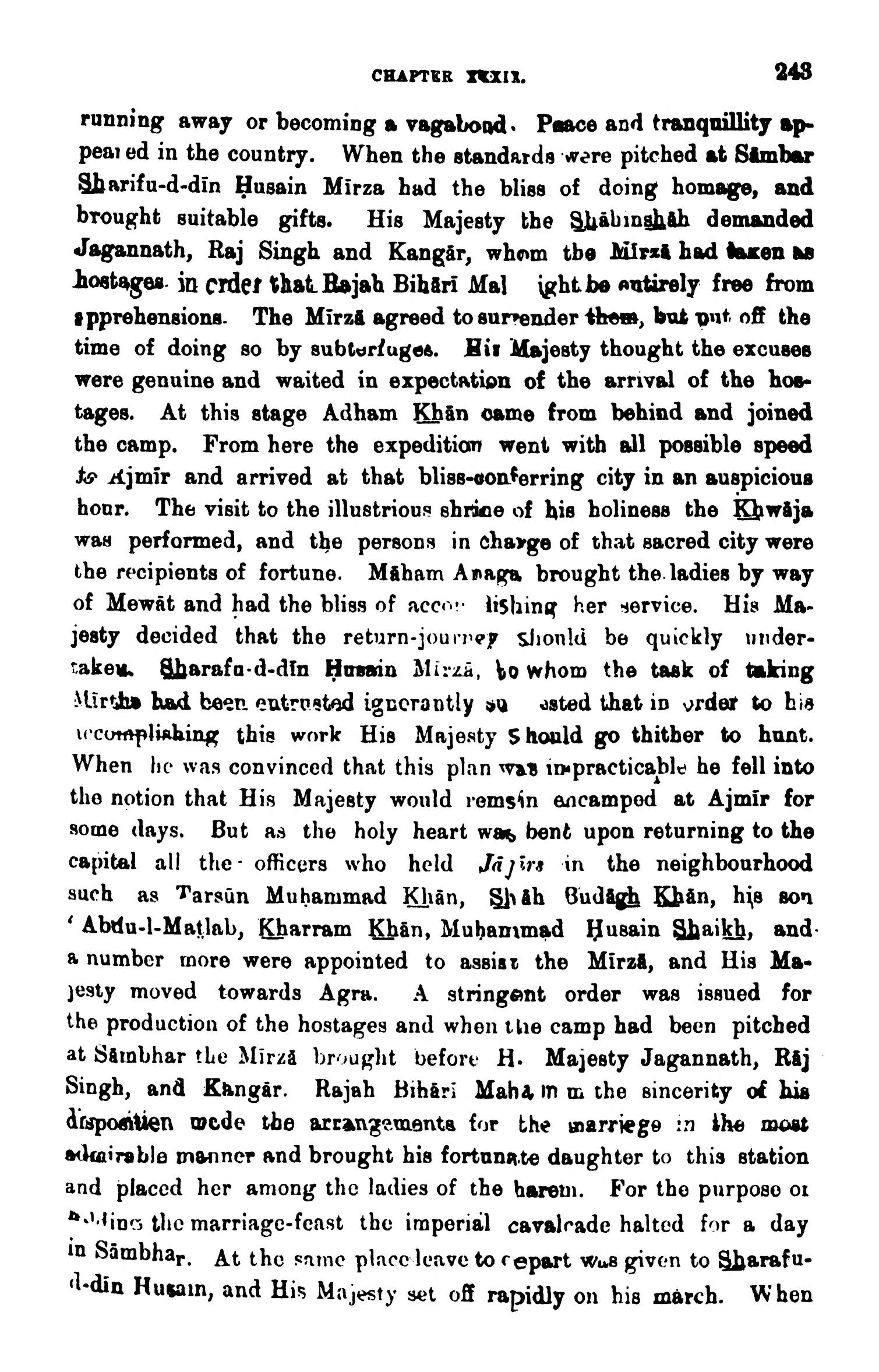
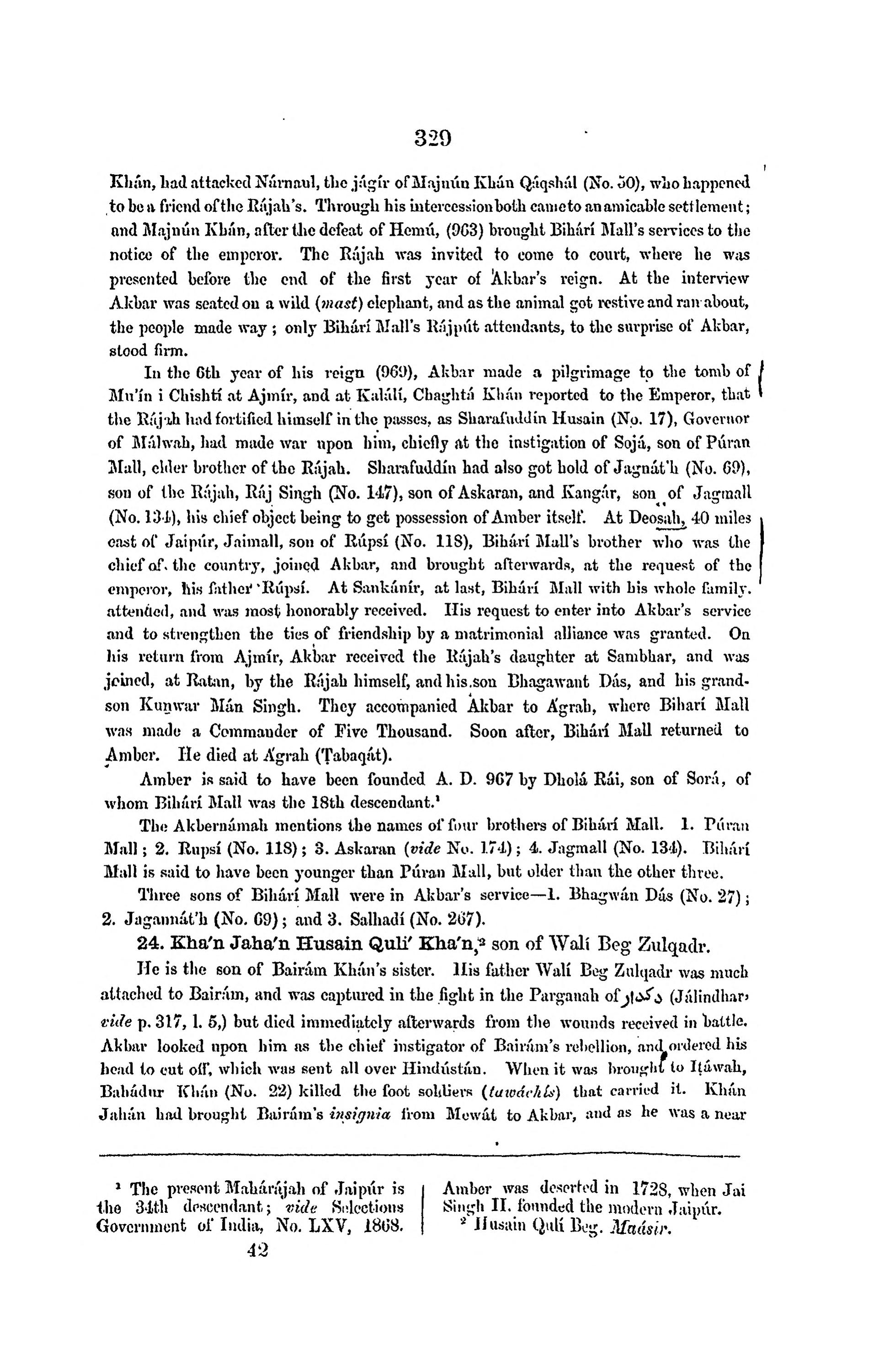
Both near-contemporary accounts describe the same act and name no one but the father. The Akbarnama's account of the Ajmer pilgrimage records that Bihari Mal "brought his fortunate daughter to this station and placed her among the ladies of the harem" [1] — a sentence that gives a place (Sambhar), a father, and a harem, and stops there. Blochmann's Ain, compiled a generation later as a register of grandees rather than a narrative, is if anything more clinical: "On his return from Ajmír, Akbar received the Rájah's daughter at Sambhar, and was joined, at Ratan, by the Rájah himself, and his son Bhagawant Dás, and his grandson Kunwar Mán Singh" [2]. Three generations of the house appear in that sentence by name — Bihari Mal, his son, his grandson — and the bride, alone, does not. This is not an omission peculiar to one text; it is the pattern in both.
This silence is worth taking at face value rather than filling. Akbar's own household did not record ladies of the harem by personal name as a matter of course, and the absence here is consistent with that convention rather than evidence of anything unusual about this particular marriage. What follows treats the bride as the sources treat her: identified by her father and her office, not by a name the primaries never give her.
Presented at court, married five years later
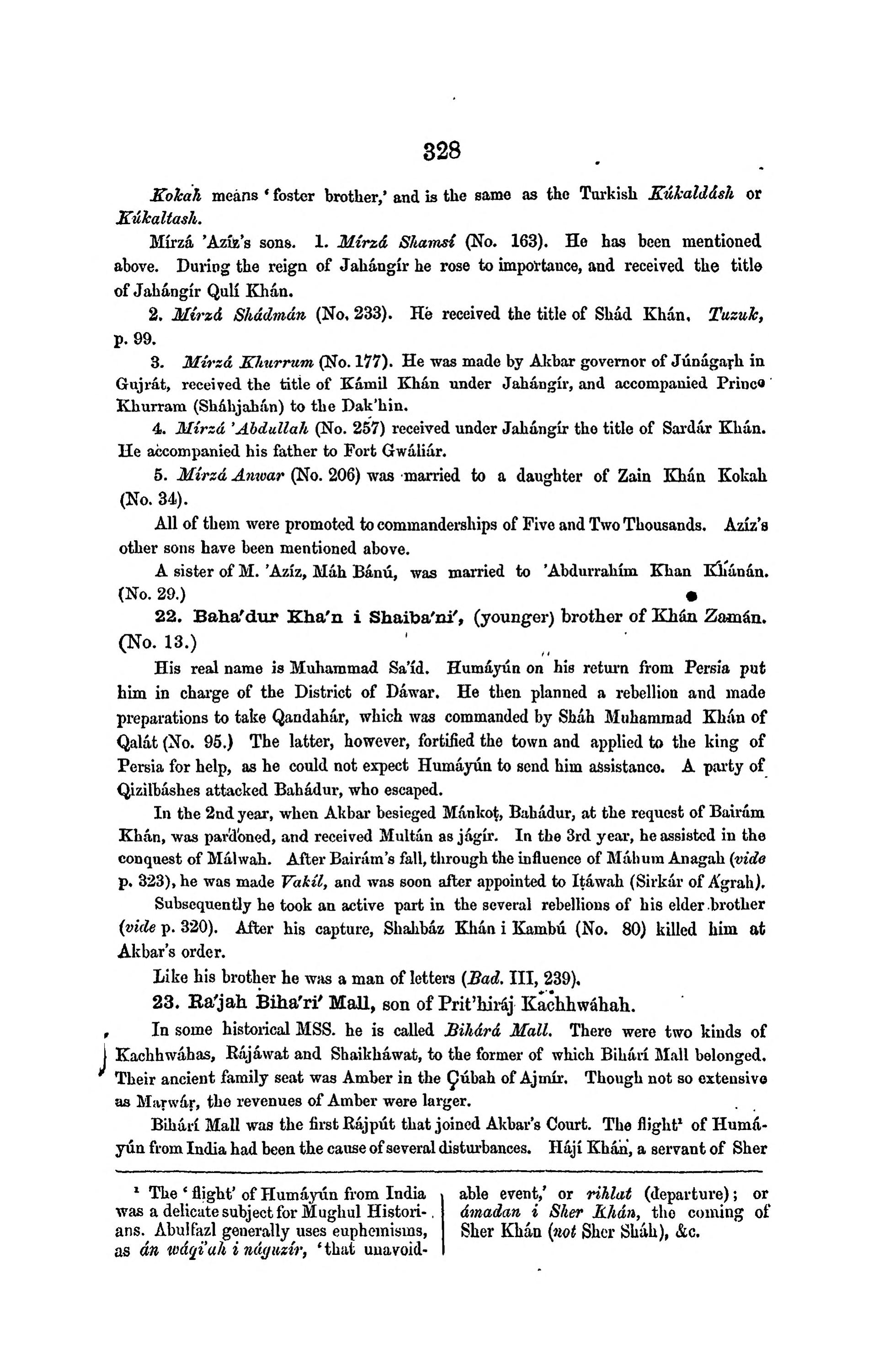
The record separates two events that popular retelling collapses into one. Bihari Mal's first appearance before Akbar was not the marriage; Blochmann's Ain states plainly that "Bihárí Mall was the first Rájpút that joined Akbar's Court" and that "the Rájah was invited to come to court, where he was presented before the end of the first year of Akbar's reign" [3] — that is, by roughly 1557, five years before Sambhar. The Rajputana Gazetteer's district history of Jaipur gives the same two-stage sequence independently: Bihari Lal "ingratiated himself with some influential adherents of the emperor Akbar, and in the first year of Akbar's reign was presented at court. Five years afterwards, when Akbar made a pilgrimage to Ajmer, this chief, with his whole family, had an honourable reception from him at Sanganer, close to Ámber; Bihári Lál gave his daughter to the emperor" [14]. Two independently descended texts — one Mughal-administrative, one a nineteenth-century British compilation — agree on the shape: presentation first, marriage five years later, on the occasion of a pilgrimage rather than the occasion of first contact.
The same Gazetteer page also carries the marriage's most consequential downstream fact in one sentence: "The daughter of Bhagwán Dás was the mother of Prince Khusrú (Akbar's grandson)" [14] — a second, later Kachhwaha marriage, one generation on, which this essay does not follow further but flags as the same alliance pattern repeating.
A window, not a year
Neither primary source gives a modern calendar date, and the two calendars they use only partly overlap. The Akbarnama places the Ajmer pilgrimage and the Sambhar marriage in Akbar's sixth Ilahi regnal year; the Ain gives "the 6th year of his reign (969)" [2], and the Hijri year AH 969 runs from September 1561 to August 1562. Akbar's sixth regnal year by the other reckoning begins in March 1561. The two windows overlap only across September 1561 to March 1562 — a span, not a date, and this essay adopts that span rather than a single year.
A modern secondary account narrows the span further without citing a primary source for the precision: Vincent Smith's 1917 biography states that "in the middle of January 1562, he started for Ajmēr with a small retinue, hunting on his way," and that at Deosa, en route, "he received Rajā Bihar Mall, the chief of Ambēr or Jaipur in Rājputāna, who offered his eldest daughter to Akbar in marriage" [5], with a marginal note reading "first marriage with a Hindu princess." Smith gives no source for the January date on this page, and it sits inside, not outside, the AH 969 window established above; it is recorded here as the closest dated claim found, not as independently verified.
"Jodha Bai": an attestation, an author, and a wrong address
The name attached to this marriage in popular use today is absent from both primaries, and its own transmission history is traceable. Smith, writing in 1917 as a working Indologist rather than a popular historian, is explicit that the name was already considered a misattribution in his own generation: describing a Fatehpur Sikri palace, he writes that it is "miscalled Jodh Bāī's Mahall," more properly the Jahangiri Mahall, "and probably was occupied by the mother of Prince Salīm (Jahāngīr)" — that is, by the same unnamed Kachhwaha bride, never called Jodha Bai in Smith's own text [7].
The earliest attestation of the name itself, on the evidence gathered here, traces to a single, later, non-primary source: Tod's Annals and Antiquities of Rajasthan (1829). A modern secondary summary states that the name's "earliest known association with Akbar's chief consort is traced to James Tod's nineteenth-century work," and that the historian Satish Chandra has argued "'Jodh Bai' properly referred to Jagat Gosain, the Rajput wife of Jahangir and daughter of Raja Udai Singh of Jodhpur" [11] — a different woman, of the Rathore house of Marwar, one generation later. The same summary states of the bride at Sambhar herself that "her personal name is not recorded in contemporary Mughal sources" [10].
Tod's own text supplies a documented instance of exactly this kind of cross-wiring. Discussing Shah Jahan's succession, Tod writes that "Sultan Purvéz, the elder son and heir of Jéhangír, was the issue of a princess of Marwar, while the second son, Khoorm, as his name imports, was the son of a Cutchwaha princess of Ambér" [8] — attaching the Kachhwaha identity to Shah Jahan's mother, whom the modern identification above places instead in the Rathore line of Marwar. Read against Chandra's correction, Tod's own page contains the confusion in miniature: a Kachhwaha-Amber label attached to the wrong marriage, in the same text later credited with launching a Kachhwaha-Amber label attached to the wrong wife. Tod is used here as both witness — his Annals record real detail about the Amber and Marwar houses no other source consulted supplies — and suspect, on the specific point of which princess belonged to which house.
Five thousand, then seven thousand
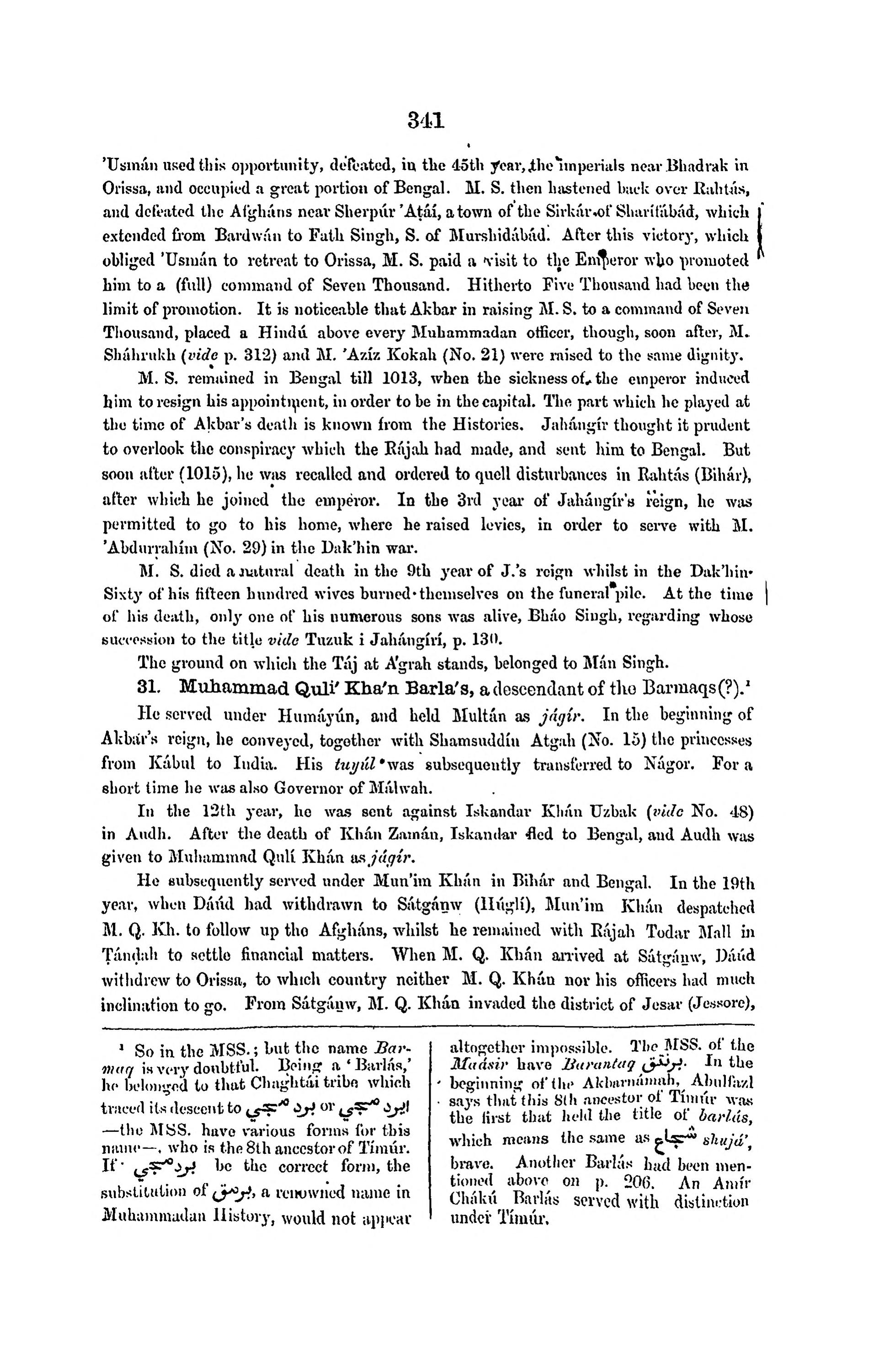
The marriage's clearest measurable consequence is a rank, not a sentiment. Bihari Mal himself, on joining Akbar's service at Agra, "was made a Commander of Five Thousand" [2] — the ordinary ceiling for a noble of his standing. A generation later his grandson Man Singh was promoted past it: "the Emperor... promoted him to a (full) command of Seven Thousand. Hitherto Five Thousand had been the limit of promotion," and Blochmann adds his own comment that "it is noticeable that Akbar, in raising M. S. to a command of Seven Thousand, placed a Hindú above every Muhammadan officer," noting that only afterward were two Muslim nobles raised to the same dignity [4]. Read as a measurement rather than a superlative, the sequence is Five Thousand, then a ceiling broken, then Seven Thousand — three fixed points, each dated by the same text.
Tod's Annals corroborate that Kachhwaha standing at court did not end with Man Singh: describing the succession crisis of Jahangir's reign, Tod writes that "the emperor gave the herole, or vanguard, to the Cutchwaha prince, the Mirza Raja of Ambér" [9] — Jai Singh I, two generations further on, still holding a post of honour credited explicitly to his house's standing.
The house behind the daughter
Bihari Mal's Amber did not appear from nowhere in 1562, and two independent sources agree on its founding tradition while disagreeing on almost every other detail of the clan's early centuries. Blochmann's Ain records: "There were two kinds of Kachhwáhas, Rájáwat and Shaikháwat, to the former of which Bihári Mall belonged. Their ancient family seat was Amber in the Çúbah of Ajmír. Though not so extensive as Marwár, the revenues of Amber were larger," and adds that "Amber is said to have been founded A.D. 967 by Dholá Rái, son of Sorá, of whom Bihárí Mall was the 18th descendant" [2]. The Rajputana Gazetteer, compiled independently for colonial administration rather than translated from a Mughal court register, gives the same founder and the same date: "one Dhola Rao founded the parent city of the present Jaipur State at Ámber in A.D. 967," tracing the lineage back further still to a legendary migration from Ajodhya through Narwar, and noting that "the Ámber chiefship of the Kachhwáhas is little mentioned in the annals of Musalmán empire until the Mughal came in" [13]. Agreement on a foundation date across a sixteenth-century Mughal administrative register in a nineteenth-century translation and a nineteenth-century British gazetteer is worth recording as agreement — the genealogical generations between founder and Bihari Mal were not independently checked here, and the clan name itself carries a contested etymology: modern scholarship glosses "Kachhwaha" as Sanskrit for tortoise, while the clan's own later tradition claims descent from Kusha, son of Rama [12]. Both are recorded as claims, not settled fact.
Dates in this essay
The marriage is dated here to a window, September 1561 – March 1562, not to a single year. The Akbarnama places it in Akbar's sixth Ilahi regnal year (beginning 10 March 1561); Blochmann's Ain gives 'the 6th year of his reign (969)' [ain-p329], and AH 969 runs from September 1561 to August 1562. The two reckonings overlap only across September 1561 – March 1562. Vincent Smith's 1917 biography narrows this to 'the middle of January 1562' [smith-p57], a date that falls inside this window but is not sourced on that page to either primary; it is recorded as the most specific claim found, not as independently verified. A modern Wikipedia article states the marriage 'took place on 6 February 1562... at Sambhar' with no citation traced or opened here; that specific date is not adopted and is flagged in openQuestions.
Where authorities disagree about when a state began or ended, the archive follows one rule — a polity is dated from the assumption of sovereign power in its own capital, and to the settlement that extinguished it — and records the alternatives rather than hiding them.
Open questions
Wikipedia's claim of an exact marriage date, 6 February 1562, was seen in a summarised fetch but its underlying citation was not identified or opened; it should be chased and either verified against a primary or dropped.
The Ain-i-Akbari's own biographical entry for Bihari Mal (Ain I, pp. 328–330) was read only through p. 329; p. 330, and the fuller run of pp. 331–340, were not opened, so anything the Ain records about Bihari Mal between his promotion and his death is not reflected here.
Beveridge's Akbarnama II was opened only at p. 243, calibrated once. The surrounding chapters (the approach to Ajmer, the Sambhar halt, the return march) were not read as images and may carry detail — court reaction, gifts exchanged, the date given in the Ilahi calendar in full — that this essay does not have.
Tod's Annals, Volume I (Mewar) and the 'Annals of Amber, or Dhoondar' chapter specifically (Vol. II, beginning at printed p. 318 per that volume's own contents list) were targeted but not located as page images in the time available; only the Annals of Marwar chapter (pp. 36–37) was read. Tod's own dedicated account of Amber's founding legend — the 'romantic legend of Dhola Rae' his contents page promises — remains unread and unquoted here.
Encyclopaedia Britannica's 'Kachwaha' and 'Rajput' entries could not be fetched (HTTP 403 in this session) and are not represented; Wikipedia stood in as the tier-C source instead.
Satish Chandra's 2008 article 'Jodha Bai — Who Is She?' (Indian Historical Review 35/2) is cited above only at second hand, through a Wikipedia summary of it; the article itself was not opened and its argument is not independently verified here.
Muhammad Nazim-type epigraphic sources, and any Persian-language chronicle other than the Akbarnama and Ain, were not searched; the genealogical chain from Dhola Rai to Bihari Mal (18 generations, per Ain I p. 329) rests entirely on the Ain's own say-so and was not cross-checked against the Rajputana Gazetteer's separate, longer legendary chain (Kash–Nal–Dhola Rao), which differs in the intermediate names.
The Rajputana Gazetteer volume searched (rajputanagazett00agegoog) contains, per a full-text search not followed up with an image read, a claim dating the Kachhwaha conquest of Amber itself to A.D. 1037 — apparently in tension with the same volume's A.D. 967 founding date two pages earlier. That page was not opened as an image and the tension is noted, not resolved.