What the budget actually says
Hyderabad printed a detailed annual budget and the volumes survive. The Detailed Budget for 1346 Fasli — the year running from October 1936 — is digitised, and its abstract of expenditure carries, under group E-1, a single head: 'Payments to H.E.H.', OS Rs 50,00,000, identical in the accounts column for 1344 F, the estimate for 1345 F and the budget for 1346 F 4. The same head, at the same figure, appears in the 1344 Fasli volume, where the accounts for 1342 F show OS Rs 54,02,552 — the extra Rs 4,02,552 being a buildings charge 5. This is a fixed civil list, not a fluctuating draw.
Around it sit the royal-family heads: tour expenses of H.E.H. and his Military Secretary, expenses of the Princes, expenses of the Sahebzadas, and royal buildings, totalling OS Rs 10,32,500 in the 1346 F budget 4. Household and ruler together: OS Rs 60,32,500. Set against the year's total budgeted expenditure of OS Rs 8,69,94,300, that is 6.9 per cent of everything the state spent. The 'Payments to H.E.H.' line alone was 53 per cent of the education vote (OS Rs 93,50,400) and 1.8 times the medicine vote (OS Rs 27,97,900) 4.
Two cautions on these numbers. First, they are Osmania Sicca rupees, Hyderabad's own currency, and the discount usually quoted is the wrong one. The Gazetteer's rate — the coin stood 'at between 115 and 116 to 100 British rupees' — is for the Hāli sikka as of 1909 and cannot simply be carried onto 1930s Osmania Sicca figures 1. The rate that matters here is established inside the budget itself: the Berar rent, fixed at British Rs 25,00,000 a year, enters the Hyderabad accounts as OS Rs 29,16,667, which is exactly 116⅔ to 100 41. That internal check, not the 1909 quotation, is what licenses the conversion used on this page. Comparisons with British Indian provincial budgets need it and almost never get it. Second, budget provisions are not spending. The 1344 F volume provisioned OS Rs 1,45,77,500 for Buildings and Communications, but only OS Rs 91,29,500 of that came from current revenues, the rest from departmental balances and surpluses; actual expenditure under that head in the accounts for 1342 F was OS Rs 69,42,315, and in the accounts for 1344 F OS Rs 66,57,446 54. Popular accounts on both sides quote whichever column suits them.
One number that is not a matter of interpretation: on the state's own accounting, the ruler's fixed personal payment was larger than what the state spent on medicine and sanitation, and about half of what it spent on educating sixteen million people.
The part of the state that was never in the budget — and where 'two crores' came from
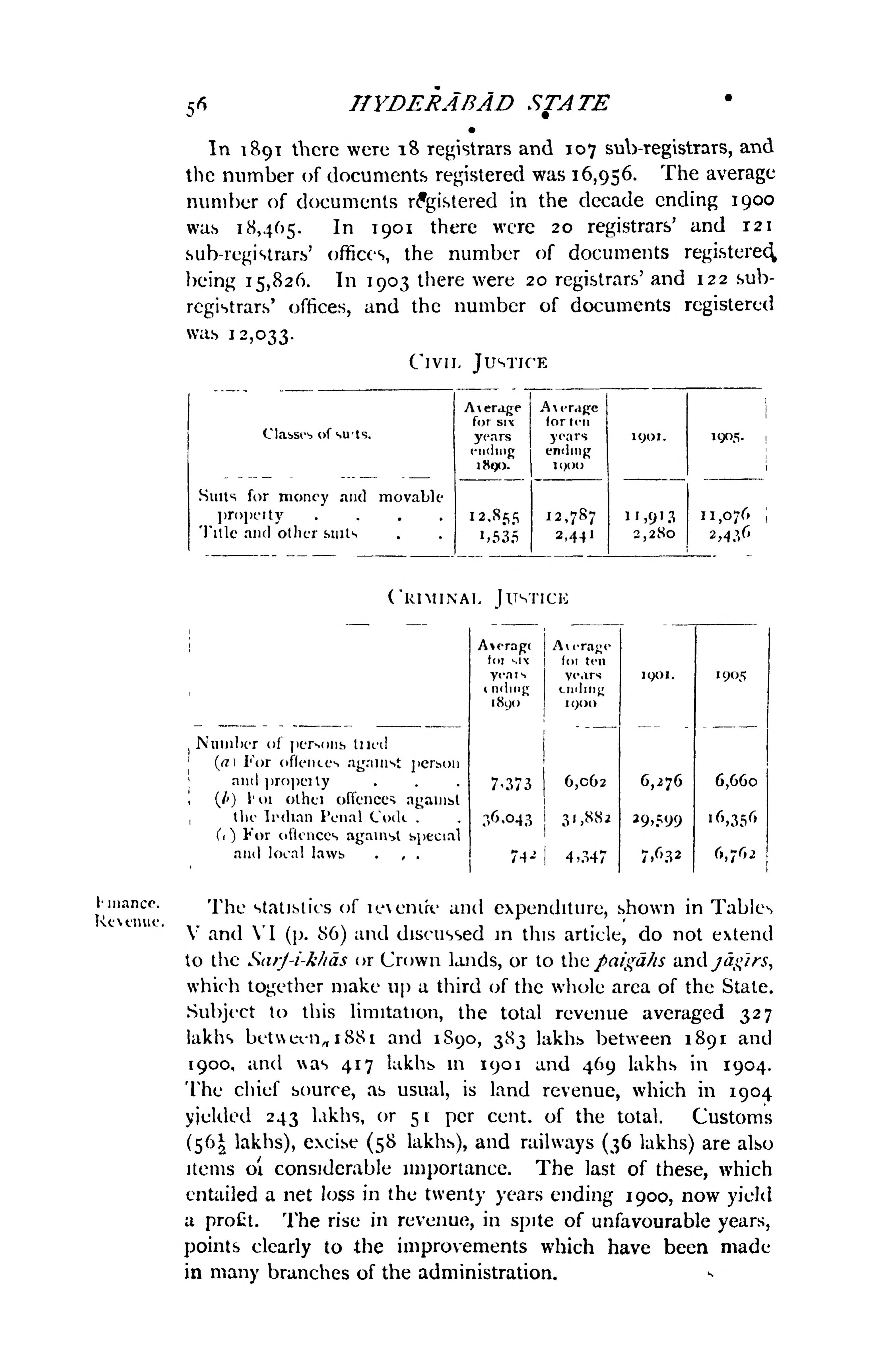
The budget covers the diwani or khalsa territory. It does not cover the rest. The 1909 Gazetteer is blunt about it: the revenue and expenditure tables 'do not extend to the Sarf-i-khās or Crown lands, or to the paigāhs and jāgīrs, which together make up a third of the whole area of the State' 1. By 1938 the Reforms Committee put the diwani share at 58.5 per cent of area, with sarf-i-khas, paigahs, samasthans, jagirs and inams making up the other 41.5 per cent; it noted that jagirs with an annual income above Rs 6,000 alone covered 12,000 square miles and over 28 lakh people 6. The sarf-e-khas was administered separately, through eighteen taluqs: seven under a Sarf-i-Khas Taluqdar, seven administered exclusively by Diwani officers whose collections were transferred to the Sarf-i-Khas after costs, and four managed by Diwani officers in consultation with the Sarf-i-Khas Secretariat 6. The claim's premise that the ruler had a revenue stream nobody could audit is straightforwardly right.
How large was it? Here the record has a hole that the literature has papered over. The figure repeated everywhere — about Rs 2 crore a year — has a single traceable origin. P. Sundarayya, who led the Communist Party in the Telangana struggle, wrote in 1972: 'The income or loot from the peasantry, from the sarf khas area, amounting to Rs. 20,000,000 annually was entirely used to meet the expenditure of the Nizam's family and its retinue.' In the same passage he gives the land split — 53 million acres, about 60 per cent diwani, 30 per cent jagirdari, 10 per cent sarf-e-khas — that has since been reproduced across encyclopaedias and examination guides, and he adds that 'the Nizam Nawab used to be given Rs. 7,000,000 per annum from the state treasury' 11. He cites no source for either figure, and he does not say whether his rupees are British or Osmania Sicca.
One of those two numbers checks out well. Rs 70 lakh from the treasury is close to what the budget shows: OS Rs 50,00,000 to the ruler plus OS Rs 17,83,407 on the royal-family heads in the accounts for 1344 F is OS Rs 67,83,407 4. Read as Osmania Sicca, Sundarayya lands within four per cent of the printed ledger; read as British rupees his figure would be OS Rs 81.7 lakh, about a fifth high. The closer fit is the Osmania reading, which is weak evidence that he was repeating a Hyderabad figure rather than inventing one. Either way, a hostile participant writing from memory a quarter-century later came within striking distance of the printed accounts. That is a point in favour of taking him seriously.
The Rs 2 crore is harder. The state's post-1948 Agrarian Reforms Committee, which had the files, reported that raiyatwari tenure covered 'Over 20 million acres or nearly 60% of the State area' and that 'With the addition of Sarf-e-Khas lands, nearly 70% of the total area of the State is now directly under Government control' — putting sarf-e-khas at about a tenth of the state, in 1,961 villages, merged into the diwani in February 1949 7. Diwani land revenue on 58.5 per cent of the area produced OS Rs 3,12,94,758 in the accounts for 1344 F 4. A tenth of the area at the same rate yields something on the order of OS Rs 50 lakh in land revenue; sarf-e-khas also drew excise and other heads within its territory, and it contained Atraf-i-Balda, the rich district ringing the capital, so a substantial premium is warranted. Even generously, the arithmetic supports roughly Rs 0.5–1.5 crore. Sundarayya's Rs 2 crore sits at or above the ceiling of what the area share will bear — and if his figure is in British rupees it is OS Rs 2.33 crore, further above it. It is a round number, unsourced, published in a work of political self-accounting. It should be quoted with that attached.
A second figure needs retiring outright. Reference works and earlier drafts of this page state that the Government of India's White Paper on Indian States (1950) records the Nizam surrendering personal estates 'yielding an annual net revenue of Rs 124 lakh' against compensation of Rs 25 lakh a year. Part XI of the White Paper, which covers privy purses, and the text of the Agreement itself at p. 395, contain nothing of the kind 1213. Part VII, on rulers' private properties, has not been inspected for this page; it is listed below as still unchecked, and the sentence is narrowed accordingly. What the White Paper does contain is the Agreement of 25 January 1950, Article I: the Nizam receives annually 'the sum of Rs. 50,00,000 (Rupees fifty lakhs), free of all taxes', payable to him for his lifetime and not to his successors, against Mysore's Rs 26,00,000 and Baroda's Rs 26,50,000 12. Until someone produces the page, 'Rs 124 lakh' should be treated as unsourced.
Where the fabulous figures come from
The superlative has a date. TIME's issue of 22 February 1937 carried the Nizam on its cover and opened its story: 'India has no native state so rich, potent and extensive as Hyderabad which is about the size of the United Kingdom and there last week the Royal Family of the Asatia Dynasty celebrated the Silver Jubilee of "The Richest Man in the World," Lieut. General His Exalted Highness Sir Mir Osman Ali Khan, the Nizam of Hyderabad & Berar' 109.
The magazine then produced the numbers that everything since has been built on: '$5,000 is his approximate daily income'; 'his jewels have an estimated value of $150,000,000'; 'he reputedly has salted down $250,000,000 in gold bars'; 'his capital totals some $1,400,000,000' 9. No source, no valuer, no method is named; the article's own verbs — 'estimated', 'reputedly' — concede as much. TIME had no access to the sarf-e-khas daftar, no inventory of the King Kothi or Chowmahalla treasuries and no appraisal of the jewels.
Every later figure descends from that base, and this page cannot show the derivation for any of them — which is the point, and the reason it will not supply one. A figure of about $2 billion 'in the early 1940s' appears in almost every account; no source has been located for it here, and it is reported as circulating without provenance. A figure above $200 billion, attached to an all-time-wealthiest ranking, circulates in twenty-first-century journalism; the ranking's publication details, rank and method have not been verified for this page, and the widely repeated explanation that it is the 1937 estimate run through a US-GDP deflator is an inference that no located source states. Asserting that mechanism as fact would be the exact laundering this section exists to describe. What can be said without a source: no published derivation running from an audited holding to any of these totals has been found, and the sourceless 1937 estimate is the earliest number in the chain. Deflating a guess yields a more precise guess, whoever performed the arithmetic.
The one valuation with anything like a paper trail arrives half a century later and measures something else. After litigation running from the 1970s over the Nizam's Jewellery Trusts, the Government of India bought 173 items in 1995 for Rs 218 crore — reported at about US$70 million, against a Supreme Court valuation of about $65 million and a Sotheby's estimate reported at about $350 million; the collection now sits in Reserve Bank vaults at Mumbai 18. That source is a tertiary encyclopaedia summary of press reporting rather than the court record, it is marked unverified here, and no part of this page's argument rests on it. Three observations follow even if every figure in it is right. A 1995 rupee price for a jewel collection is not convertible into a 1937 net worth. The spread between $65 million and $350 million on the same objects is itself a measure of how soft jewel valuations are. And none of the parties to that transaction was disinterested — one was the buyer, the others sellers — while 173 items, however extraordinary, are not a national treasury.
The traffic runs both ways. The most-repeated proof of the Nizam's generosity — 5,000 kg of gold to the National Defence Fund after Lal Bahadur Shastri's 1965 visit — does not survive contact with the record either. RTI replies in 2018 established that the Prime Minister's Office 'has no information of any such donation', and The Hindu of 11 December 1965 reported Shastri congratulating the Nizam on investing 4.25 lakh grams of gold — 425 kg — in National Defence Gold Bonds, an instrument paying 6.5 per cent, with Shastri quoted saying 'We do not want to melt these gold mohors but send them to foreign countries to obtain a higher value. We may get a crore of rupees' 14. The donation shrinks by a factor of ten and changes category from gift to investment. The standard is deliberately the same in both directions, and it is applied to the poverty figures too: a number counts when a named source states it and that source can be inspected, whether it flatters the ruler or indicts him. TIME's $1.4 billion, the 5,000 kg of gold, Sundarayya's Rs 2 crore and the Gazetteer's 1½ million famine dead are therefore all handled here as estimates — of stated or unstated provenance — and not as counts.
What poverty looked like in the state's own record
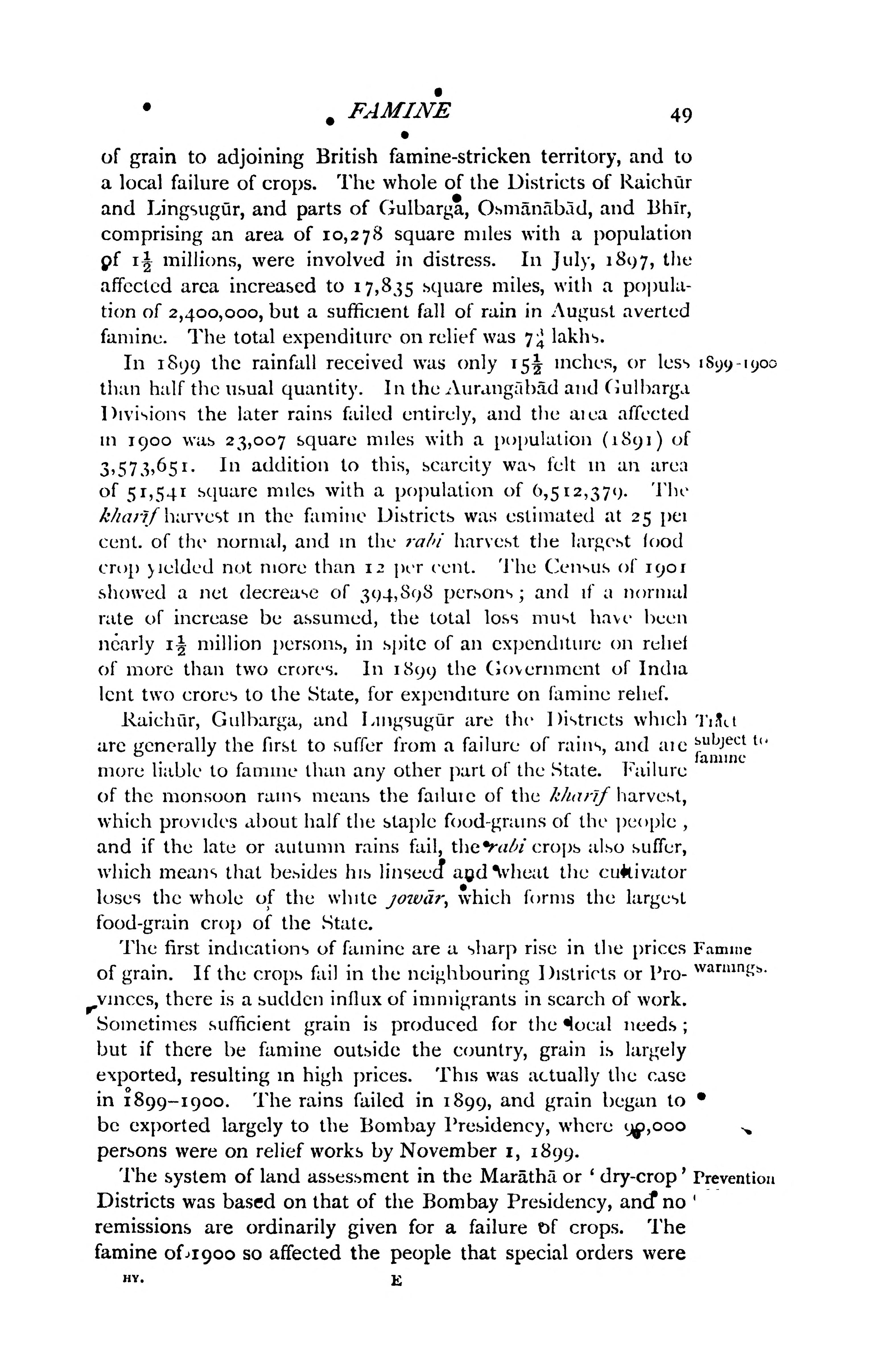
The second half of the claim needs no polemical sourcing at all; the government published it. On the famine of 1899–1900 the Gazetteer of the Nizam's Dominions records that the affected area covered 23,007 square miles with a population of 3,573,651, that the kharif harvest came in at 25 per cent of normal, and that 'The Census of 1901 showed a net decrease of 394,898 persons; and if a normal rate of increase be assumed, the total loss must have been nearly 1½ million persons, in spite of an expenditure on relief of more than two crores. In 1899 the Government of India lent two crores to the State, for expenditure on famine relief' 2. The symmetry rule applies here as much as to the jewels: the counted quantity is the net decrease of 394,898; the 1½ million is the Gazetteer's own model, stated conditionally and resting on an assumed rate of natural increase it does not print. It is an official estimate, not an enumeration, and this page quotes it as one. The counted figure alone is severe, and the state was borrowing from the paramount power to meet the relief bill.
Literacy is the one indicator collected consistently for a century, and it is grim. In 1901 the Gazetteer reports literates at 29.55 [per] 1,000 of the population, 54.7 for males and 3.4 for females 3. Forty years later the Nizam's own census returns 'The total literates in the Dominions is 1,269,004 persons which represents 9.3 p.c. on the total population as against 5 p.c. in 1931', on a population of 16,338,534 8. An earlier draft of this page set that against an all-India figure of roughly 16 per cent for the same census year. No primary return has been cited for that comparator, so it has been removed rather than left doing work no source on this page supports; establishing it is listed as an open question. The comparison that can be made from the sources actually held is internal, and it is bad enough: after a decade in which the education vote reached a crore of rupees and the literate population more than doubled, ninety-one people in a hundred still could not read.
The census also disaggregates, and this is where the claim's phrase 'their people' starts to strain. Literates per thousand in 1941, selected communities from the table: all communities 93; 'Br. [Brahmin] Hindus' 876; Aryas 347; Jains 262; Muslims 197; Christians 192; Virashaivas 104; other Hindus 63; Harijans 11 8. One caveat on the top row: 876 per thousand, with a male column of 966, implies effectively universal male literacy inside a state returning 93, and probably reflects a narrow enumerated base or a classification effect rather than a population-wide rate. It is reported here as the table's own return, not as a demographic finding. Even so, the table's ratio between its top and bottom communal rows is about eighty to one, and no plausible correction to the Brahmin base closes an order of magnitude. Whatever the Nizam's treasury did or did not do, the distribution of Hyderabad's deprivation follows caste lines with a precision that a story about one man's jewels cannot explain.
And the debt. The Agrarian Reforms Committee of 1949 reported that 'according to Mr. Bharucha the total debt amounted to Rs. 64[½] crores, giving an average of Rs. 30/- per head' 7. The report does not state whether these are British or Osmania Sicca rupees, and the two figures do not reconcile against the 1941 population of 16.3 million — they imply about 21.5 million people, so one of them is loosely stated, probably the per-head figure being computed on the agricultural population or on an earlier estimate. Both are nonetheless of an order that matters, and the order survives either currency reading: rural indebtedness in Hyderabad was several times the state's entire annual expenditure. Bharucha's underlying survey, conducted from 1933 in 312 villages, followed enquiries by S. Keshava Iyengar showing that in Aurangabad district 'nearly 30% of the total cultivated area had passed into the hands of noncultivating Marwaris and others during the course of 25 years' 7.
The arithmetic that joins the two halves
The claim's force is causal: the money in the palace is the money missing from the village. That is the part the record does not support, and it can be checked in a few lines — with the documented quantity kept separate from the estimated one, because most versions of this argument merge them.
Population, 1941: 16,338,534 8. Total state expenditure budgeted for 1346 F: OS Rs 8,69,94,300 — about OS Rs 5.32 per subject per year, everything the state did for anyone 4. Ruler and royal household out of that budget: OS Rs 60,32,500, or about 37 paise per subject per year. That 37 paise is the documented draw: printed, in a stated currency, in a volume anyone can open. Now add the sarf-e-khas at the highest figure anyone has published — Sundarayya's Rs 2 crore, unsourced and of unstated denomination — and the ruler's total annual draw rises to roughly Rs 1.60 per subject, or about Rs 1.80 if that figure is in British rupees 11. One of those numbers is evidence; the other is the ceiling of an estimate, and this page does not call it documented.
Against that, Bharucha's rural debt: Rs 30 per head 7. The peasantry owed, to moneylenders and landlords, something on the order of twenty times what the ruler took from them in a year on the most generous estimate — and about eighty times the documented budget draw. The redistribution sum is worth writing out, because it is usually asserted rather than shown. Of the OS Rs 5.32 per head the state spent, 37 paise went to the ruler and his household, leaving about OS Rs 4.95 of public provision. Confiscate the household line and add the sarf-e-khas at Sundarayya's ceiling — about Rs 1.22 per head — and the pot becomes about OS Rs 6.55 per head: a rise of roughly a quarter measured against total state resources, or roughly a third measured against public provision net of the household. Not nothing, worth arguing about, and nowhere near enough to lift a dryland economy of sixteen million out of destitution.
This is an argument about magnitude, not about desert. A ruler taking the equivalent of twice the medical budget, from estates whose accounts no legislature could see, in a state where nine people in a hundred could read, is a fact that needs no adjective attached to it. But Hyderabad's poverty was produced by low-rainfall Deccan agriculture, by a tenure order that left 30.9 per cent of the state in 6,535 jagir villages whose holders 'do not have any right to the soil' yet treated cultivators as tenants-at-will 7, by usury, by the near-absence of village schooling, and by a subordinate position in an imperial economy that had already taken Berar — assigned in 1853 and leased in perpetuity from November 1902 at Rs 25 lakh a year, part of which the state was using to service the famine loan 1.
The plural in 'the Nizams' also does work it has not earned. For much of the nineteenth century Hyderabad was a debtor state. Its own Gazetteer records, in the Land Revenue article, that Telingana under the last Golconda king yielded 166 lakhs and that 'the present revenue is about equal to the cash assessments at the beginning of the seventeenth century' — three hundred years of no real growth in the demand — and that the revenues were once 'farmed out to bankers and to Arab and Pathan soldiers, who extorted as much money as they could from the cultivators' 1. A dynasty that spent a century in arrears to its paramount power, and whose demand had not risen in real terms since the Qutb Shahs, is not well described by a word meaning accumulation.
Someone arriving convinced of the claim should leave knowing that the wealth figures are journalism, that the immediate extractor in the Telangana village was the dora and the moneylender, and that the redistribution arithmetic does not work. Someone arriving to defend the Nizams should leave knowing that the Rs 50 lakh line is real and printed, that the ruler and his family were expressly excluded from the legislature's purview by his own reform committee, that hundreds of thousands of people were counted missing after one famine and the state's own estimate of the loss was over a million, and that the 5,000 kg of gold never happened.
What the state did spend on, and what that does not settle
Hyderabad was not a state that built nothing, and the same Reforms Committee that placed the royal family beyond the legislature also recorded the expansion. On education it reports: 'In the year 1330 F. (1920-21) the expenditure the Department of Education was less than 14 lacs; in 1344 F. (1934-35) it reached a crore of rupees' — a sevenfold rise in fourteen years — with institutions going from 1,036 with 66,484 pupils in 1920-21 to 4,800 with 3,64,252 pupils by 1935-36 6. The budgets confirm the level, and more sharply than an earlier draft of this page allowed: education was the largest single head in the 1346 F abstract of expenditure, at OS Rs 93,50,400 — ahead of buildings and communications (OS Rs 87,11,500), the military (OS Rs 84,92,300) and police (OS Rs 67,90,900) 4. The state also carried its own irrigation vote (OS Rs 23,56,100), municipal and public improvements (OS Rs 23,88,100), a mint, a post office, a railway and a currency whose 1904 rupee bore the Charminar on its face 41.
This complicates the claim in a specific way and not in a general one. A state that spent more on schools than on soldiers is not a state that spent nothing on its people, and the flat version of the claim is false. It does not follow that the spending was adequate, and the 1941 literacy return says plainly that it was not: a government that had multiplied its education budget sevenfold and made it the largest head in the budget still could not get more than nine of a hundred subjects to literacy, or more than eleven per thousand of its Dalit subjects 8. That contrast is the strongest thing the developmental record yields, and it cuts both ways — the base was catastrophically low, and two-fifths of the territory lay beyond the education department's writ.
Nor does the spending record dissolve the accountability point, which is the sharpest thing on this page and comes from the regime's own reformers. Setting out the state's constitution in 1938, the Committee wrote that 'the head of the State not merely retains the power to confirm or veto any piece of legislation, but also enjoys a special prerogative to make and un-make his executive or change the machinery of government'; and it then listed, first among matters expressly excluded from any legislature's purview, 'The Ruler and the Royal family' 6. The sarf-e-khas was to be represented in the proposed legislature 'by members nominated by the Ilaqa itself' — an estate sending its own delegates rather than an administration answering for its accounts 6. Whatever the sums, the structure the claim points at was real, and it was described in print by the men appointed to reform it.