Claim examined

Did Hyderabad State have modern institutions and development?

There are two ways to lose an argument about Hyderabad. One is to say the state built nothing modern, which collapses on contact with the Imperial Gazetteer, the state's own Education Code, and the annual reports of its own departments. The other is to answer with a list of buildings and treat the list as a verdict. It is not. The government that ran a currency, a railway, a museum and a translation bureau also governed a population of which, at the 1901 census, about twenty-nine people in every thousand could read — and it knew, because its own Directors of Public Instruction had been saying so since the 1890s and its own Royal Commission repeated it in 1947. This page separates the institutional record, which is documented and substantial, from the developmental record, which is documented and poor, and identifies where the two overlap least: the countryside, and the jagir third of the state. Both halves are held to one standard. A figure is used here only where a source prints it, and the source is named, whether the figure flatters the Nizam's government or damns it.

The claim, as it circulates

Hyderabad State under the Asaf Jahi Nizams was a stagnant feudal autocracy with no modern institutions and no development; whatever infrastructure, education, public health and administration the region has arrived after its integration into the Indian Union in September 1948.

Oversimplified

The absolute form of the claim fails against documents printed by the Government of India and by the Nizam's own government — a High Court, a legislature with elected members, a state coinage and mint, 858 miles of railway, a medical school founded in 1846, an archaeological department conserving Ajanta, and a university teaching medicine and engineering through Urdu are all on the printed record, most of them before 1909. But the comparative claim underneath the absolute is documented and largely correct: the same records place Hyderabad at the bottom of the princely-state literacy table, with primary education free but never compulsory, and roughly a third of the state's area administered by intermediaries in which, on its own Royal Commission's admission in 1947, it maintained fewer than two hundred schools and no reliable statistics. The circulating claim is a hardened form of a true comparative statement, not an invention — which is why it is judged oversimplified rather than unsupported.

Draft. This entry is an unreviewed first draft. It has not yet been checked by a subject reviewer — see sources and method.

What is true here

The part of the claim the record does support, stated before the part it does not.

On mass literacy, the most comparable human-development measure available for the period, Hyderabad was the worst performer among the large princely states, and the gap widened rather than closed.
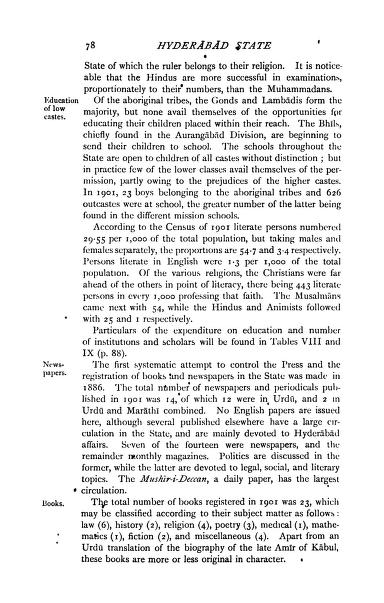
The Imperial Gazetteer records that at the 1901 census 'literate persons numbered 29·55 per 1,000 of the total population', with male and female proportions of 54·7 and 3·4 per thousand 7. Motkuri Venkatanarayana's compilation from the census series and the Hyderabad Reports on Public Instruction puts male literacy in Hyderabad at 2.1 per cent in 1901 and 8.5 per cent in 1931, against Baroda 19.9 to 35.1, Travancore 21.5 to 40.8, Mysore 11.7 to 17.4 and Madras Presidency 13.7 to 21.9 over the same span; female literacy in Hyderabad moved from 0.5 to 1.2 per cent 29. His state-level series gives Hyderabad State at 3.0 per cent in 1901, 4.1 in 1931, 6.8 in 1941 and 9.2 in 1951 30.
Free and compulsory primary education, the benchmark reform of the reformist princely states, was never enacted under the Nizams. Primary schooling was free in government schools, but never compulsory.
The Education Code of 1344 Fasli provides that 'No fees will be recovered in Primary schools and also in Primary sections of Secondary schools of such places where there are no separate Primary schools' 17. The negative half of this claim has been tested rather than assumed: a search of the whole 244-page Code for compulsion returns only compulsory English in the Osmania courses (Article 10), compulsory physical education (Article 172), a compulsory teaching-methods paper and a compulsory departmental examination for officers. There is no compulsory-attendance provision anywhere in it. Motkuri notes that Sayaji Rao Gaekwad made primary education free and compulsory throughout Baroda in 1906, 'but in Hyderabad it was made possible only after the independence' 29.
Roughly a third of the state's area — the paigah, samasthan and jagir tracts — was administered by intermediaries rather than by the Diwani, and the non-Diwani areas together held about a quarter of the population. In those areas the state maintained very few schools and kept no reliable statistics.
The 1947 Royal Commission gives a total dominion area of 82,698 square miles, of which 33,729·9 (40·79 per cent) was non-Diwani; paigahs, samasthans and jagirs alone made 25,620 square miles or 30·9 per cent, and the sarf-e-khas — the Nizam's crown estate, administered by its own state department rather than by intermediaries — a further 8,109 or 9·9 per cent; 6,535 of 22,457 villages were jagir villages; the population of the non-Diwani area was 'roughly 25%' of 16·3 millions 12. The Commission qualifies its own headline figure, and the qualifier belongs here: 'although the Paigah, Samasthans and Jagir areas on the whole make a total of 30·9%, the compact areas under these tracts is only 9·7% of the total dominion area of 82,698 sq. miles' — the intermediary third was scattered, not contiguous 10. On schooling in those areas: 'out of a total of over 5,000 schools in the Diwani villages, the Jagir and Samasthan areas have not more than 189' — few, not none — and 'It is admitted by the Revenue Department that as no records are maintained in Jagir areas, statistical data of vital importance are not available in a satisfactory manner for these jurisdictions… Even as regards population census and statistics, we are in the dark as to the true position' 10.
Rural medical provision was thin even in the districts the state governed directly, and its own officials said so in evidence to the Commission.
In his minute of dissent, Raja Someshwar Rao quoted the testimony of the Nazim Bandobast: 'The Government is not making any provision for water-supply even in Diwani villages except in famine areas. We cannot ask the Jagirdars to make provisions for these. . . . . So far as medical relief is concerned, it is not adequate even in Diwani areas. We have only one dispensary for a Taluq' 15. The Commission itself found that in the non-Diwani areas there was a 'complete absence of any kind of organisation for public health' 14.
The Urdu-medium policy that made Osmania University possible also narrowed vernacular schooling at the secondary level, and the narrowing came late and was contested at the time.
Tariq Rahman records that 'from 1944 onwards all secondary schools used Urdu as the medium of instruction—until 1941, 363 out of 444 secondary schools used the mother tongue as the medium of instruction—though primary schools could still operate in the local languages'; he adds that 'The Hindus protested but to no avail and the local languages were marginalized', and that allegations of making Osmania a 'Sectarian' University circulated in the press from 1923 23.
The state's institutional achievement was concentrated in the capital and among the state's Muslim minority, and the state's own published statistics say so without embarrassment.
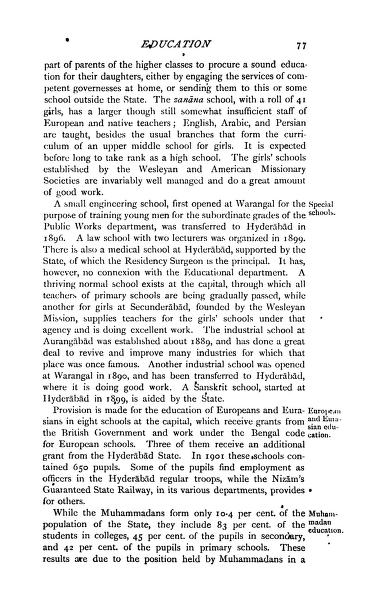
The Imperial Gazetteer: 'While the Muhammadans form only 10·4 per cent. of the population of the State, they include 83 per cent. of the students in colleges, 45 per cent. of the pupils in secondary, and 42 per cent. of the pupils in primary schools. These results are due to the position held by Muhammadans in a State of which the ruler belongs to their religion.' The passage continues on the following page: 'It is noticeable that the Hindus are more successful in examinations, proportionately to their numbers, than the Muhammadans' 6. Access to free studentships was also conditioned on domicile: under the Education Code a pupil could be admitted to the free list only if, among other conditions, 'he is a Mulki' 18.

The inventory in 1909, before any of the famous institutions existed

The most efficient test of the absolute claim is to open a book printed by the Government of India nine years before Osmania University was founded, twenty-two years before Nizam Sagar was finished, and thirty-nine years before the Police Action. The Imperial Gazetteer of India, Provincial Series volume on Hyderabad State (Calcutta, 1909) is not a Hyderabadi self-portrait; it is a colonial reference work, produced by an administration with no interest in flattering the Nizam. Almost everything the claim denies is already in it. Quotations below reproduce the printed text, including its own spellings and diacritics; where typography could not be reproduced exactly, the linked facsimile is authoritative.

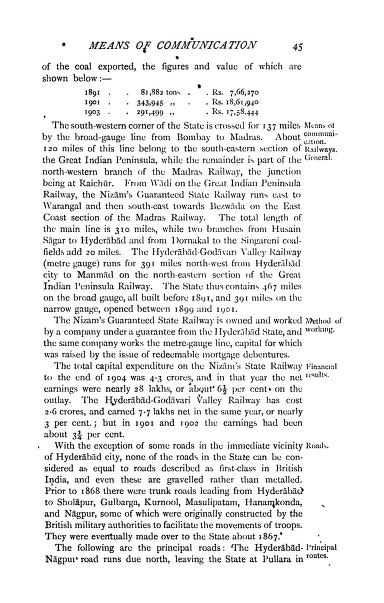
Railways. 'From Wadi on the Great Indian Peninsula Railway, the Nizam's Guaranteed State Railway runs east to Warangal and then south-east towards Bezwada… The State thus contains 467 miles on the broad gauge, all built before 1891, and 391 miles on the narrow gauge, opened between 1899 and 1901.' The financing is described too: the line 'is owned and worked by a company under a guarantee from the Hyderabad State', capital for the metre-gauge line having been 'raised by the issue of redeemable mortgage debentures', with total capital expenditure to the end of 1904 of 4·3 crores and net earnings of nearly 28 lakhs, 'or about 6½ per cent. on the outlay' 1. That is 858 route miles of railway in the State, of which 721 ran under the Hyderabad guarantee: the same page assigns 137 of the broad-gauge miles to the Great Indian Peninsula and Madras Railways crossing the state's south-western corner, leaving the Nizam's Guaranteed State Railway with 310 miles of main line and 20 miles of branches, plus the 391-mile metre-gauge Hyderabad-Godavari Valley line 1. A state raising capital on a bond market and turning a return on it, in 1904.

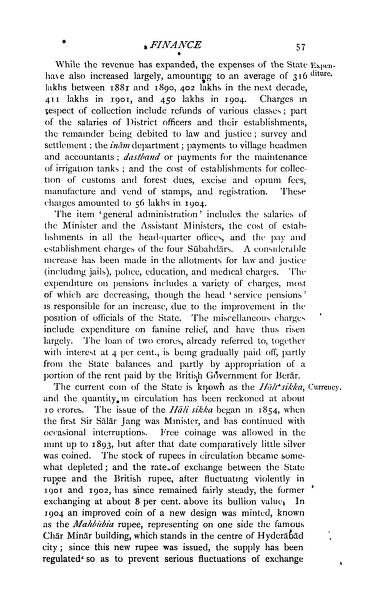
Money. 'The current coin of the State is known as the Hāli sikka, and the quantity in circulation has been reckoned at about 10 crores. The issue of the Hāli sikka began in 1854, when the first Sir Sālār Jang was Minister, and has continued with occasional interruptions. Free coinage was allowed in the mint up to 1893…' In 1904 'an improved coin of a new design was minted, known as the Mahbubia rupee, representing on one side the famous Char Minar building, which stands in the centre of Hyderabad city' 2. A separate exchange rate against the British rupee is quoted, between 115 and 116 to 100.

Courts and legislature. The Gazetteer lists the departments: 'the judicial, under the High Court, consisting of a Chief Justice and five Puisne Judges; the District police and jails, under an Inspector-General; the city police, under a Kotwal; customs, under a Commissioner; education, under a Director; stamps and mint, under a Superintendent; forests, under a Conservator; postal, under a Postmaster-General; and medical, under a Director' 3. A Legislative Council was ordered in 1893: it 'consists of 19 members', of whom six were non-official, and 'Of the 6 non-official members, 2 are elected by the jagirdars and landowners, 2 by the pleaders of the High Court, and the remaining 2 are nominated by the Minister' 4. Election by jagirdars and pleaders is a low bar for modernity, and the elected members were a minority of a minority; but it is a bar the absolute claim says the state never cleared.

Medicine. 'The first medical institution opened in the State was the Hyderabad Medical School, founded in 1846… At first instruction was imparted in Urdu, but since 1884 English has been the medium.' The medical department by 1901 had '74 surgeons, 12 lady doctors, 31 hospital assistants, 104 compounders, and 116 vaccinators'; dispensaries in the districts rose from 48 in 1884-5 to 84 in 1901, and out-patients treated across all institutions from 292,515 to 636,044 over the same period 8.

Schools. The Gazetteer is equally frank about the ceiling: 'In 1883 there were 148 primary schools… The total number of pupils attending these schools was 7,757, representing 0·5 per cent. of the population of school-going age. In 1891 the percentage rose to 2·5. In 1901 the number of primary schools increased to 753, and the number of pupils to 41,876, giving a percentage under instruction of 2·4' 5. Read carefully, that is the whole argument in one paragraph: the number of schools multiplied fivefold while the proportion of children reached actually slipped. The institutions were real; the coverage was not.

Osmania University, and what the word 'modern' is doing in the claim

The sharpest case is Osmania University, because it is simultaneously the state's most ambitious institution and the one most often read as evidence of provincialism. The Nizam's order establishing it 'was issued in Urdu on 26 April 1917. It states clearly that the medium of instruction will be "our language Urdu" (hamārī zubān Urdū) but English will retain its educational importance'; a second order of 14 August 1917 established the university's translation bureau, 'charged with translating important works from other languages into Urdu' 23. The dating is not entirely settled — other dates circulate in popular accounts, and accounts commonly distinguish the firman from the university's later opening — but none of the circulating variants has been traced here to a source that reproduces the firman itself, and the question is left open below rather than adjudicated.

What the university actually taught is not a matter of inference. The state's own Education Code sets it out: 'In a College affiliated to the Osmania University instruction is imparted through the medium of Urdu in the University courses in Arts, Science, Medicine, Engineering, Education, Theology and in the Higher Branches of Oriental Learning, the study of English as a Language being compulsory in the courses of study in Arts, Science, and Theology' 16. Medicine and engineering, taught in an Indian vernacular, in 1935. The claim that the state produced no modern institutions has to explain that sentence away.

It also has to explain the Code's preceding article, which is routinely forgotten: 'Colleges are of two types:— a. Those affiliated to the Madras University. b. Those affiliated to the Osmania University' 16. Hyderabad ran an English-medium college stream affiliated to Madras and an Urdu-medium stream of its own, in parallel. The Gazetteer confirms the older half of that arrangement: the Nizam College and the Aurangabad College were 'both affiliated to the Madras University', alongside the Dar-ul-ulum or Oriental College 5. Osmania was an addition to an existing university system, not a substitute for one.

The translation apparatus was the expensive part, and the figures are unromantic: the Bureau of Translation (Dāruíl-Tarjuma) 'produced 382 books and provided employment for 129 translators. It burned down in 1955' 24. Kavita Datla's reading of the project is that Hyderabad's Urdu educators were arguing with English, not with modernity: her article 'details how early-twentieth-century Hyderabad's Urdu educators engaged with questions of native education, language, and Western science', as those educators attempted 'to make the Urdu language a worldly vernacular, useful for more than the subcontinent's Muslim population' 25.

The cost of the policy is documented in the same literature and should not be softened. Rahman records that 'from 1944 onwards all secondary schools used Urdu as the medium of instruction—until 1941, 363 out of 444 secondary schools used the mother tongue as the medium of instruction'; the Hindus 'protested but to no avail and the local languages were marginalized' 23. Against that, the Education Code shows the vernaculars were not expelled from the system: teachers' certificate examinations at the elementary and primary levels 'will be conducted through the medium of the following languages:— Urdu, Marathi, Telugu and Kanarese' 19. Both facts are true. Urdu sat at the apex; Marathi, Telugu and Kannada survived at the base; the squeeze came in the middle, and it came late.

Money, coal and engineers: the state as an economic actor

Hyderabad's paper currency is the datum most often garbled, so it is worth taking from the Reserve Bank of India's own museum record: 'The exigency of the First World War, the Indian and Hyderabad contributions to British war effort, and an acute shortage of silver on the subcontinent led the Dominion to get its way in 1918 and paper currency was issued under the Hyderabad Currency Act.' Notes came 'in denominations of Rupees 100 and Rs 10', with 'Rupee One and Rupees Five notes… issued subsequently in 1919 and Rupees One Thousand notes… issued in 1926'. 'The currency was designated the Osmania Sicca and the notes were printed by Messrs Waterlow and Sons' 32. The RBI page also notes that earlier attempts by Indian states 'proved abortive, in the wake of British resistance to Indian States issuing paper currency' — which is the point. Hyderabad obtained something the paramount power had refused to others. The widely repeated line that Hyderabad was one of only two princely states with paper currency does not appear on the RBI page consulted here and is not asserted, although it would strengthen this section if true.

The mining sector has a longer and less flattering-to-anyone history. By the Singareni Collieries Company's own account, 'In the year 1871, Dr. King of the Geological Survey of India discovered coal near the village of Yellandu'; 'The Hyderabad (Deccan) Company Limited incorporated in England acquired mining rights in 1886'; 'The present Company was incorporated on 23rd December 1920 under the Hyderabad Companies Act as a public limited company with the name "The Singareni Collieries Company Limited"'; and 'The State of Hyderabad purchased majority shares of the Company in 1945' 33. Note the sequence: an English company held the concession for thirty-four years and the Hyderabad state bought control of it late. Both the industrial base and its foreign ownership are part of the record.

For the state's technical capacity in its last decade, the Administration Report of the Public Works Department for 1351 Fasli (printed at the Government Central Press, Hyderabad, 1944) is the plainest evidence. Its chief engineers are listed with their qualifications — King's College London, Manchester, Durham, Edinburgh, Madras — and the department carried a Chief Architect, an Irrigation branch, a Hydro-Electric Survey party, a Tungabhadra Project Division, the District Power Schemes administered under the Chief Engineer with an Electricity Department, and a temporary 'Osmania University Buildings Project Circle' under its own superintending engineer 22. The limits of that capacity are in the same document and should be stated: the calyx-drill foundation work on the Tungabhadra project 'was done by Engineers of the Madras Government', with the cost shared equally — a joint undertaking with a British Indian province, not a wholly indigenous one 22. On Nizam Sagar the report is administrative rather than triumphal: annual maintenance of Rs 3,43,750, distributary networks opening 'an area of 31,050 acres in the Armoor Taluq', and a research programme of crop and current-meter experiments across the commanded area 22. This is an unglamorous document, which is exactly why it is useful: it is a working bureaucracy describing its year.

The Musi flood of September 1908 is the origin of the capital's reconstruction, and it is also this page's clearest example of a contested number. The Imperial Gazetteer, printed within months, records in a footnote that 'a terrible disaster occurred at Hyderabad. As the result of some days' continuous rain, the Musi river suddenly rose in flood, carrying away several arches of three bridges — the Purana Pul, Afzal, and Chadarghat — inundating many quarters of the city on both sides of the river, and causing widespread destruction of life and property' 9. It gives no death toll. Figures of 15,000 and 50,000 both circulate in the modern press and in reference works; neither has been traced here to a contemporaneous enumeration, and the earliest official notice conspicuously declines to count. The same standard is applied in both directions on this page. A casualty figure is used only where a source prints it, which is why no death toll appears here — and a figure that flatters the state is treated identically: the railway mileage, the currency in circulation, the budget totals and the dispensary counts are quoted from the pages that print them, with the page named, and none is rounded upward in the state's favour.

The Archaeological Department, and what it chose to conserve

Ghulam Yazdani's Archaeological Department of H.E.H. the Nizam's Dominions is the institution that most cleanly falsifies both the 'no modern institutions' claim and the assumption that a Muslim dynasty's state apparatus attended only to Muslim monuments. Its annual reports are printed, indexed and public.

For 1339 Fasli (1929-30) the Department reported on the Ajanta caves: 'At Ajanta the most important work relates to the conservation of the frescoes which is progressing very steadily, and during the year the paintings of the verandah and the left and right-side galleries of the main hall of cave No. 2 have been conserved. In this cave now, only the frescoes of the ante-chamber and the shrine remain to be treated… It will be of interest to lovers of Indian art to know that the frescoes which were in danger of complete decay a few years ago have been treated so scientifically now that they are likely to survive for another couple of centuries, if not more' 20.

The same year's programme, as summarised in the Government's own review of the report, covered 'the Gardens of Bani Begam and Khan Jahan situated at Roza, the tomb of Amir Barid at Bidar, the Mahadeva Temple at Mankesar (Osmanabad District) and the Dargah of Hazrat Shamsuddin at Osmanabad and the Vaishnava Temple at Ter'; clearance work continued in the Bidar fort; and twenty-nine inscriptions were recovered at Raichur, of which 'eight belong to the Baihmani kings, fifteen to the "Adil Shahis' 21. The main report, not the Review, is the source for the Hindu epigraphy and the sculpture acquisitions: 'In the domain of Hindu inscriptions some Telugu records of the Kakatiya dynasty have been found at Patancheru… As these pillars and slab were lying in a neglected condition at Patancheru, they have been removed to Hyderabad and preserved at the Museum', and forty pieces of sculpture representing 'deities belonging to the Jaina, Saivite and Vishnuite professions of faith' were acquired for the museum in the same year 20.

The department's accounts were audited and criticised in public: expenditure on conservation of Rs 28,129 against Rs 46,902 the previous year, with the Government noting drily that 'The reason for this decrease should have been given in the report' 21. A department whose superiors complain in print about its budget notes is a department, not a gesture — though the complaint also records a conservation budget that had fallen by nearly forty per cent in a single year.

What the state's own Royal Commission said it had not done

The most damaging evidence against Hyderabad's developmental record is not nationalist polemic and does not need to be. It is the Nizam's government's own paperwork, and it is more precise than the polemic.

The Report of the Royal Commission on Jagir Administration and Reforms, submitted at Bangalore on 25 May 1947 under the chairmanship of Albion Rajkumar Banerji, quotes a note by a retired Director of Public Instruction: 'It is not a desirable state of affairs that, while the Diwani Ilakas are educationally advanced, the Samasthans, Jagirs and Paigahs should remain backward, thus hindering the all-round progress of the State.' The note adds that 'the late Nawab Jmadul Mulk Bahadur, during his tenure of office as Director of Public Instruction drew the attention of Government to the fact that the absence of education in Jagirs had adversely affected the educational statistics of the State. What he said forty-six years ago holds good even to-day' — dating the internal complaint to roughly the turn of the century 11.

It also reproduces A. Mayhew, the government's own Educational Adviser, writing in 1911: 'In the course of my tours I have passed through Jagirs in which there is no provision of any kind for education. . . . I am inclined to believe that the present state of education in Jagirs is such as to demand the earnest attention of the Government. All areas in which education is very noticeably below the average of the State as a whole are a source of danger to the State' 11. Thirty-six years later the Commission was still quoting him because nothing had changed: 'out of a total of over 5,000 schools in the Diwani villages, the Jagir and Samasthan areas have not more than 189' 10.

Two qualifiers from the Commission itself belong in the same paragraph, because the standard applied to evidence that damages the Nizam's government is the standard applied to evidence that helps it. On extent: 'although the Paigah, Samasthans and Jagir areas on the whole make a total of 30·9%, the compact areas under these tracts is only 9·7% of the total dominion area of 82,698 sq. miles' — the unadministered third was dispersed rather than a contiguous third of the map 10. On schooling: 'we are not unaware of the fact that some Jagirs and Samasthans provide good facilities for education. But these are very rare' 14. Neither qualifier rescues the record; both are in the document, and a page that quotes the Commission's indictments has no licence to omit its concessions.

The fiscal architecture explains the failure without needing malice. Jagir revenue was estimated 'at about 2½ crores and including Maqtas and Agrahars… at about 4½ crores', while 'The contributions now paid to Government in the form of Pan and Peshkash have been estimated at about Rs. 9,42,244 or about 2% of the total Jagir income, a very negligible percentage' 13. A third of the state's area generated revenue that almost entirely bypassed the treasury and funded almost none of the services the treasury was expected to supply.

That said, the same paragraph is the best short answer to the claim that there was no development budget at all: 'At the present moment the Government of His Exalted Highness is spending 3,40,00,000 or over Rs. 2 per head of the population on Public Health and Education alone. Taking Judicial, Police, Jails, Supply, Famine relief, Water-supply, Veterinary, Agriculture and Co-operation, the total expenditure as seen from the Budget for 56 F. amounts to nearly 6·5 crores' 13. Elsewhere the Commission notes that Government 'have provided more than 2½ crores a year for education purposes' under a 'big scheme for mass literacy' 14. A real budget, and a thin one for 16.3 million people — and one arriving in the state's final full year of existence.

Where the claim comes from, and what it is now used to settle

The proposition that Hyderabad was undeveloped has three distinct sources, and separating them is most of the work.

The first is internal and administrative: the Directors of Public Instruction from around 1900, Mayhew in 1911, the Royal Commission in 1947 11. Their claim is comparative and targeted — the jagir areas are unreached, and their absence drags the state's averages down. It is not a claim that the state built nothing; the same officials were employed by the departments that built things. This is the sourced core that the circulating absolute has been built on top of, and it is why the verdict here is oversimplified rather than unsupported.

The second is political and pre-1948: the peasant movement in Telangana from 1946, whose grievance Taylor Sherman describes as 'great resentment against the jagirdari system of landholding which governed 43 per cent of land in the state', a system 'infamous for the high rate of forced labour extracted from peasants who held little land, were given paltry access to water and manure, and were subjected to high rates by (often absentee) landlords' 26. Sherman's 43 per cent is a share of land, not of area, and sits above the Royal Commission's 30·9 per cent of dominion area for paigahs, samasthans and jagirs — 40·79 per cent counting the sarf-e-khas, 9·7 per cent counting only the compact tracts 1210. The two are not directly commensurable, one being tenurial and the other territorial, and no reconciliation has been traced here; the larger figure is not preferred because it is the more damaging one, and the smaller is not preferred because it is the less. The discrepancy is logged among the open questions. Either way, this is a claim about land and unfree labour, not about railways and dams, and nothing in the institutional inventory answers it.

The third is post-integration and governmental, and Sherman is explicit that it was deliberate. 'Socialists in the new nation detested the feudal conditions extant in the state, and believed that the system could only be abolished by dismembering every element of the Nizam's regime' 27. After 1948 the postcolonial state 'quickly learned that development programmes could be more effective than coercion in certain circumstances'; 'in Hyderabad development was an important element in their fight against communists' 28. Sherman's subject in that passage is the new Indian state generally, of which Hyderabad is the case; the contrast between a backward Nizam's state and a developmental Indian one was, in part, a produced contrast — which does not make it false, but does explain why it hardened into an absolute.

A fourth register emerged after 1956, when Telangana was merged into Andhra Pradesh and regional backwardness became a constitutional and fiscal argument about safeguards. Motkuri's paper sits openly in that tradition, tracing present-day educational deprivation in Telangana to pre-1948 structures 29.

The claim's live circulation is now bound to the commemoration of 17 September, and the argument is conducted through the name of the day. As of September 2024, 'The Union government, led by the BJP, declared the day officially as Telangana Liberation Day', while the Bharat Rashtra Samithi observed it as Telangana Integration Day and the Congress state government adopted 'Praja Palana' day 35. The developmental record of the Nizam's state is now argued about primarily as an argument about that date — which is why lists of Nizam-era institutions and lists of Nizam-era deprivations are deployed against each other, when the documents support both lists at once.
The pages themselves

Where the source is out of copyright and a scan exists, the page carrying the quoted passage is reproduced here, so the reader can check the transcription rather than take it on trust.

Page 45 of the 1909 Imperial Gazetteer volume on Hyderabad State, describing the Nizam's Guaranteed State Railway, its mileage, capital and earnings, and the 137 broad-gauge miles belonging to the Great Indian Peninsula and Madras Railways.
Imperial Gazetteer of India, Provincial Series: Hyderabad State (Calcutta: Superintendent of Government Printing, 1909), 'Means of Communication — Railways', p. 45., 45
Page 57 of the 1909 Imperial Gazetteer volume on Hyderabad State, describing the Hali sikka state coinage, free coinage in the mint to 1893, and the Mahbubia rupee of 1904 bearing the Char Minar.
Imperial Gazetteer of India, Provincial Series: Hyderabad State (Calcutta, 1909), 'Finance — Currency', p. 57. Transliteration diacritics as printed; the source sets 'Hāli sikka' in italic., 57
Page 77 of the 1909 Imperial Gazetteer volume on Hyderabad State, giving the Muslim share of the population against the Muslim share of college, secondary and primary school enrolment; the sentence breaks off at the foot of the page and continues on p. 78.
Imperial Gazetteer of India, Provincial Series: Hyderabad State (Calcutta, 1909), 'Education — Muhammadan education', pp. 77-78. The quoted passage crosses the page break: p. 77 ends at 'the position held by Muhammadans in a', and the remainder is printed on p. 78., 77-78
Page 78 of the 1909 Imperial Gazetteer volume on Hyderabad State, giving 1901 census literacy at 29.55 per 1,000 of the population.
Imperial Gazetteer of India, Provincial Series: Hyderabad State (Calcutta, 1909), 'Education', p. 78., 78

How the claim travelled

A claim’s history of telling is separate from its truth. This traces the telling.

Earliest attestation
The claim in documented form originates inside the Hyderabad administration, not outside it. The 1947 Royal Commission quotes a retired Director of Public Instruction recalling that Nawab Imad-ul-Mulk had warned Government 'forty-six years ago' — i.e. around 1900-01 — that 'the absence of education in Jagirs had adversely affected the educational statistics of the State', adding that 'What he said forty-six years ago holds good even to-day'. The earliest precisely dated attestation is A. Mayhew, the government's own Educational Adviser, reporting in 1911 that he had 'passed through Jagirs in which there is no provision of any kind for education' 11.
First embellishment
The move from the sourced comparative statement — Hyderabad lags Baroda, Mysore, Travancore and Madras on literacy and primary schooling, and its jagir third is essentially unadministered — to the absolute statement that the state possessed no modern institutions and produced no development. The absolute form requires disregarding the railway, the mint and coinage, the High Court, the Legislative Council, the medical school of 1846, the archaeological department, the Public Works Department and Osmania University, all of which are documented in the state's own published records and in a Government of India gazetteer printed in 1909.
Why it took this shape
Three documented pressures, none of which require bad faith. First, the integration of September 1948 was internationally contested and the incoming administration measured its own legitimacy in developmental terms; Sherman shows development programmes deployed simultaneously as counter-insurgency against the Telangana communists and as evidence of the postcolonial state's superiority to what it replaced 28. Second, after the 1956 linguistic reorganisation, Telangana's relative backwardness became a live claim about regional safeguards and fiscal entitlement within Andhra Pradesh, giving the pre-1948 record continuing political weight 29. Third, since the Union government's designation of 17 September as an official observance, the Nizam-era record has become the terrain of a commemorative dispute conducted through the naming of the day 35.
Where the scholarship now stands
No historian of Hyderabad working from the archives defends the absolute claim, and none of them defends the state's developmental record either. The publisher's description of Eric Lewis Beverley's book presents Hyderabad 'as a locus for experimentation in global and regional forms of political modernity' 34 — the wording is the press's and the book itself was not read for this page. Datla reads the Osmania project as a serious engagement with modern science rather than a retreat from it 25. Rahman reads the same project as a power project with real costs to Marathi, Telugu and Kannada 23. Sherman reads the post-1948 contrast as partly constructed and partly earned 28. Motkuri and the Telangana regional-development literature hold that the educational deficit was structural and consequential 29. The disagreement is about weighting, causation and cost. It is not about whether the institutions existed, and it is not about whether the countryside was reached.

Where historians differ

What this page cannot settle

Connected to

Citations

Every quotation is given verbatim with its page, and linked to the copy it was read from. Spelling and diacritics are those of the source — where they look wrong, that is the evidence, not an error. Tier A: academic or peer-reviewed. Tier B: archival, contemporary or reference. Tier C: journalism or popular history, never load-bearing on its own.

  1. 1AImperial Gazetteer of India, Provincial Series: Hyderabad State (Calcutta: Superintendent of Government Printing, 1909), 'Means of Communication — Railways', p. 45., 45 (1909)
    The State thus contains 467 miles on the broad gauge, all built before 1891, and 391 miles on the narrow gauge, opened between 1899 and 1901. … The Nizam's Guaranteed State Railway is owned and worked by a company under a guarantee from the Hyderabad State, and the same company works the metre-gauge line, capital for which was raised by the issue of redeemable mortgage debentures. The total capital expenditure on the Nizam's State Railway to the end of 1904 was 4·3 crores, and in that year the net earnings were nearly 28 lakhs, or about 6½ per cent. on the outlay.
    Page 45 of the 1909 Imperial Gazetteer volume on Hyderabad State, describing the Nizam's Guaranteed State Railway, its mileage, capital and earnings, and the 137 broad-gauge miles belonging to the Great Indian Peninsula and Madras Railways.
    Page 45 of the 1909 Imperial Gazetteer volume on Hyderabad State, describing the Nizam's Guaranteed State Railway, its mileage, capital and earnings, and the 137 broad-gauge miles belonging to the Great Indian Peninsula and Madras Railways.Imperial Gazetteer of India, Provincial Series: Hyderabad State (Calcutta, 1909), p. 45. Digital Library of India scan via Internet Archive.. Public domain (published 1909). Full scan.
  2. 2AImperial Gazetteer of India, Provincial Series: Hyderabad State (Calcutta, 1909), 'Finance — Currency', p. 57. Transliteration diacritics as printed; the source sets 'Hāli sikka' in italic., 57 (1909)
    The current coin of the State is known as the Hāli sikka, and the quantity in circulation has been reckoned at about 10 crores. The issue of the Hāli sikka began in 1854, when the first Sir Sālār Jang was Minister, and has continued with occasional interruptions. Free coinage was allowed in the mint up to 1893 … In 1904 an improved coin of a new design was minted, known as the Mahbubia rupee, representing on one side the famous Char Minar building, which stands in the centre of Hyderabad city
    Page 57 of the 1909 Imperial Gazetteer volume on Hyderabad State, describing the Hali sikka state coinage, free coinage in the mint to 1893, and the Mahbubia rupee of 1904 bearing the Char Minar.
    Page 57 of the 1909 Imperial Gazetteer volume on Hyderabad State, describing the Hali sikka state coinage, free coinage in the mint to 1893, and the Mahbubia rupee of 1904 bearing the Char Minar.Imperial Gazetteer of India, Provincial Series: Hyderabad State (Calcutta, 1909), p. 57. Digital Library of India scan via Internet Archive.. Public domain (published 1909). Full scan.
  3. 3AImperial Gazetteer of India, Provincial Series: Hyderabad State (Calcutta, 1909), 'Administration', p. 51., 51 (1909)
    the judicial, under the High Court, consisting of a Chief Justice and five Puisne Judges; the District police and jails, under an Inspector-General; the city police, under a Kotwal; customs, under a Commissioner; education, under a Director; stamps and mint, under a Superintendent; forests, under a Conservator; postal, under a Postmaster-General; and medical, under a Director.
  4. 4AImperial Gazetteer of India, Provincial Series: Hyderabad State (Calcutta, 1909), 'Legislation', p. 53. The same page states that orders for the Council's establishment were promulgated in 1893., 53 (1909)
    The Legislative Council consists of 19 members, of whom, besides the president and vice-president, 11 are official and 6 non-official members. … Of the 6 non-official members, 2 are elected by the jagirdars and landowners, 2 by the pleaders of the High Court, and the remaining 2 are nominated by the Minister from among the residents of the State, of whom one must be nominated from the paigah ilaka.
  5. 5AImperial Gazetteer of India, Provincial Series: Hyderabad State (Calcutta, 1909), 'Education — University, Secondary and Primary education', p. 75., 75 (1909)
    There are three Arts colleges: the Nizam College at Hyderabad (first grade), the Aurangabad College (second grade), both affiliated to the Madras University, and the Dar-ul-ulum or Oriental College … In 1883 there were 148 primary schools, of which 13 were at the capital. The total number of pupils attending these schools was 7,757, representing 0·5 per cent. of the population of school-going age. In 1891 the percentage rose to 2·5. In 1901 the number of primary schools increased to 753, and the number of pupils to 41,876, giving a percentage under instruction of 2·4 to children of school-going age in that year
  6. 6AImperial Gazetteer of India, Provincial Series: Hyderabad State (Calcutta, 1909), 'Education — Muhammadan education', pp. 77-78. The quoted passage crosses the page break: p. 77 ends at 'the position held by Muhammadans in a', and the remainder is printed on p. 78., 77-78 (1909)
    While the Muhammadans form only 10·4 per cent. of the population of the State, they include 83 per cent. of the students in colleges, 45 per cent. of the pupils in secondary, and 42 per cent. of the pupils in primary schools. These results are due to the position held by Muhammadans in a State of which the ruler belongs to their religion. It is noticeable that the Hindus are more successful in examinations, proportionately to their numbers, than the Muhammadans.
    Page 77 of the 1909 Imperial Gazetteer volume on Hyderabad State, giving the Muslim share of the population against the Muslim share of college, secondary and primary school enrolment; the sentence breaks off at the foot of the page and continues on p. 78.
    Page 77 of the 1909 Imperial Gazetteer volume on Hyderabad State, giving the Muslim share of the population against the Muslim share of college, secondary and primary school enrolment; the sentence breaks off at the foot of the page and continues on p. 78.Imperial Gazetteer of India, Provincial Series: Hyderabad State (Calcutta, 1909), p. 77. Digital Library of India scan via Internet Archive.. Public domain (published 1909). Full scan.
  7. 7AImperial Gazetteer of India, Provincial Series: Hyderabad State (Calcutta, 1909), 'Education', p. 78., 78 (1909)
    According to the Census of 1901 literate persons numbered 29·55 per 1,000 of the total population, but taking males and females separately, the proportions are 54·7 and 3·4 respectively. Persons literate in English were 1·3 per 1,000 of the total population.
    Page 78 of the 1909 Imperial Gazetteer volume on Hyderabad State, giving 1901 census literacy at 29.55 per 1,000 of the population.
    Page 78 of the 1909 Imperial Gazetteer volume on Hyderabad State, giving 1901 census literacy at 29.55 per 1,000 of the population.Imperial Gazetteer of India, Provincial Series: Hyderabad State (Calcutta, 1909), p. 78. Digital Library of India scan via Internet Archive.. Public domain (published 1909). Full scan.
  8. 8AImperial Gazetteer of India, Provincial Series: Hyderabad State (Calcutta, 1909), 'Medical', p. 79., 79 (1909)
    The first medical institution opened in the State was the Hyderabad Medical School, founded in 1846, which has done much useful work in training medical officers and subordinates for the Hyderabad medical service, and hospital assistants for Berar. At first instruction was imparted in Urdu, but since 1884 English has been the medium. … The total strength for the State is 74 surgeons, 12 lady doctors, 31 hospital assistants, 104 compounders, and 116 vaccinators. … Statistics are only available from 1884-5. In that year there were 6 hospitals in the city and suburbs and 48 dispensaries in the Districts. By 1891 the number of dispensaries had increased to 67, and in 1901 it rose to 84. The total number of out-patients treated in all institutions in 1884-5, 1891, and 1901 was 292,515, 384,660, and 636,044 respectively.
  9. 9AImperial Gazetteer of India, Provincial Series: Hyderabad State (Calcutta, 1909), footnote at the foot of the Secunderabad article, p. 119 n., 119, footnote (1909)
    At the end of September, 1908, a terrible disaster occurred at Hyderabad. As the result of some days' continuous rain, the Musi river suddenly rose in flood, carrying away several arches of three bridges — the Purana Pul, Afzal, and Chadarghat — inundating many quarters of the city on both sides of the river, and causing widespread destruction of life and property.
  10. 10BReport of the Royal Commission on Jagir Administration and Reforms (Hyderabad-Deccan: H.E.H. the Nizam's Government, 1356 Fasli / 1947), paras 34-35, p. 21., 21 (1947)
    For example, out of a total of over 5,000 schools in the Diwani villages, the Jagir and Samasthan areas have not more than 189. A proposal was that a levy of 3% should be made from the income of Jagirdars and handed over to the Education Department to carry out the policy of providing adequate educational facilities in the Jagir areas. … We may point out that although the Paigah, Samasthans and Jagir areas on the whole make a total of 30·9%, the compact areas under these tracts is only 9·7% of the total dominion area of 82,698 sq. miles. … It is admitted by the Revenue Department that as no records are maintained in Jagir areas, statistical data of vital importance are not available in a satisfactory manner for these jurisdictions, and even in the case of big estates the accuracy of data supplied is of very doubtful nature. Even as regards population census and statistics, we are in the dark as to the true position.
    Fetchedsource
  11. 11BReport of the Royal Commission on Jagir Administration and Reforms (1356 F. / 1947), paras 32-33, pp. 20-21. The report prints 'Jmadul Mulk' for Imad-ul-Mulk; the spelling is preserved as printed., 20-21 (1947)
    "It is not a desirable state of affairs that, while the Diwani Ilakas are educationally advanced, the Samasthans, Jagirs and Paigahs should remain backward, thus hindering the all-round progress of the State." … "Realising the gravity of this problem, the late Nawab Jmadul Mulk Bahadur, during his tenure of office as Director of Public Instruction drew the attention of Government to the fact that the absence of education in Jagirs had adversely affected the educational statistics of the State. What he said forty-six years ago holds good even to-day." … Equally significant were the remarks made by Mr. A. Mayhew, Educational Adviser, in the report which he submitted to Government in 1911. In that he said:— "In the course of my tours I have passed through Jagirs in which there is no provision of any kind for education. … All areas in which education is very noticeably below the average of the State as a whole are a source of danger to the State."
    Fetchedsource
  12. 12BReport of the Royal Commission on Jagir Administration and Reforms (1356 F. / 1947), 'Area and Population', paras 72-73, pp. 36-37., 36-37 (1947)
    The total area of the Dominions is 82,698 sq. miles of which 33,729·9 sq. miles or 40·79 is non-Diwani and 59·21% Diwani. Of this the total area of the Sarf-e-Khas is 8,109 sq. miles or 9·9% of the total area of the Dominions. The total area of Paigahs, Samasthans and Jagirs is 25,620 sq. miles or 30.9% of the total area of the Dominions. The total population of the State is 16·3 millions of which the population of the non-Diwani area is roughly 25%. … out of a total number of 22,457 villages in the Dominions 6,535 or 29·5% are Jagir villages, 1,961 or 8·7% Sarf-e-Khas, and 13,961 or 61·9% Diwani villages.
    Fetchedsource
  13. 13BReport of the Royal Commission on Jagir Administration and Reforms (1356 F. / 1947), Chapter XVI 'Conclusion', para 279, p. 111., 111 (1947)
    …have roughly estimated the total Revenue from them at about 2½ crores and including Maqtas and Agrahars they estimate the total Revenue at about 4½ crores. The contributions now paid to Government in the form of Pan and Peshkash have been estimated at about Rs. 9,42,244 or about 2% of the total Jagir income, a very negligible percentage. At the present moment the Government of His Exalted Highness is spending 3,40,00,000 or over Rs. 2 per head of the population on Public Health and Education alone. Taking Judicial, Police, Jails, Supply, Famine relief, Water-supply, Veterinary, Agriculture and Co-operation, the total expenditure as seen from the Budget for 56 F. amounts to nearly 6·5 crores.
    Fetchedsource
  14. 14BReport of the Royal Commission on Jagir Administration and Reforms (1356 F. / 1947), Chapter XI 'Administration of Nation-Building Departments and Other Welfare Activities', paras 193 and 195, pp. 79-80., 79-80 (1947)
    Owing to the complete absence of any kind of organisation for public health in non-Diwani Ilaqas and the lack of control measures during outbreaks of epidemic diseases, these areas constitute a perennial source of danger to the whole State. … The Government have a big scheme for mass literacy and expansion of education in the State as a whole and have provided more than 2½ crores a year for education purposes. … When we make the above remarks, we are not unaware of the fact that some Jagirs and Samasthans provide good facilities for education. But these are very rare.
    Fetchedsource
  15. 15BReport of the Royal Commission on Jagir Administration and Reforms (1356 F. / 1947), Minute of Dissent submitted by Raja Someshwar Rao, para 2, p. 115., 115 (1947)
    I would only refer to the evidence of the Nazim Bandobast who has said in reference to the public amenities in Jagirs, "The Government is not making any provision for water-supply even in Diwani villages except in famine areas. We cannot ask the Jagirdars to make provisions for these. . . . . So far as medical relief is concerned, it is not adequate even in Diwani areas. We have only one dispensary for a Taluq. So the Jagirdars cannot be accused for not undertaking the responsibility."
    Fetchedsource
  16. 16BThe Education Code of H.E.H. the Nizam's Dominions (Hyderabad-Deccan: Education Department, sanctioned 1344 Fasli; printed 1935), Articles 4 and 10, p. 2. The Internet Archive item is flagged 'In copyright'; no facsimile is reproduced here., 2 (1935)
    Article 4. Colleges are of two types:— a. Those affiliated to the Madras University. b. Those affiliated to the Osmania University. … Article 10. In a College affiliated to the Osmania University instruction is imparted through the medium of Urdu in the University courses in Arts, Science, Medicine, Engineering, Education, Theology and in the Higher Branches of Oriental Learning, the study of English as a Language being compulsory in the courses of study in Arts, Science, and Theology.
  17. 17BThe Education Code of H.E.H. the Nizam's Dominions (1344 F. / 1935), Article 291, p. 66 (the article heading sits at the foot of p. 65)., 66 (1935)
    No fees will be recovered in Primary schools and also in Primary sections of Secondary schools of such places where there are no separate Primary schools.
  18. 18BThe Education Code of H.E.H. the Nizam's Dominions (1344 F. / 1935), Article 296, p. 66., 66 (1935)
    Article 296. A pupil may be admitted on the free list on the following conditions:— a. That his age does not exceed the average age of the class. b. That he is a Mulki. c. That he is vaccinated or otherwise protected from small-pox and that he is physically fit for further study.
  19. 19BThe Education Code of H.E.H. the Nizam's Dominions (1344 F. / 1935), Article 378, p. 81. The source spells Kannada as 'Kanarese'., 81 (1935)
    Article 378. The Teachers' Diploma and the Teachers' Certificate examinations will be conducted through the medium of Urdu while the Higher Elementary, the Upper and the Lower Primary Teachers' Certificate examinations will be conducted through the medium of the following languages:— Urdu, Marathi, Telugu and Kanarese.
  20. 20BAnnual Report of the Archaeological Department of H.E.H. the Nizam's Dominions for 1339 Fasli (1929-30 A.C.), ed. G. Yazdani (Calcutta: Baptist Mission Press, 1933), pp. 26-27 (leaves n39-n40). The title page reads 1933; the 1932 given in the Internet Archive metadata record is not the imprint date., 26-27 (1933)
    At Ajanta the most important work relates to the conservation of the frescoes which is progressing very steadily, and during the year the paintings of the verandah and the left and right-side galleries of the main hall of cave No. 2 have been conserved. In this cave now, only the frescoes of the ante-chamber and the shrine remain to be treated, which work is likely to be completed in the middle of the next year (1341 F.). It will be of interest to lovers of Indian art to know that the frescoes which were in danger of complete decay a few years ago have been treated so scientifically now that they are likely to survive for another couple of centuries, if not more. … In the domain of Hindu inscriptions some Telugu records of the Kakatiya dynasty have been found at Patancheru … As these pillars and slab were lying in a neglected condition at Patancheru, they have been removed to Hyderabad and preserved at the Museum. … Forty pieces of sculpture … deities belonging to the Jaina, Saivite and Vishnuite professions of faith
  21. 21B'Review of the Report on the working of the Archaeological Department for the year 1339 Fasli (1929-30 A.C.)', dated 26 November 1931, prefixed to the Annual Report of the Archaeological Department of H.E.H. the Nizam's Dominions for 1339 F. (Calcutta: Baptist Mission Press, 1933), pp. vii-viii., vii-viii (1933)
    The Gardens of Bani Begam and Khan Jahan situated at Roza, the tomb of Amir Barid at Bidar, the Mahadeva Temple at Mankesar (Osmanabad District) and the Dargah of Hazrat Shamsuddin at Osmanabad and the Vaishnava Temple at Ter … were surveyed during the year. … A systematic search for inscriptions was made in the town of Raichur and twenty-nine records were found, of which eight belong to the Baihmani kings, fifteen to the 'Adil Shahis … The total expenditure on the conservation of monuments amounted to Rs. 28,129 as against Rs. 46,902 in the previous year. The reason for this decrease should have been given in the report.
    Fetchedsource
  22. 22BAdministration Report of the Public Works Department, H.E.H. the Nizam's Government, for the year 1351 F. (Hyderabad-Deccan: Government Central Press, 1944), pp. 2 and 6, and Chapter VI (Nizamsagar Project), p. 17., 2, 6, and 17 (Nizamsagar Project, Chapter VI) (1944)
    Osmania University Buildings Project Circle.— Mr. M. Anwarullah, B.Sc. (Durham), Superintending Engineer, was in charge of the Circle throughout the year … The following are the works carried out by the Tungabhadra Project Division. 1. Preparation of plans and estimates of the Tungabhadra Reservoir. 2. Drafting of the report on Hydro-Electric scheme of the Dominions. … These waterways open out an area of 31,050 acres in the Armoor Taluq for irrigation and development … Annual Maintenance.— The annual maintenance of the project amounting to Rs. 3,43,750 of works and establishment was spent on necessary items of works to keep the system in efficient order.
    Fetchedsource
  23. 23ATariq Rahman, 'Urdu in Hyderabad State', The Annual of Urdu Studies 23 (2008), 36-54, at p. 50. Transliteration macrons as printed by Rahman., 50 (2008)
    Eventually, the Nizam's order establishing this university, now called Osmania University, was issued in Urdu on 26 April 1917. It states clearly that the medium of instruction will be "our language Urdu" (hamārī zubān Urdū) but English will retain its educational importance (Pachauri 1993, 45). Another order (14 August 1917) establishes the Translation Bureau of the university (Shuba'-e Tarjuma) charged with translating important works from other languages into Urdu … Thus, from 1944 onwards all secondary schools used Urdu as the medium of instruction—until 1941, 363 out of 444 secondary schools used the mother tongue as the medium of instruction—though primary schools could still operate in the local languages (Jang 1944). The Hindus protested but to no avail and the local languages were marginalized
    Fetchedsource
  24. 24ATariq Rahman, 'Urdu in Hyderabad State', The Annual of Urdu Studies 23 (2008), 36-54, at p. 48. Transliteration diacritics as printed by Rahman., 48 (2008)
    Maulavī ʿAbduíl-Ḥaq was also one of the pioneers of Osmania University. He presided over the Dāruíl-Tarjuma and invited eminent people from North India … The Bureau of Translation (Dāruíl-Tarjuma) produced 382 books and provided employment for 129 translators. It burned down in 1955, though some of the books which had been translated earlier are to be found in the Nizam Trust Library in Hyderabad (Bedar 1979, 228).
    Fetchedsource
  25. 25AKavita Datla, 'A Worldly Vernacular: Urdu at Osmania University', Modern Asian Studies 43:5 (2009), 1117-1148. DOI 10.1017/S0026749X08003715. Abstract page only consulted., 1117-1148 (abstract page consulted) (2009)
    This article details how early-twentieth-century Hyderabad's Urdu educators engaged with questions of native education, language, and Western science. It highlights the discussions and disagreements that accompanied this educational project as Urdu advocates re-evaluated their language and its sources of authority, attempting to make the Urdu language a worldly vernacular, useful for more than the subcontinent's Muslim population.
    Fetchedsource
  26. 26ATaylor C. Sherman, 'The integration of the princely state of Hyderabad and the making of the postcolonial state in India, 1948-56', Indian Economic and Social History Review 44:4 (2007), 489-516; accepted manuscript, LSE Research Online, p. 21., 21 (LSE Research Online accepted manuscript pagination) (2007)
    Amongst the poor peasantry and landless labourers, there was great resentment against the jagirdari system of landholding which governed 43 per cent of land in the state. This system was infamous for the high rate of forced labour extracted from peasants who held little land, were given paltry access to water and manure, and were subjected to high rates by (often absentee) landlords.
    Fetchedsource
  27. 27ATaylor C. Sherman, 'The integration of the princely state of Hyderabad…' (2007); accepted manuscript, LSE Research Online, p. 30., 30 (LSE Research Online accepted manuscript pagination) (2007)
    Socialists in the new nation detested the feudal conditions extant in the state, and believed that the system could only be abolished by dismembering every element of the Nizam's regime.
    Fetchedsource
  28. 28ATaylor C. Sherman, 'The integration of the princely state of Hyderabad…' (2007); accepted manuscript, LSE Research Online, pp. 31-32. In the first sentence Sherman's subject is the postcolonial state generally, in a concluding passage, not the Hyderabad administration alone., 31-32 (LSE Research Online accepted manuscript pagination) (2007)
    It quickly learned that development programmes could be more effective than coercion in certain circumstances. … in Hyderabad development was an important element in their fight against communists; in other places, other tactics predominated.
    Fetchedsource
  29. 29CMotkuri Venkatanarayana, 'Historical Factors in the Process of Educational Deprivation of Children: The Case of Telangana Region of Nizam's Hyderabad State', MPRA Paper No. 48508 (Centre for Development Studies, Thiruvananthapuram, March 2005), Table 6 and accompanying text, p. 19., 19 (2005)
    Table 6: A Comparison of literacy levels in Hyderabad with other Princely states and Madras Province: 1901-51 … [Male] 1901: Mysore 11.7, Baroda 19.9, Travancore 21.5, Hyderabad 2.1, Madras 13.7; 1931: Mysore 17.4, Baroda 35.1, Travancore 40.8, Hyderabad 8.5, Madras 21.9. [Female] 1901: … Hyderabad 0.5 …; 1931: … Hyderabad 1.2 … Source: Census, Administration Reports, Report on Public Instruction of Hyderabad. … Maharaja Sayaji Rao Gaikwad of Baroda had made primary education free and compulsory within the territories of his state in 1906 but in Hyderabad it was made possible only after the independence.
    Fetchedsource
  30. 30CMotkuri Venkatanarayana, MPRA Paper No. 48508 (2005), Table 2, p. 5., 5 (2005)
    Table 2: Literacy Rate in Telingana Districts of Nizams' Hyderabad: 1901-1951 … Hyderabad State 1901: 3.0; 1911: 2.8; 1921: 2.9; 1931: 4.1; 1941: 6.8; 1951: 9.2. Source: Census of India (1951) Hyderabad, Vol. IX, Part I A- Report
    Fetchedsource
  31. 31CMotkuri Venkatanarayana, MPRA Paper No. 48508 (2005), pp. 8-9, citing Ramakrishna Reddy (1987). The quoted passage spans the page break: the opening sentence is on p. 8, all of the figures on p. 9., 8-9 (2005)
    The government imposed restrictions on establishment and funding of private school and denied permissions to voluntary efforts and even if village people come forward to set up schools. The policy impact is that the number of private schools and pupils in those schools fell down to 929 and the pupils were to 25,865 in 1936 from the 4053 with 76,654 pupils in the year 1920. In Warangal Suba, out of 25 taluqs 23 were without a middle school or a high school in 1936.
    Quoted insourcequoted in Motkuri Venkatanarayana, MPRA Paper No. 48508 (2005), pp. 8-9 and footnote 16, attributing the restriction policy to Ramakrishna Reddy (1987); the underlying departmental minutes were not consulted here.
  32. 32BReserve Bank of India, Monetary Museum, 'Hyderabad' (paper money of the princely state of Hyderabad), rbi.org.in., web page, section on the Hyderabad Currency Act
    The exigency of the First World War, the Indian and Hyderabad contributions to British war effort, and an acute shortage of silver on the subcontinent led the Dominion to get its way in 1918 and paper currency was issued under the Hyderabad Currency Act. … These attempts to issue paper currency proved abortive, in the wake of British resistance to Indian States issuing paper currency. … Notes were issued in denominations of Rupees 100 and Rs 10. … Rupee One and Rupees Five notes were issued subsequently in 1919 and Rupees One Thousand notes were issued in 1926. … The currency was designated the Osmania Sicca and the notes were printed by Messrs Waterlow and Sons.
    Fetchedsource
  33. 33CThe Singareni Collieries Company Limited, 'Company History', scclmines.com., web page
    In the year 1871, Dr. King of the Geological Survey of India discovered coal near the village of Yellandu in Khammam district. … The Hyderabad (Deccan) Company Limited incorporated in England acquired mining rights in 1886 to exploit coal found in Yellandu area. … The present Company was incorporated on 23rd December 1920 under the Hyderabad Companies Act as a public limited company with the name 'The Singareni Collieries Company Limited' (SCCL). … The State of Hyderabad purchased majority shares of the Company in 1945.
    Fetchedsource
  34. 34AEric Lewis Beverley, Hyderabad, British India, and the World: Muslim Networks and Minor Sovereignty, c. 1850-1950 (Cambridge: Cambridge University Press, 2015), ISBN 978-1-107-09119-1; frontmatter, publisher's description and table of contents. The passage quoted below is the publisher's jacket description, not Beverley's prose; the book itself was not consulted for this page., frontmatter (description and contents, pp. vii-viii) (2015)
    Beverley argues that Hyderabad's position as a subordinate yet sovereign "minor state" was not just a legal formality, but that, in exercising the right to internal self-government and acting as a conduit for the regeneration of transnational Muslim intellectual and political networks, Hyderabad was indicative of the fragmentation of sovereignty between multiple political entities amidst empires. By exploring connections with the Muslim world beyond South Asia, law and policy administration along frontiers with the colonial state and urban planning in expanding Hyderabad City, Beverley presents Hyderabad as a locus for experimentation in global and regional forms of political modernity.
    Fetchedsource
  35. 35CRaj Rayasam, 'What's in a name? 17 September is still the day Hyderabad state became part of Indian Union in 1948', South First, 17 September 2024., web article (2024)
    The Union government, led by the BJP, declared the day officially as Telangana Liberation Day.
    Fetchedsource

Further reading

Consulted or recommended, but not quoted above — nothing on this page rests on these.