What the state actually built — and what it counted while building it
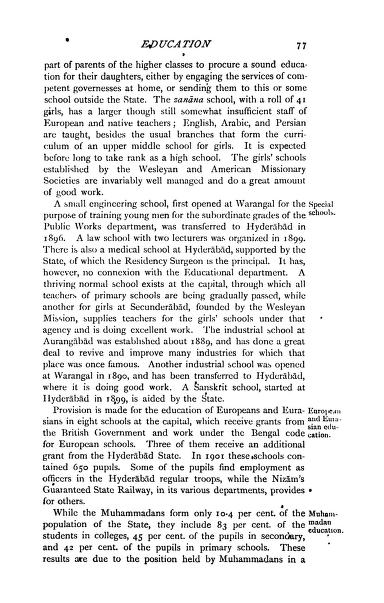
The institutional record starts in 1854 and it is not ambiguous. The Imperial Gazetteer of India's Hyderabad volume records that 'State education commenced in 1854, when a school called the Dar-ul-ulum was founded in the city of Hyderabad', that in 1859 orders went out 'directing that two schools, one Persian and the other vernacular, should be opened in each táluk, and one at the headquarters of each District', and that education stayed in the hands of revenue officials — 'and did not receive due attention' — until it was moved out in 1868 and given deputy-inspectors of its own in 1875 3. This is not a hostile source reconstructing the state's failings; it is a British compendium reproducing the state's own departmental history.
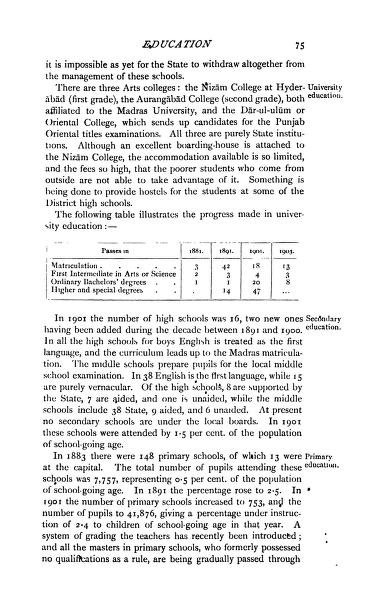
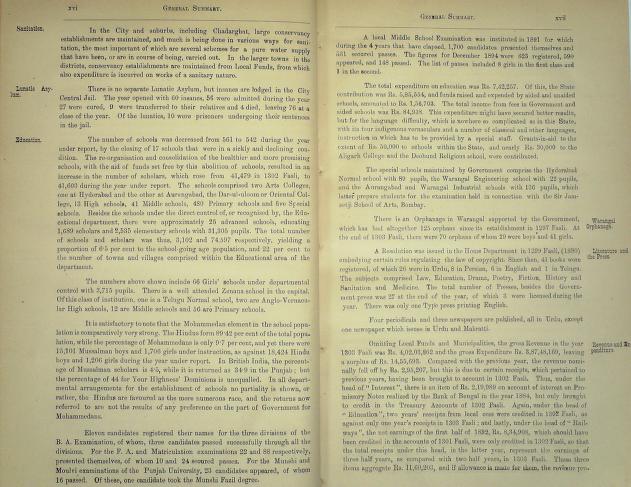
The growth figures from that period are small and they are the state's own. 'In 1883 there were 148 primary schools, of which 13 were at the capital. The total number of pupils attending these schools was 7,757, representing 0·5 per cent. of the population of school-going age. In 1891 the percentage rose to 2·5. In 1901 the number of primary schools increased to 753, and the number of pupils to 41,876, giving a percentage under instruction of 2·4 to children of school-going age in that year' 1. In 1893–94 the department directly controlled 542 schools with 41,603 scholars — the number of schools having fallen from 561 by the deliberate closure of seventeen 'in a sickly and declining condition' — alongside 25 advanced schools with 1,689 scholars and some 2,535 private elementary schools with 31,305 pupils. The report's 6·5 per cent of the school-going age population is computed on all three categories together, 3,102 schools and 74,597 scholars, not on the departmental schools alone 6.
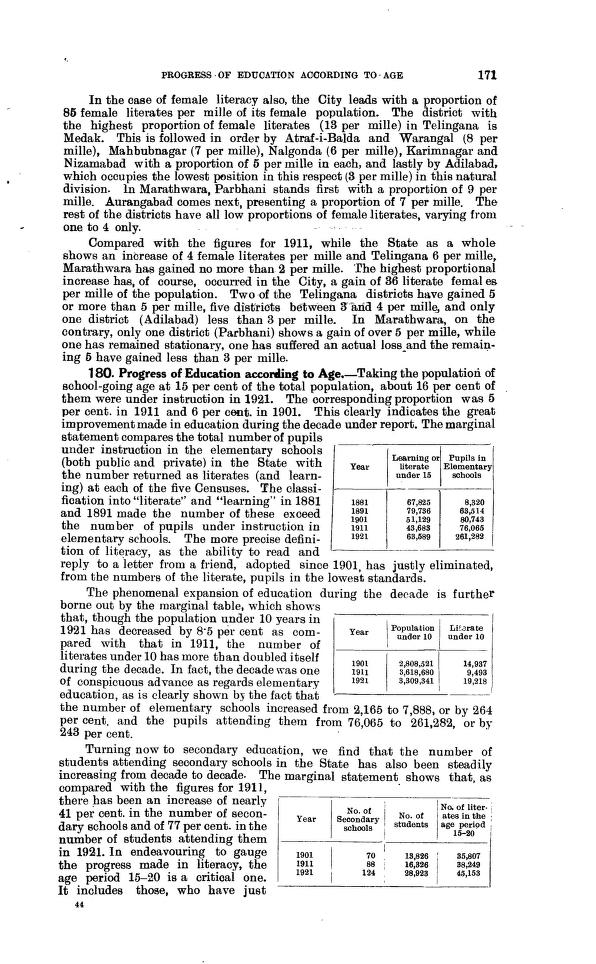
Then came the surge. The 1921 census: 'Taking the population of school-going age at 15 per cent of the total population, about 16 per cent of them were under instruction in 1921. The corresponding proportion was 5 per cent. in 1911 and 6 per cent. in 1901.' And: 'the number of elementary schools increased from 2,165 to 7,888, or by 264 per cent, and the pupils attending them from 76,065 to 261,282, or by 243 per cent' 8. That decade is the single strongest fact against the claim, and it is a primary one.
The signature act came under Mir Osman Ali Khan. The Registrar of Osmania University, writing an appendix to the 1931 census, reproduces the firman: 'The fundamental principle in the working of the University should be that Urdu should form the medium of higher education but that a knowledge of English as a language should, at the same time, be deemed compulsory for all students' 15. To make that possible the state first built a Bureau of Translation under Maulvi Abdul Haq with eight translators, which 'in the short space of five years completed the translation of nearly all the books required for the Matriculation, Intermediate, and B. A. Examinations'; by the end of 1339 Fasli it had published 148 books, with 71 more in translation and 66 in the press, and the terminology for them was coined by standing committees before the translators could begin 15. The College opened on 28 August 1918: 'The College started with 142 students on its rolls and in 1339 Fasli the number rose to 535' 15.
What followed is a full modern faculty structure: 'A College of Medicine was opened in Shahrewar 1336 Fasli (July 1927), an Engineering College and a College for the training of Teachers in 1338 Fasli (1929)' 15. The Nizamiah Observatory, founded 1908, passed to the university in 1919 and took part in the international Carte du Ciel, publishing six volumes of the Hyderabad Astrographic Catalogue and forwarding its seismograms to Oxford 15. The Dairat-ul-Maarif, publishing rare Arabic texts, received an endowment of one lakh in 1930 and four lakhs more in 1932, giving it an annual income of Rs 30,000 15. And 'although Urdu is the medium of instruction in the University and English occupies a secondary position, its degrees have been recognised by the Government of India for the I. C. S. and other Competitive Examinations' 15.
On the second half of the claim, the record is one-sided. A government that between 1330 and 1340 Fasli spent 'nearly three crores of rupees' on original road construction and another eighty-one lakhs on bridges and culverts, taking road mileage from 2,481 to 3,938 and cutting the area served per mile of road from about 33 square miles to 21 (arithmetic mine) 16, that raised education expenditure from Rs 53·06 lakhs to Rs 90·97 lakhs across the same decade 14, and that ran an observatory feeding an international astrometric survey, is not a state resisting the twentieth century. 'Opposed modernisation' is the weaker half of the claim and it does not survive its own sources.
The comparison the Nizam's own census printed
The decisive evidence for the claim's factual core is not nationalist and not retrospective. It is a table in the Nizam's own 1931 census. Section 125 of Chapter IX opens: 'Of the total population of the State, 50 persons per mille are literate in the sense of being able to write a letter to a friend and read a reply thereto.' It then concedes the comparison outright — 'But in comparison with some of the principal Indian States and British Indian Provinces, Hyderabad still ranks very low, as will appear from the following table' — and prints literate males per mille aged 5 and over for 1931: Travancore 408, Baroda 331, Madras 219, Bengal 188, Mysore 174, Bombay 149, C.P. & Berar 110, Hyderabad 85. On the female side: Travancore 168, Baroda 79, Mysore 33, Madras 25, Hyderabad 12 10.
Hyderabad was therefore at roughly one-fifth of Travancore's male literacy and half of Mysore's, in a comparison it published itself, in a volume presented to its own ruler. The direction of travel was upward but slow: the retrospective series in the 1951 census gives 3.0 per cent (1901), 2.8 (1911), 2.9 (1921), 4.1 (1931), 6.8 (1941) and 9.2 (1951) for the total population 17.
The internal distribution was as unequal as the external comparison. In 1921 the rate per mille aged 5 and over was 47 for Hindu males and 4 for Hindu females, against 140 and 35 for Musalman males and females, 308 and 188 for Christians and 399 and 35 for Jains 9. The state average was carried almost entirely by the capital: two sections further on, the census gives 331 per mille literate in Hyderabad City against 26 in Karimnagar and 29 in Adilabad 11, and warns explicitly that 'Eliminating Hyderabad City, the proportion of literacy in Telangana comes on a par with that in Marathwara' 10.
Sex was the sharpest cut of all. The Gazetteer's figure for 1901: 'the number of children under instruction is 6·1 per cent. on the school-going age population for boys, and only 0·5 for girls' 4. Fifty years later the 1951 census could report that female literates had grown from 18,883 in 1901 to 280,288 — a 1,384 per cent increase — and add, in its own exclamation mark, that 'in spite of this, the percentage of female literates is even now only 3.0 !' 17.
The 1941 figure, and why no single number is safe
The literacy percentage most often quoted for the end of the Nizam's rule is 9.3 per cent for 1941 31. It does not match either figure that the census volumes support, and the reason is documented at length in the census itself.
The 1951 Hyderabad census devotes an appendix to the problem. 'According to the provisional figures released in March 1941 immediately after the census enumeration, the total number of literates in the state was 1,111,245 consisting of 939,544 males and 171,701 females.' The final tabulation, published in 1947, counted 1,269,004, consisting of 983,478 males and 285,526 females. 'Thus, the final figures were in excess of the provisional figures by 14.2 per cent in case of the total literates, 4.7 in case of male literates and 66.3 per cent in case of female literates' 20. District by district the divergence is wilder still: female literates in Atraf-e-Balda up 229.2 per cent between the two counts, in Adilabad up 228.5 per cent, while male literates in Medak fell 23.4 per cent and in Nalgonda 20.2 per cent 20.
The 1951 Census Superintendent's verdict on his predecessors is unsparing. The major drawback in comparing the 1951 data with earlier censuses, he writes, is 'the exaggeration of the literacy figures at the 1941 Census'; 'the tables prepared in the Census Tabulation Office in 1941 suffer from serious discrepancies which render them of doubtful value', and the right course is 'ignoring the final figures altogether and confining the comparision to the provisional figures in so far as the 1941 census data are concerned' 18. That is why the 6.8 per cent in Table 15 carries a dagger and the footnote 'These percentages have been calculated on the basis of the 1941 provisional figures supplied by the District Census Staff. They are not as given in the 1941 Census Report' 17.
So the honest range for 1941 is 6.8 per cent on the provisional count the census preferred, or about 7.8 per cent on the final count it distrusted (arithmetic mine, on the final 1941 population of 16,338,534). Neither is 9.3. What 9.3 is, exactly, is the 1901 literacy figure for Hyderabad district in Table 16 of the same 1951 volume, printed two inches below Table 15 on the same page 17. Whether the school textbook figure descends from that neighbouring cell cannot be established from the sources opened here, and is offered as an observation rather than a derivation.
A further figure circulates for the same year and measures something else again. The secondary literature gives an enrolment rather than a literacy rate: 'In the first decade of the early twentieth century, the school enrollment rate in Hyderabad was 3.5 percent, which increased to 17.6 percent in 1941' 34. That sits within half a percentage point of the Director of Public Instruction's 17.3 per cent for 1339 Fasli, eleven years earlier 14 — so it either reports a decade-stale departmental figure or implies that enrolment barely moved between 1930 and 1941. Ghanta gives no source for it, and it is tier C. The point for a reader is that enrolment and literacy are different measures with different bases, and that a figure quoted to one decimal place for 1941 should not be used without naming the volume, the table and which of the two it is.
1921: the state stops expanding, and writes down why
The hinge of the whole question is what happened after the 1911–21 surge. Here the state convicts itself in its own words, three times, in the same volume.
The census literacy chapter gives the polite version: 'Prior to 1330 Fasli (1921 A.D.) the Government of H.E.H. the Nizam followed a policy of rapid expansion of primary education with the result that both the number of institutions and scholars more than trebled ; but subsequently the Department cared more for efficiency than number. It, therefore, overhauled the whole substructure by closing down unsuccessful and inefficient experimental primary schools and consolidating the remainder' 10. The Director of Public Instruction, given his own note in the appendices, sets out the same rationale in his own signed departmental account, and adds the demand he was refusing: 'In spite of this increase there was a demand for the opening of more schools, especially from the more advanced districts like Aurangabad, Nanded, Parbhani, Gulbarga, and Warangal. But, instead of further expansion in the number of schools, H.E.H. the Nizam's Government deemed it necessary first to consolidate and improve the very large number of Primary schools which had already been opened' 14.
Chapter I of the same census gives the reason neither of those passages gives. The schools were closed 'in pursuance of a policy of retrenchment of expenditure which the Department found itself compelled to follow on account of having to work under a departmentalized budget' 12. That is a budget decision, not a quality decision, and it is the state's own account of itself printed a few hundred pages from the version that calls it efficiency. Any reading of the 1921 halt has to reckon with the fact that the government published both.
The numbers bear out the policy. Across the decade 1330–1339 Fasli, primary institutions went from 4,126 to 4,028 while scholars rose from 1,98,503 to 2,39,526, and total direct expenditure on education rose from Rs 29,38,923 to Rs 58,59,247 14. College expenditure more than tripled over the decade, from Rs 2,61,278 to Rs 9,30,071, and secondary schooling roughly doubled; primary rose from Rs 13,52,430 to Rs 22,95,652 (arithmetic mine, on the department's own table). The growth rates favour the colleges heavily; in absolute rupees primary schooling still took the largest single share. The share of school-age children in school moved from 16.6 to 17.3 per cent in ten years 14.
On private schooling the accounts diverge, and the divergence is itself evidence. The DPI's version is benign: 'One natural result of this process was that the scholars in inefficient private schools began to take more and more advantage of these public schools and consequently a few unsuccessful experimental and private schools closed down. Private schools, as a matter of principle, are given every possible encouragement provided they are conducted on right lines' 14. The census chapter is more dismissive: 'A very large number of private schools of varying descriptions and size existed, but most of them, being of mushroom growth, died a natural death' 13. The development literature reads the same decade as coercion: 'The government imposed restrictions on establishment and funding of private school and denied permissions to voluntary efforts and even if village people come forward to set up schools', with private schools falling from 4,053 institutions and 76,654 pupils in 1920 to 929 and 25,865 by 1936, and 23 of Warangal suba's 25 taluqs without a middle or high school in 1936 27.
The 1920 baseline in that sentence is not the working paper's alone. The 1931 census's own Chapter I gives the identical pair: 'At the beginning of the decade there were 4,287 public schools with 234,505 pupils besides 4,053 private schools with a strength of 76,654 pupils' 12. It is the 1936 endpoint that rests on a Centre for Development Studies working paper and should be weighed accordingly. For comparison, the 1931 census's own count of private institutions at the end of 1339 Fasli is 1,040 with 29,277 pupils 13 — a collapse of the same order, on the state's own count, four years before the working paper's endpoint.
There is also a plain contradiction in the sources that nobody appears to have reconciled. For 1921 the census literacy chapter gives 7,888 elementary schools with 261,282 pupils 8; the Education Department's own returns for 1330 Fasli give 4,287 institutions of all grades with 2,34,505 scholars 14; and the 1931 census's summary of departmental figures gives 3,835 primary schools with 184,628 pupils for the same census year 13. The three counts are counting different things — enumerator returns of every place where instruction happened, versus recognised institutions, versus primary schools alone — and any argument that leans on the size of the 1911–21 expansion should say which one it is using.
The part of the state that never got any of this was the part the government did not administer. An education department return records 108 schools in the jagir areas against a state total of 5,131 — 2.1 per cent — with one school per 17 square miles in diwani territory and one per 231 square miles in jagir territory; a 1949 review counted 158 primary schools across 9,000 non-diwani villages and 33,000 square miles, leaving 98 per cent of those villages without one 27. The 1951 census, explaining why the state's own agricultural statistics could not be trusted, gives an incidental measure of how little reach the government had there: 'in some of the Jagir areas no honest attempt was ever made to implement them' 21.
The language rule, dated precisely
The strongest form of the claim is that Urdu was imposed to shut the majority out. The evidence supports a narrower and later statement than that, and the narrowing does not make it harmless.
Hyderabad had genuinely multilingual schooling before Urdu became the state language. 'There were, for instance, 162 educational institutions in 1880–81 out of which 105 were Persian-, 35 Mahratti-, 19 Telugu-, and 3 English-medium schools', and inspectors of schools 'were ordered to pass in the vernaculars of their district' 24. Salar Jung I told trainee settlement officers in January 1880 that 'Not to learn Mahratti therefore is to place yourselves outside the pale of official employment' 24. The shift to Urdu in administration was completed under Salar Jung II from 1884; the shift in education came later and in stages.
Osmania's founding memorandum met the obvious objection head-on — though the page has it at one remove, and the remove matters. Writing in 1933, the university's Registrar summarises Sir Akbar Hydari's founding memorandum thus: it was pointed out that 'although it was true that those whose mother-tongue is Urdu are in minority yet Urdu is the cultural and official language of the State and of polite society, and is generally spoken by those classes from which students proceeding to a college course are drawn' 15. Those are the Registrar's words, not demonstrably Hydari's: elsewhere in the same note he sets Hydari's direct utterances inside quotation marks and here he does not. Taking it as the Registrar's account of the state's own justification, it can be read two ways. Read one way it is a candid recognition that university entrants were drawn from a narrow social band. Read another, it is a decision to keep them there.
The decisive dates for schools are 1941 and 1944: 'from 1944 onwards all secondary schools used Urdu as the medium of instruction—until 1941, 363 out of 444 secondary schools used the mother tongue as the medium of instruction—though primary schools could still operate in the local languages' 22. So for most of the last Nizam's reign, four-fifths of secondary schools taught in the pupils' mother tongue; the blanket Urdu rule at secondary level belongs to the state's last four years. The Resident's assessment of the motive — Hydari's aim was 'to enforce a Muslim culture throughout the state and so strengthen the Muslim hold on Hyderabad in the event of Federation or independence for India in any other form' 23 — is the most damaging single sentence in this file, and it is the paramount power's own reading, not a nationalist one.
The specific claim that Telugu-medium school leavers were barred from Osmania 31 could not be verified against any admission regulation in the sources opened here, and is recorded as unverified. What can be shown is that medium of instruction was invoked as a ground for exclusion, and that it was applied unevenly. When Osmania expelled its Vande Mataram strikers, 'Madras and Mysore Universities refused to grant admission to the expelled students of Osmaniya University on ground that their medium of instruction differed' 28 — but Nagpur University's Vice Chancellor T. J. Kedar invited applications, and in January 1939 Nagpur and its affiliated colleges 'admitted all the expelled students of Osmaniya University, whoever had applied', with staff foregoing their summer vacation to make it possible; Jabalpur admitted students too 28. Two universities raised the barrier and two waived it, which is the precise shape of the difficulty rather than an absolute bar. Medium of instruction was also a live grievance inside Osmania, where students pressed 'the need for high school-level education in Indian languages such as Telugu, Kannada, and Marathi to be prioritised alongside Urdu and the inadequacy of resources for non-Urdu speakers at the primary school level' 30.
The 1938 crisis began not over Urdu but over a song. Osmania's hostels had had two prayer halls since early 1938, 'one for the Muslims and the other for the Hindus. The Muslim prayer hall was free from any restrictions, whereas the songs sung in the Hindu Prayer hall were subjected to scrutiny by the Government' 28. The trigger was at Aurangabad, where students of the Government Intermediate College refused to sing a song of loyalty to the Asaf Jahi house and sang Vande Mataram instead; the ban followed on 16 November 1938 and reached Osmania's prayer halls on 28 November 28. Numbers vary by source and should be given as a range: 350 struck off the Osmania University College rolls on 12 December 1938, with 70 from City College, 120 from a Mahbubnagar high school and about 1,200 statewide, on one account 28; 850 rusticated, 420 of them from the capital, on another 29. Neither has been traced to a state record, and both are tier C. The same standard is applied here as to the endowment figures below, which run the other way politically: a number that damages the state is not admitted on weaker paper than a number that flatters it. The direction of events, as distinct from the count, is not in doubt: the government stopped the strikers' scholarships and fee concessions and threatened them with consequences for future employment 28.
Who the schools were for — and what the state paid for elsewhere
Any account of Hyderabad's schooling that stops at the aggregate literacy figure misses the composition, which is where the state's priorities are legible.
Muslims were about a tenth of the population and close to half the school population. The 1893–94 administration report puts it approvingly: the Hindus form 89.42 per cent of the population and Mohammedans 9.7 per cent, 'and yet there were 15,101 Mussalman boys and 1,706 girls under instruction, as against 18,424 Hindu boys and 1,206 girls'; against 4.5 per cent in British India and 34.9 in the Punjab, 'the percentage of 44 for Your Highness' Dominions is unequalled' 6. Then the pre-emptive defence, which overshoots: 'In all departmental arrangements for the establishment of schools no partiality is shown, or rather, the Hindus are favoured as the more numerous race, and the returns now referred to are not the results of any preference on the part of Government for Mohammedans' 6. A state report in 1894 that not only denies preference but claims the opposite preference — while printing figures showing a Muslim scholar share four and a half times the Muslim population share — is the earliest attestation of the grievance the claim now carries. The Imperial Gazetteer, unbound by that need, states the explanation directly: 83 per cent of college students, 45 per cent of secondary and 42 per cent of primary pupils were Muslim, and 'These results are due to the position held by Muhammadans in a State of which the ruler belongs to their religion' — adding, with some relish, 'It is noticeable that the Hindus are more successful in examinations, proportionately to their numbers, than the Muhammadans' 2.
Caste ran through the system as visibly. The Director of Public Instruction, describing his own department's provision for the depressed classes in 1930, writes that 'the children of these classes are admitted to many secondary schools although their seats have to be arranged separately. They are admitted to some Primary schools also but they are seated separately', and that ninety-seven separate schools with 4,005 pupils had been opened for them 14. The Gazetteer had recorded thirty years earlier that 'The schools throughout the State are open to children of all castes without distinction ; but in practice few of the lower classes avail themselves of the permission, partly owing to the prejudices of the higher castes', with 23 boys of aboriginal tribes and 626 outcastes at school in 1901 5.
Against this sits a real and documented pattern of state money going to institutions of other faiths. Karen Leonard's study of Hyderabad's Hindu temples, built from Persian and Urdu archival material and the state's own publications, finds that the head of the Ecclesiastical Department 'gave out cash grants to individuals and money for mosque construction and repair and the dispatch of hajis to Mecca; state money went to Hindus and their institutions as well' 25, and that 'Up until the end of the state in 1948, the state administration continued to fund and supervise important Hindu institutions and events, and it publicly proclaimed its role in the face of increasingly communal politics both within and outside the state' 26. The 1943 government publication she describes lists the Sitaram Bagh temple with a jagir of nearly Rs 50,000 a year, the Kishen Bagh temple at Rs 18,000, the Jham Singh temple at Rs 8,408 from the third Nizam, and the math of Baba Khaim Das at Rs 11,521 26. This is patronage of a patrimonial and supervisory kind rather than a policy of educational equity, and Leonard reads it partly as the state advertising composite legitimacy at the moment that legitimacy was under threat — but it is real, it is archival, and a claim that the Nizam's government was uniformly hostile to non-Muslim institutions cannot survive it.
The most-cited gifts, however, are the ones with the weakest paper — and they are held to exactly the standard applied above to the expulsion counts. A Hyderabad newspaper reproduces photographs of farmans and reports Rs 10 lakh to Banaras Hindu University, Rs 1 lakh to the Indian Institute of Science and Rs 5 lakh to Aligarh 33. That is the only version of these figures traced here to any named source; other sums circulate, but this page has not identified who published them or on what authority, and they are therefore not repeated. None of the three has been traced to an archival reference, a university record or a scholarly work. They should be treated as press claims, not as a figure — the same disposition given to the 350/1,200 and 850/420 expulsion counts, which likewise rest on untraced secondary reports.
The claim that compulsory primary education was the Nizam's own concept is carried in the press on the authority of a named historian but without a firman or an act 32, and stands against compulsory primary education being introduced in Hyderabad only in 1952, four years after the state ended, and against the development literature's statement that compulsion 'was made possible only after the independence' 27.
Put together, the record does not support 'the Nizam opposed education'. It supports something more specific and, on the distributional question, worse: a government that built a research university, a translation bureau, an observatory and four professional colleges for the classes 'from which students proceeding to a college course are drawn' 15; that in 1893–94 spent under two per cent of its expenditure on education and sent three-fifths of its internal grant-in-aid budget to Aligarh and Deoband instead 7; that in 1921 chose consolidation over expansion, said so in print, and recorded elsewhere in the same volume that the real driver was retrenchment under a departmentalised budget 1012; that left a quarter of its territory to jagirdars who built almost nothing 27; that made Urdu the medium of every secondary school in 1944 22; and that expelled hundreds of its own students in 1938 for singing 28. That is a coherent charge sheet, and it can be laid without a claim about the ruler's opinion of learning — which is the one part of the story for which no document has been found.