Claim examined

Is Dakhni a distinct language, or a dialect of Urdu?

Two different questions travel under one label. Is Dakhni structurally far enough from Urdu to count as a separate language? And is Dakhni older than, and independent of, standardised northern Urdu? The second is answerable and the answer is largely yes. The first has never been measured by anything opened for this page — the unanimity of the reference works is an inheritance, not a measurement — and the best evidence against the classification, a convergence literature that none of those reference works engages, was itself not opened here. The claim as it circulates states a taxonomic conclusion the evidence will not carry; this page cannot state the opposite conclusion either.

The claim, as it circulates

Dakhni (Deccani) is a language in its own right — its own grammar, its own phonology, its own literature reaching back to the fifteenth century. Calling it "a dialect of Urdu" or "Hyderabadi Urdu" or "Hyderabadi Hindi" is a demotion imposed from the north. (A stronger form — that Dakhni is older than Urdu and not derived from it at all — circulates informally, but it was not found stated in any source opened for this page, and it is not treated below as part of the claim.)

Contested

Every published classification opened for this page files Dakhni as a variety of Hindostani/Urdu — but none of them measures the distance. No intelligibility test, feature-distance metric or lexicostatistical count for Dakhni against Standard Urdu was found in any source opened here, so "structurally one language" is an inference from inherited taxonomy rather than a finding. Against that inheritance stands a documented case of contact-induced convergence reaching the genitive, the pronoun system and the finite verb — which the classification literature opened here has never weighed. The chronology in the claim is right and is not seriously disputed: the Deccan corpus and the name Dakanī precede the name "Urdu" by roughly three centuries, and Dakhni was an elaborated literary standard that was later de-standardised by administrative replacement. The taxonomic question is open, and the strongest scholarly statements of the separate-language position were not read for this page.

Draft. This entry is an unreviewed first draft. It has not yet been checked by a subject reviewer — see sources and method.

What is true here

The part of the claim the record does support, stated before the part it does not.

The divergences are not only lexical. They reach the pronoun system, case alignment and finite verb morphology — the domains comparative linguistics normally treats as diagnostic.
Dakhni has two honorific levels rather than three and does not use āp at all; it has an exclusive/inclusive contrast in the first person plural (ham logāñ vs apan/apal logāñ) that Hindi and Standard Urdu lack; and it has undergone what Arora and Subbarao called "dativisation", "losing the genitive structures that are common in both Hindi and SU" 19. Sharma's list adds agglutinated auxiliaries, tumhārā for apnā, honā for cāhie, and a quotative bolke/karke calqued on Telugu -ani 21. The features Casadei describes are those of Dakhni "as it is spoken in Rayalaseema, in Andhra Pradesh" — the Telugu-converged sub-variety, not Dakhni at large 19.
Nobody opened for this page has measured the structural distance. The classification consensus is inherited, not tested.
Grierson's nesting of Dakhinī under Urdū 2, Glottolog's bare level label 22, the encyclopaedia infobox 30 and Casadei's opening sentence 19 agree — and descend from one another. No intelligibility testing, feature-distance metric or lexicostatistical count appears in any of them. Meanwhile the literature that would bear most directly on the question is a convergence literature — Arora and Subbarao, "On extreme convergence: the case of Dakkhni Hindi-Urdu" (1988); Pray, "Evidence of grammatical convergence in Dakhni Urdu and Telugu" (1980) — and none of the classifying sources engages it 20.
The chronology in the claim is right, and is the strongest thing in it. The Deccan corpus is older than the word "Urdu".
Faruqi's naming sequence puts Dakanī among the early names of the language now called Urdu, and "'Urdu' as a name for the language seems to occur for the first time around 1780" 1011. Fakhr-e Dīn Nizāmī, dated "fl.1434", "wrote in the Deccan" 12. "Dakhni is a late corruption of Delhi Urdu" is chronologically impossible.
"Corrupt Urdu" is rejected by the very colonial survey usually cited for the dialect classification — and rejected on chronological grounds, not out of politeness.
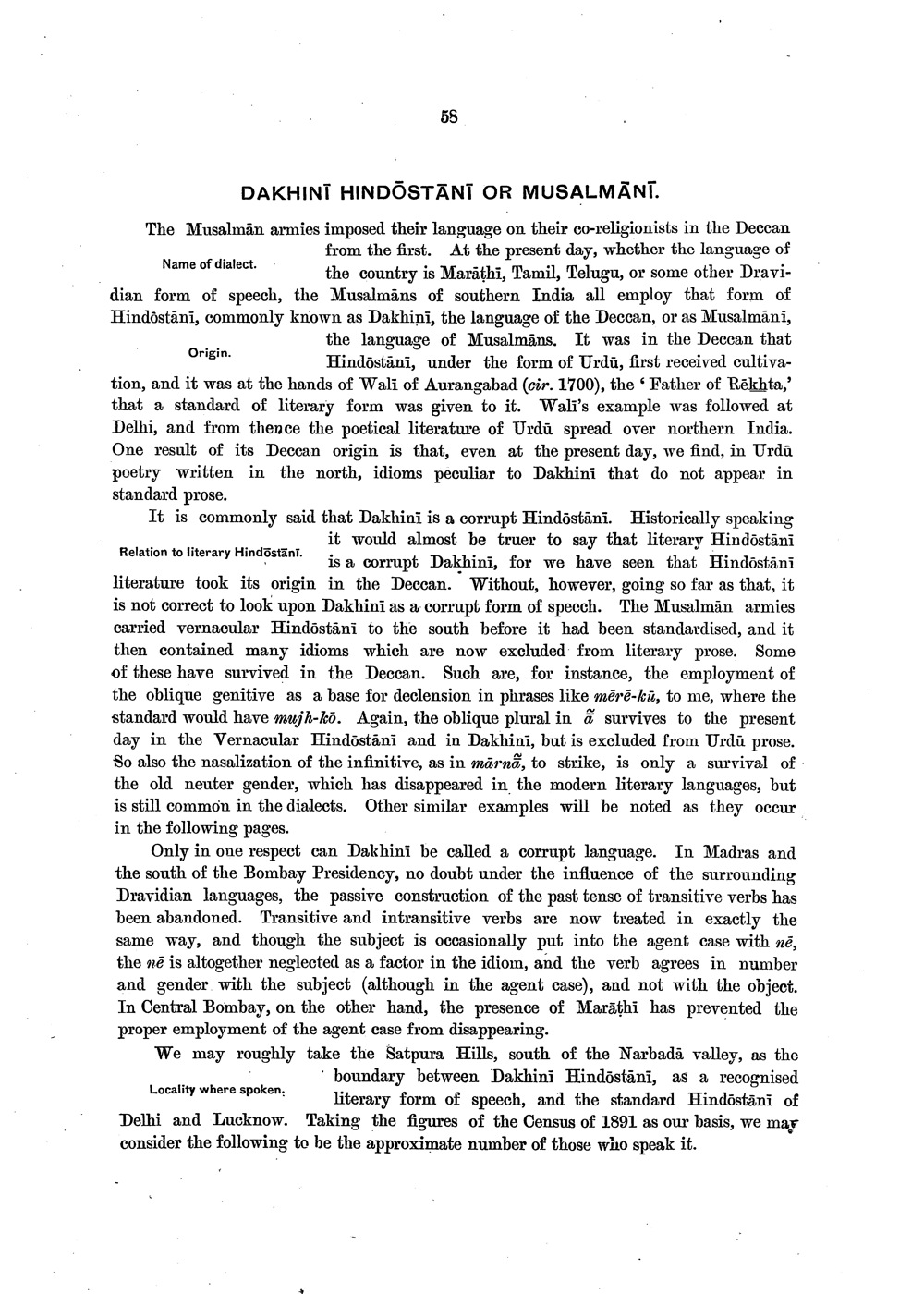
Grierson: "It is commonly said that Dakhinī is a corrupt Hindōstānī. Historically speaking it would almost be truer to say that literary Hindōstānī is a corrupt Dakhinī, for we have seen that Hindōstānī literature took its origin in the Deccan" 3. On the same page, however, Grierson dates literary cultivation to "Walī of Aurangabad (cir. 1700)" — post-dating the whole Qutb Shahi and Adil Shahi corpus, and reproducing the Delhi canon he is otherwise refusing 312.
The archaic-retention argument is documented in the colonial reference works themselves, not a modern invention.
The Imperial Gazetteer of 1907 records that Dakhinī Hindostānī "differs somewhat from the modern standard of Delhi and Lucknow, and retains several archaic features which have disappeared in the north" 7. Grierson gives the mechanism: the armies "carried vernacular Hindōstānī to the south before it had been standardised, and it then contained many idioms which are now excluded from literary prose. Some of these have survived in the Deccan" 3.
Dakhni was an elaborated literary standard in its own right and was then de-standardised by administrative replacement. On Kloss's own criterion that is a demotion, not a description.
Wajhī's Sab Ras, edited by Maulvi Abdul Haq and published by the Anjuman-i Taraqqī-yi Urdū in 1932, is standardly described as the earliest work of Urdu literary prose 34; Zore's edition of Muhammad Qulī Quṭb Shāh's Kulliyāt appeared in 1940 35. The dismantling is documented: under the Nizams "the Urdu chosen as the language of the state was the northern variant spoken in Delhi", and in 1919 Osmania University took Northern-Urdu as its medium of education, "limiting or even eradicating" Dakhni's use in the official public domain 19. Elaboration that was destroyed by administrative replacement is not elaboration that never happened.
High literary Dakhni was hard even for Deccan readers a hundred miles away. The intelligibility argument has a real limit — but not the one usually drawn from it.
Shafīq Aurangābādī — whom Faruqi identifies as "a major historian, poet and tazkirah writer of the South" 15 — wrote of the Bijapuri poet Nusratī that his poems come "heavy on the tongue because of their being in the mode of the Dakanīs", with Faruqi adding that "Hasan Shauqī's poetry is comparatively gentler on the Aurangabadi ear" 16. That is an Aurangabadi judgement on Bijapur, not a northern demotion: it is evidence of internal distance within the Deccan itself.
The code registries have not carefully assessed Dakhni either way, so "the classification systems never examined it" is closer to true than to false — and that cuts against using them as authorities.
No ISO 639-3 code is assigned to Dakhni 3022, and the code dcc, named "Deccan" 24, is mapped by Glottolog to Deccan Marathi with the comment that "this entry is spurious either as the Marathi variety or as Dakkhini Urdu" 23. Glottolog's own Dakhini entry carries the level label Dialect but no bibliography-backed comment, and links to the article "Hyderabadi Urdu" — the sub-variety Casadei identifies as the one that "shows more resemblance to the Standard Urdu" 2219.

One label, two questions — and one of them has never been measured

The argument is unresolvable as stated because two questions are being answered at once. The first is structural distance — what Kloss called Abstand, "a language variety or cluster of varieties with significant linguistic distance from all others". The second is social elaboration — Ausbau, "a standard variety, possibly with related dependent varieties" 28. Kloss's 1967 article was not opened for this page; the definitions here come from a Tier-C encyclopaedia entry, and nothing below turns on any finer reading of his framework than those two sentences will bear 2928.

An earlier version of this page answered the Abstand question by counting authorities, and that was the same category shift it convicts the claim of. Abstand is a measurement — feature distance, lexicostatistics, mutual intelligibility — and Kloss devised it precisely to be capable of overriding inherited taxonomic labels. What the authorities supply is inherited taxonomy. Grierson's nesting of Dakhinī under Urdū 2, Glottolog's level field 22, the encyclopaedia infobox 30 and Casadei's opening classification 19 agree with one another and descend from one another. No source opened for this page reports an intelligibility test between Dakhni and Standard Urdu, a feature-distance metric, or a lexicostatistical count. On the Abstand question the honest report is that it has not been measured here, and that the unanimity is an inheritance rather than a result.

On the Ausbau question the answer is historical, and the tense does the work. Dakhni was an elaborated court and literary language in the Deccan before Delhi's Rekhta poetry existed 101219. It is not one now, and the record names the mechanism: under the Nizams Urdu replaced Persian in the courts and administration, but "the Urdu chosen as the language of the state was the northern variant spoken in Delhi", and in 1919 the foundation of Osmania University with Northern-Urdu as its medium "led to the further segregation of Dakhni to the non-official sphere, limiting or even eradicating its use in the official public domain" 19. Under Kloss's criterion elaboration is what makes a variety a language; de-standardisation by conquest and administrative substitution does not retroactively unmake the elaboration that occurred. The Ausbau answer is therefore yes-then-no. Stating only the present tense — "it is not an elaborated standard now" — reports the demotion as though it settled the question, and it does not.

There is a third question underneath both, and it is the one the popular claim answers correctly: is the Deccan's literature older than standardised northern Urdu? It is, by centuries 1011. The claim takes that chronological answer and reports it as a taxonomic one — but this page's own taxonomic answer has to be stated as an inference, not a finding.

What the reference works actually record

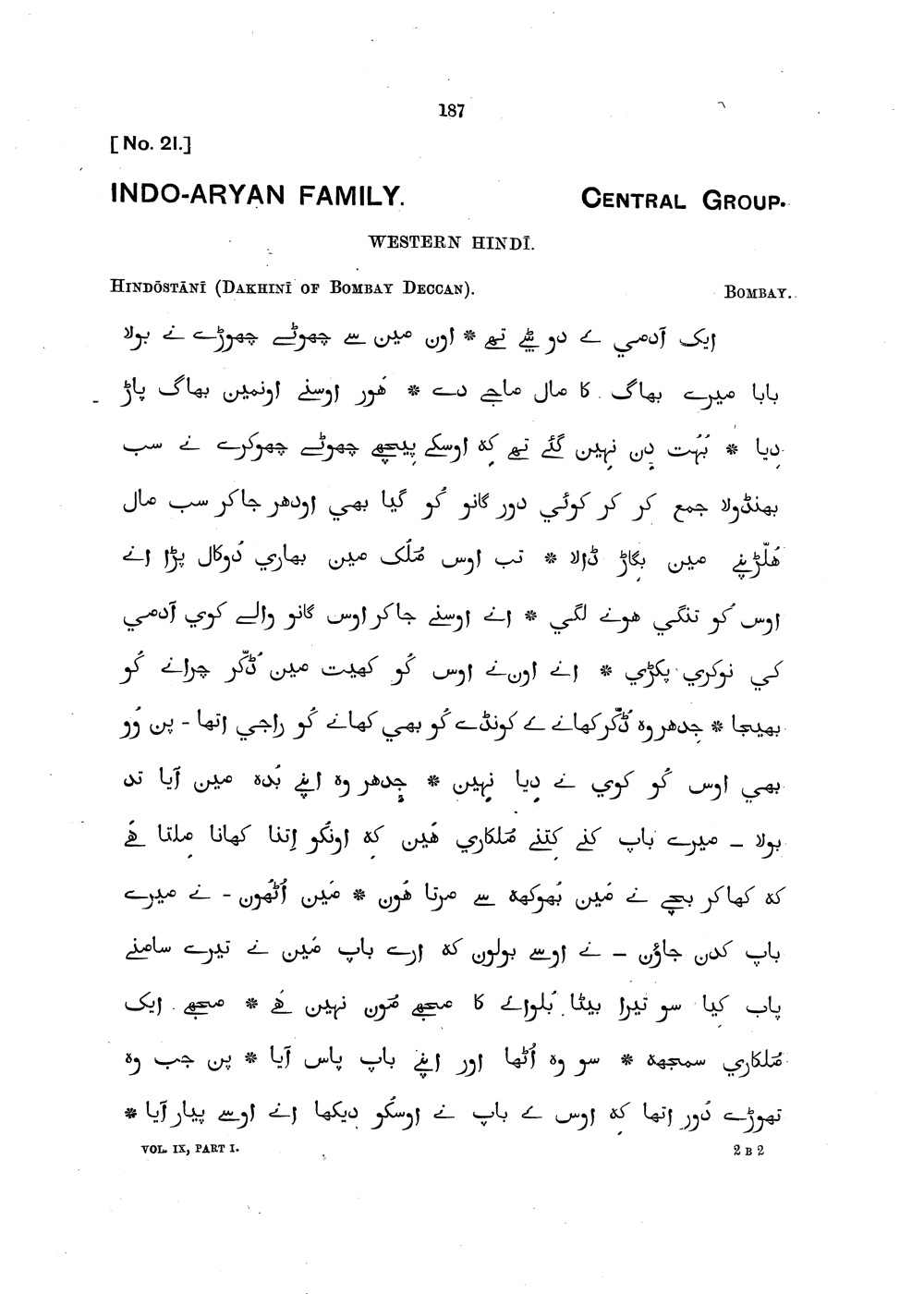
The classification most often cited against Dakhni is Grierson's. Volume IX Part I of the Linguistic Survey of India — title page dated 1916, in the volume titled Specimens of Western Hindī and Pañjābī 1 — states on its first page: "Urdū, itself, has two varieties, the standard literary form of Delhi and Lucknow, and the Dakhinī, spoken, and used as a literary medium, by Musalmāns of Southern India" 2. The nesting is explicit on the same page, where the returns are broken out as "Hindōstānī— Local Vernacular 5,282,733 / Literary Hindōstānī (including Urdū and Hindī) 7,696,264 / Dakhinī 3,654,172" 2. The section devoted to it is headed "DAKHINĪ HINDŌSTĀNĪ OR MUSALMĀNĪ" 3, and the specimen text is headed "INDO-ARYAN FAMILY. CENTRAL GROUP. WESTERN HINDĪ. HINDŌSTĀNĪ (DAKHINĪ OF BOMBAY DECCAN)" 6.

Anyone re-checking these pages should note that the title page reads 1916 while some library metadata attached to the scan gives 1907 1; the earlier date belongs to other volumes and to the Imperial Gazetteer.

The nineteenth-century surveys say the same thing in weaker terms. Cust in 1878: "Taking the Hindustáni of Dehli as the standard of purity, we have in Southern India another variation in the so-called Dekhani, and it is admitted, that there are points of difference in it from the Northern Lingua-franca" 8. The Imperial Gazetteer of 1907 adds the archaism observation and, notably, the Deccan's priority: "and here Urdū literature took its rise. 'Dakhinī Hindostānī,' as it is called, differs somewhat from the modern standard of Delhi and Lucknow, and retains several archaic features which have disappeared in the north" 7.

The modern catalogue agrees. Glottolog files dakh1244, "Dakhini (Urdu)", with the explicit level label Dialect, under Urdu, with no ISO 639-3 code shown 22. What none of these four records contains is an argument, a measurement, or a bibliography addressed to the question. They are consistent with each other; consistency among descendants of a single nineteenth-century classification is not independent corroboration.

Grierson's argument runs against the "corrupt Urdu" framing — and against his own chronology

The page that classifies Dakhni as a variety of Urdu is also the page that refuses the hierarchy usually smuggled in with that classification. "It is commonly said that Dakhinī is a corrupt Hindōstānī. Historically speaking it would almost be truer to say that literary Hindōstānī is a corrupt Dakhinī, for we have seen that Hindōstānī literature took its origin in the Deccan. Without, however, going so far as that, it is not correct to look upon Dakhinī as a corrupt form of speech" 3.

The reason given is chronological, not sentimental: "The Musalmān armies carried vernacular Hindōstānī to the south before it had been standardised, and it then contained many idioms which are now excluded from literary prose. Some of these have survived in the Deccan. Such are, for instance, the employment of the oblique genitive as a base for declension in phrases like mērē-kū, to me, where the standard would have mujh-kō" 3.

That passage is the single most useful thing to put in front of a reader who believes the colonial survey settled the hierarchy. But Grierson's chronology, on the same page, is wrong by roughly 270 years, and an earlier version of this page suppressed the fact. Immediately before the anti-"corrupt" passage he writes: "It was in the Deccan that Hindōstānī, under the form of Urdū, first received cultivation, and it was at the hands of Walī of Aurangabad (cir. 1700), the 'Father of Rēkhta,' that a standard of literary form was given to it" 3. That date post-dates the entire Qutb Shahi and Adil Shahi corpus — Fakhr-e Dīn Nizāmī at fl.1434, Muhammad Qulī Quṭb Shāh, Wajhī 12. Grierson refuses the derivation hierarchy and then dates Deccan literature from the one Deccan poet whom Delhi's tazkirah tradition had canonised, which is the hierarchy operating in another register.

So Grierson is a good witness against "corrupt Urdu" and a bad witness on when Deccan literature begins. The accurate formulation is not his 1916 sentence but Faruqi's, which puts Gujrī, Dakanī and Rekhtah on a level as regional names of one language 17.

The differences, stated in full

Conceding a shared core does not require minimising the divergences, which are substantial. One scoping note first, because it changes how far the inventory generalises. Casadei's descriptive section states its object explicitly: "some salient syntax features of Dakhni as it is spoken in Rayalaseema, in Andhra Pradesh" 19. Following Mustafa (2008), she records that Andhra Dakhni splits between the Rayalaseema variety, "which has features imported from Telugu", and the Telangana variety, "called Hyderabadi Urdu, which shows more resemblance to the Standard Urdu" 19. Everything below is drawn from the most Telugu-converged sub-variety described in the article, and should be read as such.

On phonology: "Although it generally shares with Standard Urdu (SU) the same sound system, it presents the aspirates /mh/, /lh/, /rh/, /vh/ and /yh/ and the nasal and lateral retroflex phonemes, /ṇ/ and /ḷ/" 19.

On pronouns, the system itself is restructured: "Rather than the three-level pronominal system present in Hindi and SU (tū, tum, āp), Dakhni instead presents a two-level hierarchy: tu... and tūme... The honorific form āp is not used in Dakhni" 19. There is a clusivity contrast — exclusive ham logāñ against inclusive apan/apal logāñ — which Hindi and Standard Urdu do not have 19.

On case, the genitive has been eaten by the dative: "Arora and Subbarao (1993) observed that the Dakhni language went through a process of 'dativisation', losing the genitive structures that are common in both Hindi and SU" 19, as in kā ku jāre? 'Where are you going?' 19. (The reference is to Arora and Subbarao; Casadei's own bibliography carries only their 1988 paper, not a 1993 one 20.) On the verb there are categories with no Hindi-Urdu equivalent: a "habitual present-cum-future (maiñ jātũ)", a permissive-imperative in -ñde, and a relative adjectival participle in -so (maiñ bolya so bāt, suno!) 19.

A second description points the same way, with a heavy caveat about its standing. Reporting Vashini Sharma's chapter, Ferro lists features that make Dakhinī "resemble Telugu more than Urdū/Hindī": "the use of the ergative particle ne does not follow the rules of Standard Hindī"; "Dakhinī is 'degenitivising' for a dativisation"; "the use of short versions of emphatic particles, such as hī, bhī, to, which are -ī, -īṁ in Dakhinī"; agglutination of the auxiliary (rahā + hai > rā / ray / raiṁ); honā for cāhie; the Marathi forms हौ (which Ferro transliterates hai) and नको nako; and the quotative bolke / karke "calqued from the Telugu form -ani" 21. This is second-hand, and worse than second-hand: Ferro states that Sharma's chapter "is unfortunately just a draft, since Sharma passed away before the publication of the volume" and that "the conclusions of this paper are absent" 21. An unfinished posthumous draft, reported in a review, does not converge with anything; it points the same way, which is a weaker thing.

One widely repeated feature was wrongly dismissed in an earlier version of this page and is restored here. The emphatic -ič is not attested in either academic article opened for this page, but it is not unattributed: an encyclopaedia entry records "suffix -ich [it͡ʃʰ] (mai idharich hũ)" against standard hī, as an "Emphasis marker", with the note that "Matthews comments that this is 'probably from Marathi'" — referring to Matthews's 1976 London dissertation on Dakhani language and literature 3020. Ferro/Sharma's short emphatics -ī/-īṁ are a different item, about the shortening of hī, bhī and to; they neither exclude nor compete with a separate borrowed clitic, and the earlier version's "instead" was a non-sequitur. A borrowed emphatic clitic displacing inherited hī is core-grammar borrowing of exactly the kind that bears on structural distance. It is recorded here at Tier C, and confirming it means opening Matthews 1976, which was not done.

That correction generalises into a warning about this page's own method. Verifying only what could be opened produces false negatives on every feature whose primary literature was not reached, and the verified-only method is doing heavy work in the verdict below. "Not in the sources opened here" is not "not in the literature", and the earlier version reported one as the other.

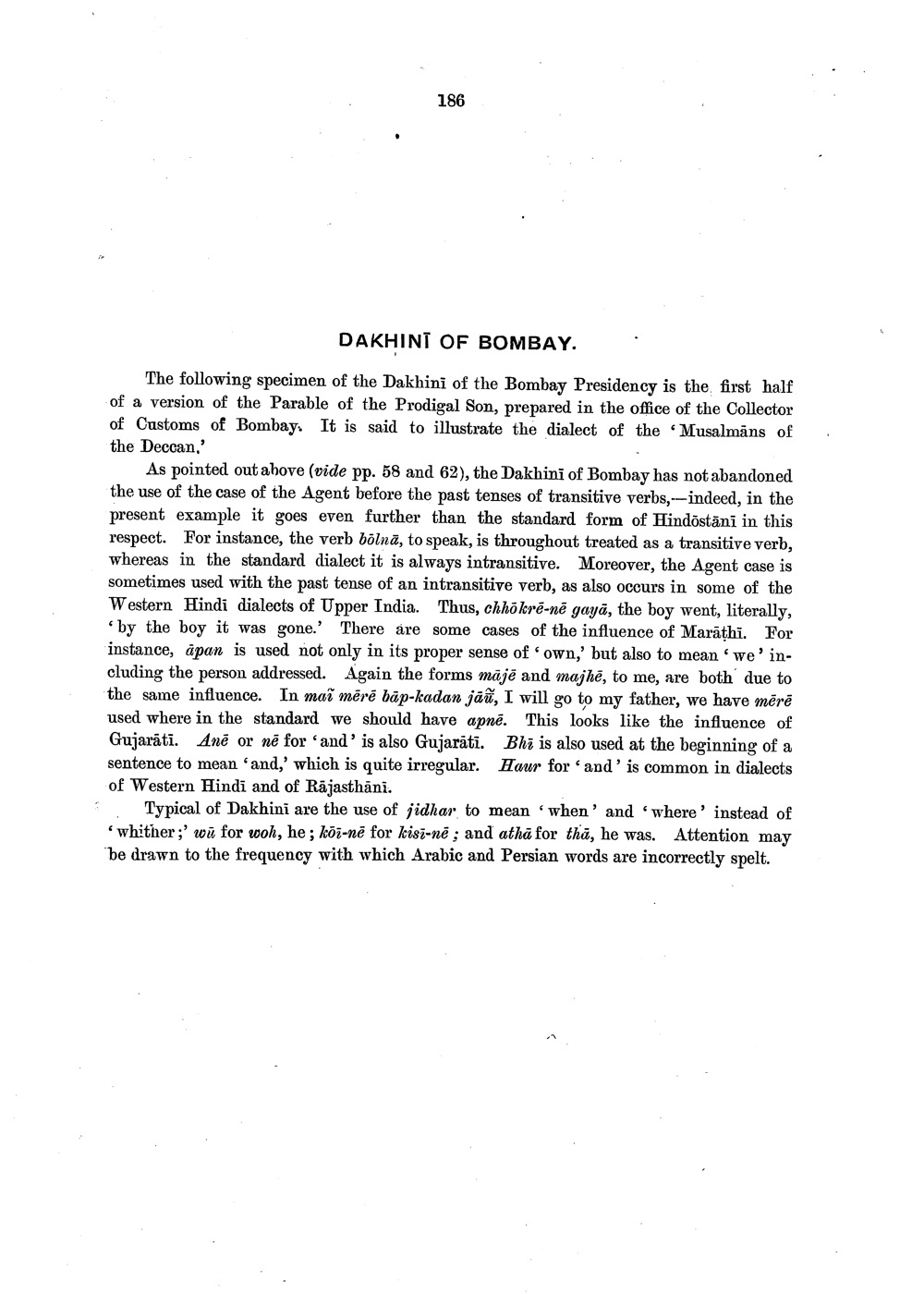
Grierson's 1916 specimen headnote catches part of the same picture, with his own hedge attached. The specimen was "prepared in the office of the Collector of Customs of Bombay" and "is said to illustrate the dialect of the 'Musalmāns of the Deccan'" — an office translation exercise, not field data 5. The headnote reads: "Typical of Dakhinī are the use of jidhar to mean 'when' and 'where' instead of 'whither;' wŭ for woh, he; kōĭ-nē for kisī-nē; and athā for thā, he was" 5.

Convergence, and what it does to the shared-architecture claim

An earlier version of this page said the differences "sit inside a shared postpositional, participial and lexical architecture". That sentence is falsified by the sources cited two paragraphs above it, and it is withdrawn. The genitive postpositions are being lost to dativisation; the pronominal system is reduced from three honorific levels to two and gains a clusivity contrast; the finite verb acquires categories with no Hindi-Urdu equivalent; the reflexive possessive apnā is reported replaced by tumhārā; the conjunctive participle is joined by a Telugu-calqued quotative 1921. Those are the postpositional, pronominal and participial systems — precisely the domains named as the shared core.

What survives as genuinely shared is narrower and should be stated at its real size: the Perso-Arabic script, the Indo-Aryan core lexicon, the postpositional rather than case-inflecting typology, and enough shared morphology that Delhi could read a Deccan dīvān in 1720 without a translator 14. That is real. It is less than "one architecture".

The frame the descriptive literature itself uses is convergence, and this page never used the word. Casadei: "The special linguistic situation in South India favored the bidirectional convergence of Dakhni towards Dravidian languages, e.g., Telugu" 19. Her bibliography is a convergence bibliography: Arora and Subbarao, "On extreme convergence: the case of Dakkhni Hindi-Urdu" (1988); Pray, "Evidence of grammatical convergence in Dakhni Urdu and Telugu" (1980); Mustafa's 1985 Aligarh dissertation and his 2008 encyclopaedia article on Dakkhni 20. None of these was opened for this page; the bibliographic details are transcribed from Casadei's reference list, which was read 20. The earlier version cited Arora and Subbarao once, for dativisation, and left the title of their paper out.

Stated at full strength, the case against the classification is this. Dakhni is one of the standard South Asian examples of contact-induced structural convergence; the affected domains include core grammar rather than lexicon and colour; and no classifying source opened for this page has weighed that convergence against its own classification. Glottolog's Dialect label carries no supporting comment 22. Grierson wrote before the convergence literature existed. Casadei describes the convergence and files Dakhni as a variety of Urdu in the same article without reconciling the two 19. A classification that has never been tested against the strongest evidence available against it is a convention in good standing, not a finding — and that is the reason this page's verdict is contested rather than settled.

The contact literature also disagrees with itself about which neighbour did the work, and nothing opened here resolves it. Casadei says the borrowed words and grammatical features came "from Marathi and, to a smaller extent, local Dravidian languages, e.g., Kannada and Telugu" 19. Ferro, reporting Sharma, gives features that "make Dakhinī resemble Telugu more than Urdū/Hindī" 21. Matthews, at second hand, "states that Dravidian influence was much less" than Marathi 30. Sharma's is the single most damaging formulation on this page for the position it argues, and it deserves an answer rather than a listing. The answer available from here is partial and should not be mistaken for a refutation: the claim is about a set of syntactic features, not about the script, the noun morphology or the core lexicon; it is asserted in a review of an unfinished posthumous draft whose conclusions are missing 21; and the varieties in question are the Telugu-converged ones, which Casadei and Mustafa distinguish from the Telangana variety that "shows more resemblance to the Standard Urdu" 19. Those qualifications reduce the claim's reach. They do not dispose of it, and no source opened here does.

The chronology, where the claim is strongest

The load-bearing evidence for the claim's historical half is Faruqi's account of the names: "Early names for the language now called Urdu were Hindvī, Hindī, Dihlavī, Gujrī, Dakanī, and Rekhtah, more or less in that order, though until about the middle of the nineteenth century Dakanī continued to be the name for the form of the language used in the Deccan" 10. On Faruqi's account Dakanī is not the name of a different language; it is an older name of the same one. That account is itself a position in a live dispute, which the transmission section below states rather than hides.

"'Urdu' as a name for the language seems to occur for the first time around 1780" 11. Before that the term meant something else: "The name 'Urdu' seems to have begun its life as zabān-e urdū-e mu'allā-e Shāhjahānābād (the language of the exalted City / Court of Shāhjahānābād, that is, Delhi). It originally seems to have signified Persian and not Urdu" 11.

Against that date, the Deccan corpus is very old. Fakhr-e Dīn Nizāmī is dated "fl.1434", writing "in the Deccan" 12. His surviving work is the masnavī Kadam Rāo Padam Rāo, edited by Jamīl Jālibī; neither the text nor Jālibī's edition was opened for this page, and no date for it is asserted here beyond Faruqi's "fl.1434" 42. Wajhī's Sab Ras was edited by Maulvi Abdul Haq and published by the Anjuman-i Taraqqī-yi Urdū in 1932, and is standardly described as the earliest work of Urdu literary prose 34. Zore's edition of Muhammad Qulī Quṭb Shāh's Kulliyāt appeared in 1940 35. Two figures asserted in an earlier version of this page — a page count for the Kulliyāt, and edition details for Sab Ras including a note dated 2 January 1953 — could not be confirmed against any scan and are withdrawn.

One correction the claim usually needs. Dakhni is not the oldest stratum of this literature. Faruqi puts the first substantial surviving corpus in Gujarat: "The first person whose Hindvī survives in substantial quantity, and with whom Urdu literature can seriously be said to begin, is Shaikh Bahā ud-Dīn Bājan (1388-1506)" 12. Gujri and Dakani are siblings, not parent and child — which is exactly Faruqi's point when he writes that Valī "showed conclusively, and for all time, that Rekhtah / Hindī was capable of great poetry, just as Gujrī / Hindī and Dakanī / Hindī were, at their best" 17. All three names carry the same second element. This correction bites against a Deccan-primacy stronger than the exemplar quoted on this page actually states 32; it is offered as a limit on the claim's strong form, not as a refutation of its stated one.

The 1720 test, and its limits

The sharpest available intelligibility test is what happened when a Deccan poet's collected works reached Delhi. Faruqi writes that "we know Valī to have already been a substantial poet when he visited Delhi in 1700" 15. "When his dīvān arrived in Delhi in the second regnal year of Emperor Muhammad Shāh [the second regnal year began in October 1720], it took Delhi by storm, and everybody, young or old, adopted Valī's style of poetry" 14. Mushafī, writing in 1794-95 and quoting an eyewitness, says its "verses became current on the tongues of young and old" 14. Language boundaries do not behave like that. One caveat on the source: points 1-3 are Faruqi's summary of the received Gulshan story, and he accepts only the third, writing that "There is fairly firm ground for accepting the third assumption" 14.

Faruqi also reports Maulvī 'Abd ul-Haq's judgement "that in the first half of the eighteenth century, the language registers of Delhi and Aurangabad were practically indistinguishable" 1816.

The counter-evidence is on the same pages and is not suppressed here. Valī's language "had a greater tilt toward the Persian-mixed Rekhtah of Delhi", and "Most of the 'Dakanī' component of Valī's language is tadbhav, and a good bit of it is to be found in Delhi's register as well" 16. What Delhi embraced may have been the most Delhi-like Dakhni available. The harder case is Nusratī, "perhaps the greatest Dakanī poet" — but the judgement usually quoted against him is not a northern one. Shafīq Aurangābādī, "a major historian, poet and tazkirah writer of the South" 15, writes that Nusratī's poems come "heavy on the tongue because of their being in the mode of the Dakanīs", and Faruqi glosses it by adding that "Hasan Shauqī's poetry is comparatively gentler on the Aurangabadi ear" 16. That is Aurangabad on Bijapur. It is still a real limit on the intelligibility argument, and arguably a sharper one, because it shows the distance inside the Deccan rather than across the Vindhyas.

A twentieth-century remark often quoted alongside it needs its context restored. In a private letter of 1967, Habīb ur-Rahmān al-Siddīqī Merathī wrote "'My problem is that I've forgotten Dihlavī, and I never did master Dakanī'" 13. Faruqi introduces the footnote as "Interesting evidence of Delhi's continuing bias against Valī"; two weeks earlier the same correspondent had written that Valī "needs to be debunked", and Faruqi notes that al-Siddīqī "regarded his own speech as that of Delhi" 13. It is a partisan aside in private correspondence, not neutral testimony about intelligibility, and the earlier version of this page built an inference on the verb "master" that the passage will not support. It is retained as colour and used for nothing.

The traffic also ran south — but the earlier version overstated how far. Faruqi endorses as "accurate" 'Abd us-Sattār Siddīqī's account, which is explicitly geographical: by 1590/1 there were "two forms of the Hindustani language in the Deccan. One, which was current in Dravidian[-dominated] areas of the Deccan, outside the territory of Daulatabad, and found few opportunities to renew its connections with the language of Delhi....The other form of the language was that which was prevalent in Daulatabad and its surrounds" 16. The Delhi re-infusion is about the second: "People from Delhi came to Aurangabad in very large numbers in the times of Shāhjahān and Aurangzeb, and brought Delhi's high Urdu with them. It renewed and refurbished the language of the territory of Daulatabad, and the Aurangabadis happily adopted the new language of Delhi. And that is the language that we find in Valī" 16. Golconda and Bijapur — Quli Qutb Shah, Wajhī, Nusratī, the corpus the chronology rests on — are in the first zone, which Siddīqī explicitly exempts. And Faruqi continues: "Once the Deccan became more or less independent of Delhi in the 1750's, the language of the Daulatabad-Aurangabad area lost touch with Delhi, and gradually tilted back to the main Dakanī mode" 16. So the documented Delhi re-infusion is confined to the Aurangabad-Daulatabad marches and was reversed within a century. It is not fatal to the independence claim outside Aurangabad, and the earlier version's "fatal" is withdrawn.

A weaker statement of derivation does stand, with a weaker warrant: "starting with Sayed (1968), scholars share the opinion that Dakhni developed from Urdu, which arose in and around Delhi" 19. That is one summary sentence in a ten-page overview, crediting a 1968 Mysore publication that was not opened here. It is reported, not relied on.

The forms in the poems

Grierson's diagnostic example of an archaic retention is "the employment of the oblique genitive as a base for declension in phrases like mērē-kū, to me, where the standard would have mujh-kō" 3. The Deccan poetic corpus carries the same stratum. Muhammad Qulī Quṭb Shāh: "'qutub' shah na de muj divāne ko pand / divāne kuuñ kuch pand diyā jaa.e nā", and "dekhtā huuñ har kahāñ dasta hai tuj mukh kā safā" 37. Valī: "kiyā mujh ishq ne zālim kuuñ aab āhista āhista", "yaad karnā har ghaḌī tujh yaar kā", "tujh lab kī sifat la.al-e-badaḳhshāñ suuñ kahūñgā" 38.

Three honesty notes on that convergence, one of them new. First, Grierson's example (mērē-kū) and the poets' usage (muj/tuj before a noun, kuuñ for ko, suuñ for se) are related features of the same stratum, not the identical form; the poets do not illustrate Grierson's example. Second, these transliterations come from a modern digital archive that states no source edition, no manuscript basis and no editorial policy, so they are Tier C and cannot serve as a text-critical witness. Third, and the reason their status here is now "unverified" rather than "fetched": rekhta.org returns HTTP 403 to automated retrieval, so the transliterations could not be re-checked, and internally they mix two incompatible romanisation registers across the three records 373839.

That the older Deccan register needed glossing for later Urdu readers is a point of intelligibility evidence rather than a note on poetics. Abdul Haq's twentieth-century volume on Nusratī is reported to carry a farhang, a glossary of Dakhni — but that report could not be re-confirmed against the scan and is recorded here as unverified; nothing rests on it 36.

Codes, schedules and speaker counts

No ISO 639-3 code has ever been assigned to Dakhni: the reference entry shows "ISO 639-3: – (none assigned)" with only a Glottolog code 30, and Glottolog's Dakhini page shows none either 22. The Urdu code page lists no alternate or dialect names at all 25.

The code dcc, sometimes produced as Dakhni's, is a different entry. It is registered as "Language Name: Deccan. Status: Active. Scope: Individual. Language Type: Living" 24, and Glottolog maps it to Deccan Marathi with an explicit comment that it conflates two things: the entry "closely matches the information from George A. Grierson 1905 ... on the 'broken dialects of the Dekhan'" while "also contains information matching the similarly named Dakkhini Urdu variety of the Urdu [urd] ... such as the primary usage of Arabic script", concluding "Hence this entry is spurious either as the Marathi variety or as Dakkhini Urdu" 23.

There is a referent problem on the other entry too, and it removes Glottolog from the authority column rather than qualifying it. Glottolog's Dakhini entry links, as its own article, to "Hyderabadi Urdu" 22 — and Hyderabadi Urdu is, on Casadei's account following Mustafa (2008), the Telangana sub-variety that "shows more resemblance to the Standard Urdu", as against the Rayalaseema variety "which has features imported from Telugu" 19. If dakh1244 is anchored on the least divergent sub-variety, its bare Dialect label is no better targeted than the dcc entry the catalogue itself calls spurious. This page therefore does not count Glottolog as evidence for the classification, and it should not be counted against it either.

India's Eighth Schedule lists twenty-two languages, including Urdu; Deccani is not among them 26. No body has granted Dakhni separate official status.

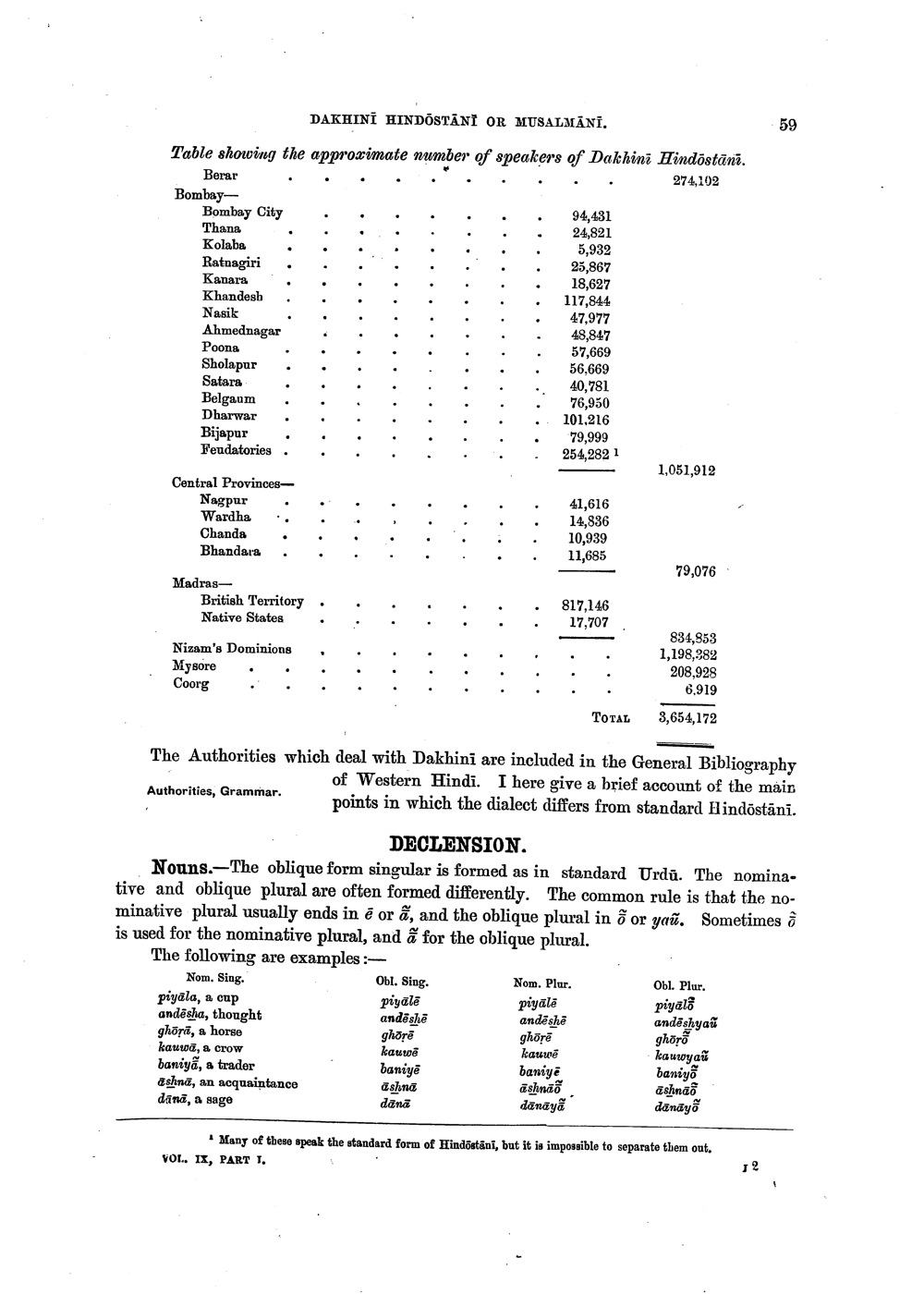
On numbers: the only speaker figure this page can vouch for is Grierson's total of 3,654,172, which appears both in the summary on p. 1 and as the total of the table on p. 59 24. Its basis is stated on p. 58 — "Taking the figures of the Census of 1891 as our basis" — so it is an 1891 return published in 1916, not a 1916 count 3. Grierson footnotes the Bombay Feudatories sub-figure of 254,282, not the total: "Many of these speak the standard form of Hindōstānī, but it is impossible to separate them out" 4. No modern figure is asserted here.

Who is answering which question

The popular statement of the claim is explicit that both alternatives are errors: "Typically, 'Hyderabadi Hindi' is what north Indians wrongly call Dakhni. Please, DON'T call it Hindi... Many Urdu speakers also mistake it for a form of localized Urdu, which, again, is incorrect" 32. Read as a claim about structural distance, it is not supported by anything opened for this page — and, on the argument above, it is not refuted either, because nothing opened here measures the distance. Read as a claim about elaboration and chronology — that the Deccan had a court and literary standard before Delhi's Rekhta, and that the name Dakanī is older than the name Urdu — it is well supported 101112.

One source used four times in an earlier version of this page was misfiled, and the correction matters to the shape of the argument. Dakhni.org was described there as "the most careful source stating the separate-language claim", and its statements were presented as concessions wrung from an advocate. It states no such claim. Its summary field reads "Family: Southern register of Urdu", and its opening sentence calls Dakhni "the southern register of Urdu that took shape in the Deccan between the fourteenth and sixteenth centuries" 33. It holds this page's own position; it can concede nothing to it; and every "even its own advocates concede" construction built on it has been deleted. Its provenance also went undisclosed: the site carries a standing banner stating that its content "is compiled with AI assistance from historical sources" and recommending independent verification, and it is a single-maintainer heritage project with no named editorial authority 33. It is retained below only as an example of how the variety classification is stated in popular Deccan heritage writing.

That leaves the position being adjudicated with a single exemplar: a 2020 web essay 32. The thinness is this page's fault and not the position's. A monograph literature on Dakhni exists, and none of it was opened: Sayed, The Value of Dakhni Language and Literature (Mysore, 1968); Hashmi, Deccan men Urdu (1963); Khan, Qadim Urdu (Osmania, 1965); Schmidt, Dakhini Urdu: History and Structure (New Delhi, 1981); Matthews, Dakhani Language and Literature (London PhD, 1976); Mustafa's 1985 Aligarh dissertation 20. Nor was Jamīl Jālibī's Tārīkh-e Adab-e Urdū, the standard Urdu-language treatment 42. Whether any of these argues separate-language status is not known from here; the word "language" in a title settles nothing, since Casadei uses it throughout while classifying Dakhni as a variety of Urdu 19. What can be said plainly is that the strongest scholarly form of the opposing position was not read for this page, that Schmidt's title promises exactly the structural treatment this page says is missing, and that Matthews is the source behind the one feature the earlier version dismissed. The verdict is set accordingly.

The formulation that survives all of this is narrower than the earlier version's. Dakhni is the older southern variety of a language later standardised in the north; it was an elaborated literary standard and was de-standardised, after 1687 and again through the administrative and educational substitution of northern Urdu in the Nizam's state 19. Whether the accumulated convergence has carried it past whatever threshold "separate language" would name is a question no source opened here has asked, let alone answered. What can be refused without hesitation is the hierarchy — the "broken Urdu" framing Grierson was already rejecting in 1916 3.
The pages themselves

Where the source is out of copyright and a scan exists, the page carrying the quoted passage is reproduced here, so the reader can check the transcription rather than take it on trust.

Title page of Linguistic Survey of India, Vol. IX Part I, Calcutta 1916
George Abraham Grierson (ed.), Linguistic Survey of India, Vol. IX: Indo-Aryan Family, Central Group, Part I: Specimens of Western Hindī and Pañjābī. Calcutta: Superintendent Government Printing, India, 1916., title page (DSAL leaf 004)
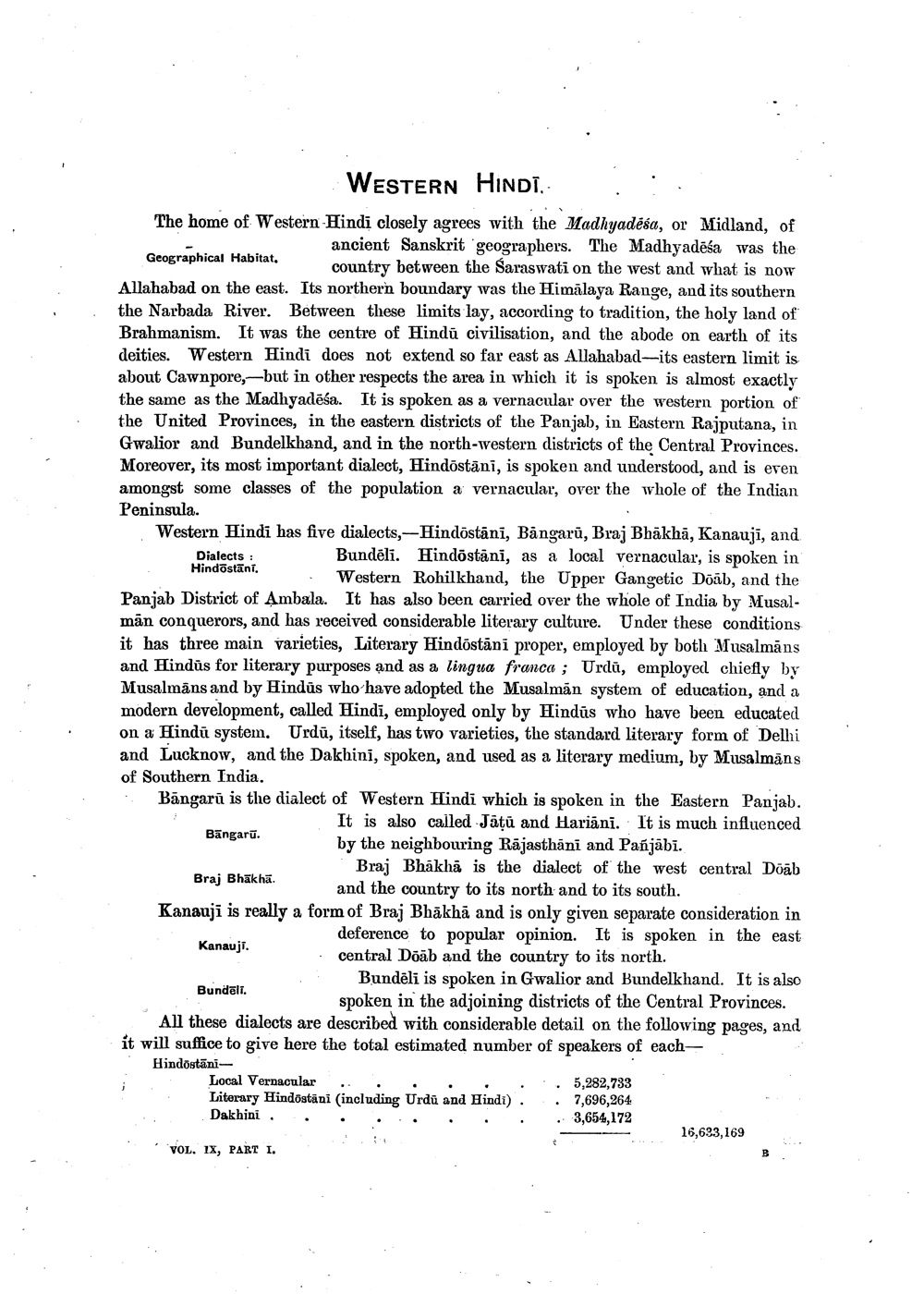
Linguistic Survey of India vol. IX pt. I, p. 1, opening of the Western Hindī chapter, listing Dakhinī as one of two varieties of Urdū
George Abraham Grierson (ed.), Linguistic Survey of India, Vol. IX Part I: Specimens of Western Hindī and Pañjābī. Calcutta: Superintendent Government Printing, India, 1916., p. 1 (DSAL leaf 019)
Linguistic Survey of India vol. IX pt. I, p. 58, the section headed DAKHINĪ HINDŌSTĀNĪ OR MUSALMĀNĪ
George Abraham Grierson (ed.), Linguistic Survey of India, Vol. IX Part I: Specimens of Western Hindī and Pañjābī. Calcutta: Superintendent Government Printing, India, 1916., p. 58 (DSAL leaf 076)
Linguistic Survey of India vol. IX pt. I, p. 59, table of approximate speakers of Dakhinī Hindōstānī, total 3,654,172
George Abraham Grierson (ed.), Linguistic Survey of India, Vol. IX Part I: Specimens of Western Hindī and Pañjābī. Calcutta: Superintendent Government Printing, India, 1916., p. 59 (DSAL leaf 077). NOTE ON SCOPE: the footnote marker sits on the Bombay ‘Feudatories 254,282¹’ line, so the footnote qualifies that sub-figure, not the total. The basis of all the figures is stated on p. 58: the Census of 1891.
Linguistic Survey of India vol. IX pt. I, p. 186, headnote to the Dakhinī of Bombay specimen
George Abraham Grierson (ed.), Linguistic Survey of India, Vol. IX Part I: Specimens of Western Hindī and Pañjābī. Calcutta: Superintendent Government Printing, India, 1916., p. 186 (DSAL leaf 204). Breves as printed (wŭ, kōĭ-nē); an earlier version of this page rendered them as macrons.
Linguistic Survey of India vol. IX pt. I, p. 187, Specimen No. 21: Dakhinī of Bombay Deccan, printed in Urdu script
George Abraham Grierson (ed.), Linguistic Survey of India, Vol. IX Part I: Specimens of Western Hindī and Pañjābī. Calcutta: Superintendent Government Printing, India, 1916. Specimen No. 21., p. 187 (DSAL leaf 205)
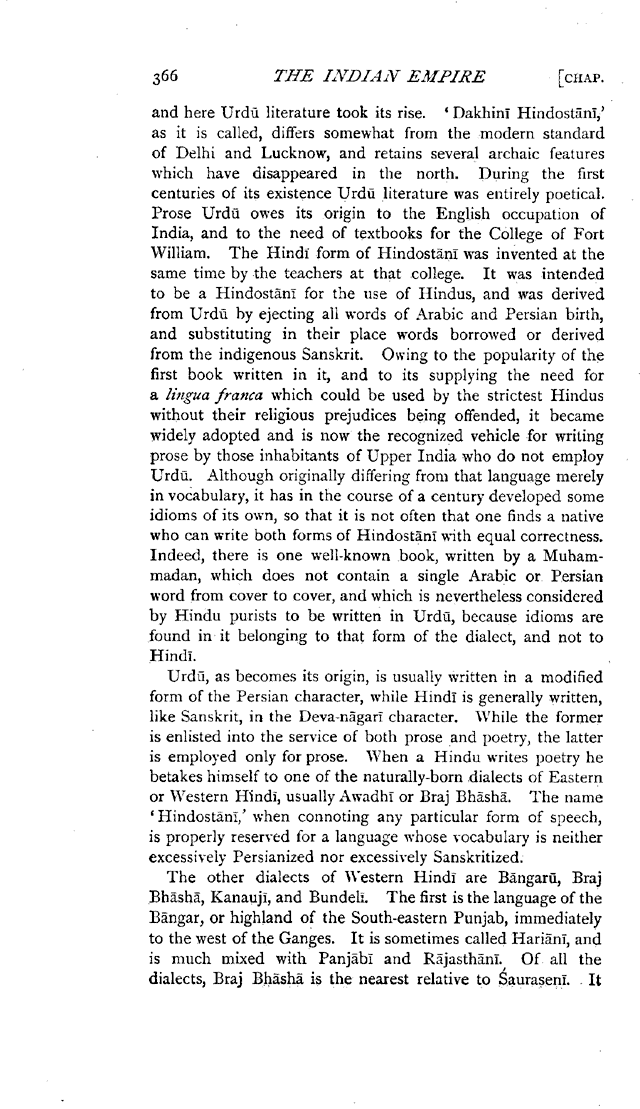
Imperial Gazetteer of India, vol. I, p. 366, discussing Dakhinī Hindostānī
The Imperial Gazetteer of India, Vol. I: The Indian Empire, Descriptive. New (revised) edition. Oxford: Clarendon Press, 1907. Chapter on Languages., p. 366. NOTE: the Gazetteer prints ‘Hindostānī’ (no macron on the o) throughout this page; an earlier version of this page silently imported Grierson's ‘Hindōstānī’ into the quotation.
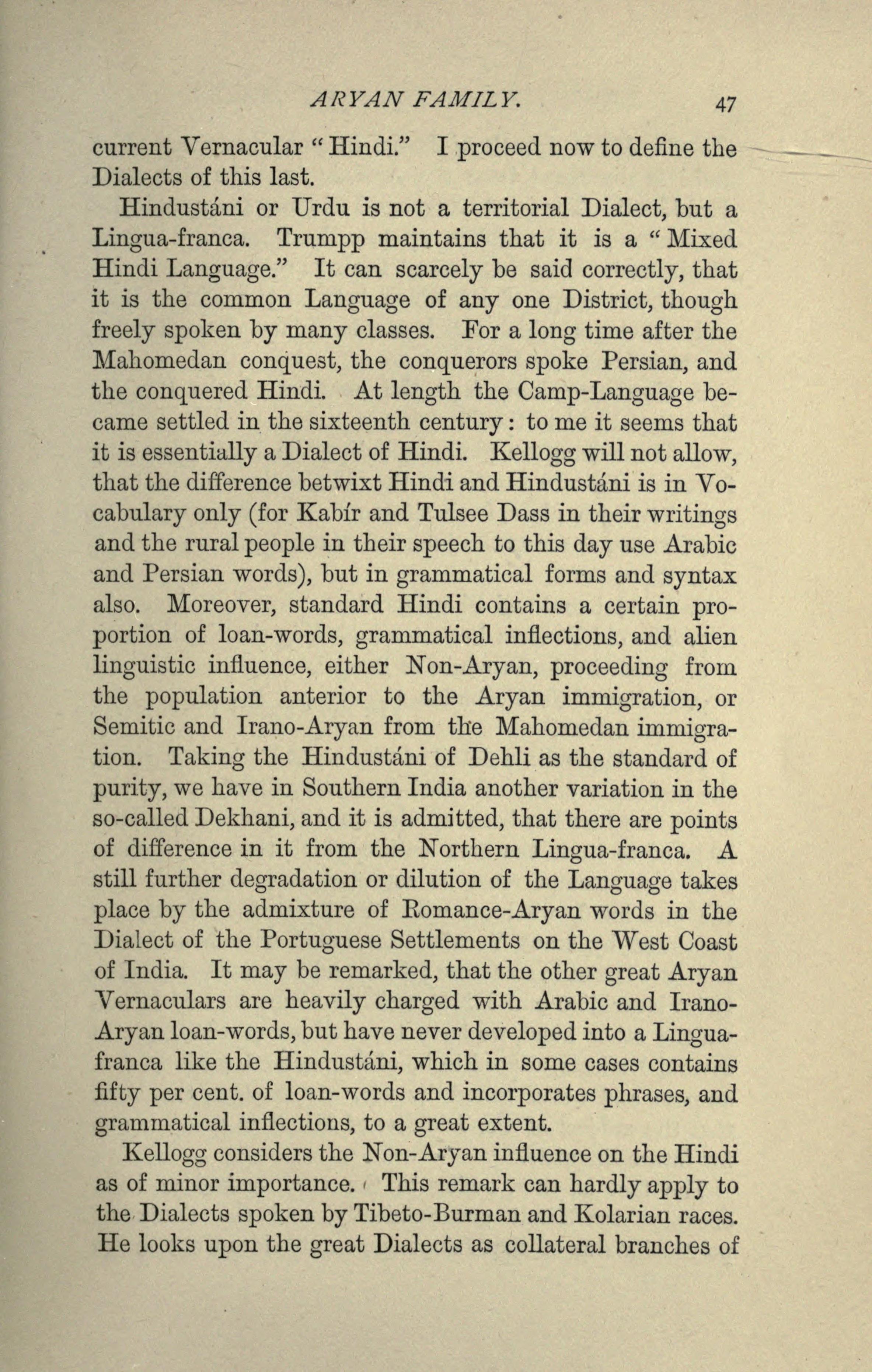
Cust, A Sketch of the Modern Languages of the East Indies (1878), p. 47, on 'the so-called Dekhani'
Robert Needham Cust, A Sketch of the Modern Languages of the East Indies, Accompanied by Two Language-Maps. London: Trübner & Co., 1878., p. 47. CORRECTION: an earlier version of this page warned that Cust uses ‘Dakhini’ on p. 48 for a dialect of Marathi. That page reference is wrong — p. 48 carries a numbered list of ten Hindi Dialect-Fields and no Marathi content. Cust does use the name elsewhere for a Marathi variety, but the location was not established; only this p. 47 passage, which uses ‘Dekhani’, is used here.

How the claim travelled

A claim’s history of telling is separate from its truth. This traces the telling.

Earliest attestation
No source opened for this page states the separate-language claim earlier than the present century; the earliest exemplar cited here is a 2020 web essay 32. What is demonstrably old is the framing it reacts against: Grierson recorded in 1916 that "It is commonly said that Dakhinī is a corrupt Hindōstānī" — and rejected it on the same page 3. An earlier version of this page also produced Shafīq Aurangābādī's remark on Nusratī as an eighteenth-century antecedent of the northern slight; that was a misattribution, since Shafīq is "a major historian, poet and tazkirah writer of the South" and the judgement is Aurangabad's on Bijapur 1516. Dating the modern claim's first formulation is an open question, not a finding of this page.
First embellishment
The characteristic move is a category shift rather than an invented fact: a true statement about chronology — that the name Dakanī and the Deccan corpus are older than the name Urdu 1011 — is restated as a statement about taxonomy. Two subsidiary overstatements are often attached, and both need care. "Not derived from Urdu" stated flat does not appear in the exemplar quoted here or in any source opened for this page; it circulates informally, and it is recorded as unsourced rather than refuted. What the evidence does contradict is a strong form of it: Delhi migration under Shāhjahān and Aurangzeb demonstrably reshaped the language of the Daulatabad-Aurangabad area 16, though Siddīqī exempts the Dravidian-zone Deccan and Faruqi records that even the Aurangabad convergence "gradually tilted back to the main Dakanī mode" after the 1750s 16. "The oldest" is likewise a stronger form than the exemplar states; against it, Faruqi places the first substantial Hindvī corpus with Shaikh Bahā ud-Dīn Bājan (1388-1506) in Gujarat 12. No datable chain of embellishment could be traced in the sources opened, and none is asserted here.
Why it took this shape
The claim answers an insult that is documented in the record. The "corrupt Hindōstānī" framing was current enough in 1916 to need refuting in print 3; the modern version of the same slight is the label "Hyderabadi Hindi", which the popular statement of the claim opens by rejecting 32. Asserting separate-language status is the readiest available way to refuse a hierarchy. The grievance is about status; the answer offered is taxonomic; and the taxonomic answer is one the evidence opened here declines to give in either direction. The stake on the other side has to be stated too, because this page's own sources have one. Faruqi's project in Early Urdu Literary Culture and History is to secure a deep antiquity for Urdu, explicitly against a dispute he describes as having passed "first to the colonialist constructions of the history of Urdu / Hindi, and then to the political and emotional space of Indian (that is, Hindu) identity in modern India" 9. "Dakanī is an early name of the language now called Urdu" is therefore a move in a live nomenclature war, not a neutral report. That does not make it wrong — the naming evidence he gives is checkable and was checked — but the framing is interested, and this page relies on it heavily. Sharper still: the description of Wajhī's Sab Ras as the oldest literary composition in Urdu prose is Maulvi Abdul Haq's, and Abdul Haq was the moving figure of the Anjuman-i Taraqqī-yi Urdū, the institution whose standardisation programme is part of what displaced Dakhni from official and literary use 3419. Naming a 1635 Golconda text "Urdu" is the annexation under discussion; it cannot also be evidence for it. This page uses Abdul Haq for the existence and dating of the editions, and not as testimony that the language is one.
Where the scholarship now stands
The chronological half of the claim holds and the taxonomic half is unresolved. "A dialect of Urdu" is the wrong shape, because it implies derivation from a standard that did not yet exist: "'Urdu' as a name for the language seems to occur for the first time around 1780" 11, while Dakanī was already a name for the Deccan form of the same language and remained so "until about the middle of the nineteenth century" 10. "A separate language" is not established either, but the reasons usually given for rejecting it are weaker than they look: the classification consensus is inherited rather than measured; the registries have handled the Deccan badly enough that Glottolog cannot be counted on either side 2223; the Ausbau answer is that Dakhni was an elaborated standard and was demoted by administrative replacement, not that it never was one 19; and the convergence literature that bears most directly on structural distance has never been weighed against the classification, and was not opened here 20. The sentence this page will defend is that Dakhni is the older southern variety of the language later standardised in the north, with a contact history deep enough that whether it has passed a separate-language threshold is a real and open question. That is not Grierson's 1916 sentence — his chronology dates Deccan literature from Walī, three centuries too late 3 — and it is not the popular claim's sentence either.

Where historians differ

What this page cannot settle

Connected to

Citations

Every quotation is given verbatim with its page, and linked to the copy it was read from. Spelling and diacritics are those of the source — where they look wrong, that is the evidence, not an error. Tier A: academic or peer-reviewed. Tier B: archival, contemporary or reference. Tier C: journalism or popular history, never load-bearing on its own.

  1. 1AGeorge Abraham Grierson (ed.), Linguistic Survey of India, Vol. IX: Indo-Aryan Family, Central Group, Part I: Specimens of Western Hindī and Pañjābī. Calcutta: Superintendent Government Printing, India, 1916., title page (DSAL leaf 004) (1916)
    LINGUISTIC SURVEY OF INDIA / VOL. IX / INDO-ARYAN FAMILY / CENTRAL GROUP / PART I / SPECIMENS OF WESTERN HINDĪ AND PAÑJĀBĪ / COLLECTED AND EDITED BY / SIR GEORGE ABRAHAM GRIERSON, K.C.I.E., PH.D., D.LITT., I.C.S. (RETD.) ... CALCUTTA / SUPERINTENDENT GOVERNMENT PRINTING, INDIA / 1916
    Title page of Linguistic Survey of India, Vol. IX Part I, Calcutta 1916
    Title page of Linguistic Survey of India, Vol. IX Part I, Calcutta 1916Digital South Asia Library, University of Chicago. Public domain (published 1916). Full scan.
  2. 2AGeorge Abraham Grierson (ed.), Linguistic Survey of India, Vol. IX Part I: Specimens of Western Hindī and Pañjābī. Calcutta: Superintendent Government Printing, India, 1916., p. 1 (DSAL leaf 019) (1916)
    Urdū, itself, has two varieties, the standard literary form of Delhi and Lucknow, and the Dakhinī, spoken, and used as a literary medium, by Musalmāns of Southern India. […] Hindōstānī— Local Vernacular 5,282,733 / Literary Hindōstānī (including Urdū and Hindī) 7,696,264 / Dakhinī 3,654,172
    Linguistic Survey of India vol. IX pt. I, p. 1, opening of the Western Hindī chapter, listing Dakhinī as one of two varieties of Urdū
    Linguistic Survey of India vol. IX pt. I, p. 1, opening of the Western Hindī chapter, listing Dakhinī as one of two varieties of UrdūDigital South Asia Library, University of Chicago. Public domain (published 1916). Full scan.
  3. 3AGeorge Abraham Grierson (ed.), Linguistic Survey of India, Vol. IX Part I: Specimens of Western Hindī and Pañjābī. Calcutta: Superintendent Government Printing, India, 1916., p. 58 (DSAL leaf 076) (1916)
    DAKHINĪ HINDŌSTĀNĪ OR MUSALMĀNĪ. The Musalmān armies imposed their language on their co-religionists in the Deccan from the first. At the present day, whether the language of the country is Marāṭhī, Tamil, Telugu, or some other Dravidian form of speech, the Musalmāns of southern India all employ that form of Hindōstānī, commonly known as Dakhinī, the language of the Deccan, or as Musalmānī, the language of Musalmāns. It was in the Deccan that Hindōstānī, under the form of Urdū, first received cultivation, and it was at the hands of Walī of Aurangabad (cir. 1700), the ‘Father of Rēkhta,’ that a standard of literary form was given to it. […] Taking the figures of the Census of 1891 as our basis […] It is commonly said that Dakhinī is a corrupt Hindōstānī. Historically speaking it would almost be truer to say that literary Hindōstānī is a corrupt Dakhinī, for we have seen that Hindōstānī literature took its origin in the Deccan. Without, however, going so far as that, it is not correct to look upon Dakhinī as a corrupt form of speech. The Musalmān armies carried vernacular Hindōstānī to the south before it had been standardised, and it then contained many idioms which are now excluded from literary prose. Some of these have survived in the Deccan. Such are, for instance, the employment of the oblique genitive as a base for declension in phrases like mērē-kū, to me, where the standard would have mujh-kō.
    Linguistic Survey of India vol. IX pt. I, p. 58, the section headed DAKHINĪ HINDŌSTĀNĪ OR MUSALMĀNĪ
    Linguistic Survey of India vol. IX pt. I, p. 58, the section headed DAKHINĪ HINDŌSTĀNĪ OR MUSALMĀNĪDigital South Asia Library, University of Chicago. Public domain (published 1916). Full scan.
  4. 4AGeorge Abraham Grierson (ed.), Linguistic Survey of India, Vol. IX Part I: Specimens of Western Hindī and Pañjābī. Calcutta: Superintendent Government Printing, India, 1916., p. 59 (DSAL leaf 077). NOTE ON SCOPE: the footnote marker sits on the Bombay ‘Feudatories 254,282¹’ line, so the footnote qualifies that sub-figure, not the total. The basis of all the figures is stated on p. 58: the Census of 1891. (1916)
    Table showing the approximate number of speakers of Dakhinī Hindōstānī. Berar 274,102 … Bombay [subtotal] 1,051,912 … Central Provinces [subtotal] 79,076 … Madras [subtotal] 834,853 … Nizam’s Dominions 1,198,382 … Mysore 208,928 … Coorg 6,919 … TOTAL 3,654,172 […] Feudatories 254,282¹ […] ¹ Many of these speak the standard form of Hindōstānī, but it is impossible to separate them out.
    Linguistic Survey of India vol. IX pt. I, p. 59, table of approximate speakers of Dakhinī Hindōstānī, total 3,654,172
    Linguistic Survey of India vol. IX pt. I, p. 59, table of approximate speakers of Dakhinī Hindōstānī, total 3,654,172Digital South Asia Library, University of Chicago. Public domain (published 1916). Full scan.
  5. 5AGeorge Abraham Grierson (ed.), Linguistic Survey of India, Vol. IX Part I: Specimens of Western Hindī and Pañjābī. Calcutta: Superintendent Government Printing, India, 1916., p. 186 (DSAL leaf 204). Breves as printed (wŭ, kōĭ-nē); an earlier version of this page rendered them as macrons. (1916)
    DAKHINĪ OF BOMBAY. The following specimen of the Dakhinī of the Bombay Presidency is the first half of a version of the Parable of the Prodigal Son, prepared in the office of the Collector of Customs of Bombay. It is said to illustrate the dialect of the ‘Musalmāns of the Deccan.’ […] Typical of Dakhinī are the use of jidhar to mean ‘when’ and ‘where’ instead of ‘whither;’ wŭ for woh, he; kōĭ-nē for kisī-nē; and athā for thā, he was. Attention may be drawn to the frequency with which Arabic and Persian words are incorrectly spelt.
    Linguistic Survey of India vol. IX pt. I, p. 186, headnote to the Dakhinī of Bombay specimen
    Linguistic Survey of India vol. IX pt. I, p. 186, headnote to the Dakhinī of Bombay specimenDigital South Asia Library, University of Chicago. Public domain (published 1916). Full scan.
  6. 6AGeorge Abraham Grierson (ed.), Linguistic Survey of India, Vol. IX Part I: Specimens of Western Hindī and Pañjābī. Calcutta: Superintendent Government Printing, India, 1916. Specimen No. 21., p. 187 (DSAL leaf 205) (1916)
    [No. 21.] INDO-ARYAN FAMILY. CENTRAL GROUP. WESTERN HINDĪ. HINDŌSTĀNĪ (DAKHINĪ OF BOMBAY DECCAN). BOMBAY.
    Linguistic Survey of India vol. IX pt. I, p. 187, Specimen No. 21: Dakhinī of Bombay Deccan, printed in Urdu script
    Linguistic Survey of India vol. IX pt. I, p. 187, Specimen No. 21: Dakhinī of Bombay Deccan, printed in Urdu scriptDigital South Asia Library, University of Chicago. Public domain (published 1916). Full scan.
  7. 7AThe Imperial Gazetteer of India, Vol. I: The Indian Empire, Descriptive. New (revised) edition. Oxford: Clarendon Press, 1907. Chapter on Languages., p. 366. NOTE: the Gazetteer prints ‘Hindostānī’ (no macron on the o) throughout this page; an earlier version of this page silently imported Grierson's ‘Hindōstānī’ into the quotation. (1907)
    and here Urdū literature took its rise. ‘Dakhinī Hindostānī,’ as it is called, differs somewhat from the modern standard of Delhi and Lucknow, and retains several archaic features which have disappeared in the north. During the first centuries of its existence Urdū literature was entirely poetical.
    Imperial Gazetteer of India, vol. I, p. 366, discussing Dakhinī Hindostānī
    Imperial Gazetteer of India, vol. I, p. 366, discussing Dakhinī HindostānīDigital South Asia Library, University of Chicago. Public domain (published 1907). Full scan.
  8. 8ARobert Needham Cust, A Sketch of the Modern Languages of the East Indies, Accompanied by Two Language-Maps. London: Trübner & Co., 1878., p. 47. CORRECTION: an earlier version of this page warned that Cust uses ‘Dakhini’ on p. 48 for a dialect of Marathi. That page reference is wrong — p. 48 carries a numbered list of ten Hindi Dialect-Fields and no Marathi content. Cust does use the name elsewhere for a Marathi variety, but the location was not established; only this p. 47 passage, which uses ‘Dekhani’, is used here. (1878)
    Taking the Hindustáni of Dehli as the standard of purity, we have in Southern India another variation in the so-called Dekhani, and it is admitted, that there are points of difference in it from the Northern Lingua-franca.
    Cust, A Sketch of the Modern Languages of the East Indies (1878), p. 47, on 'the so-called Dekhani'
    Cust, A Sketch of the Modern Languages of the East Indies (1878), p. 47, on 'the so-called Dekhani'Internet Archive, from the University of California Libraries (Reese Library) copy. Public domain (published 1878). Full scan.
  9. 9AShamsur Rahman Faruqi, Early Urdu Literary Culture and History (New Delhi: Oxford University Press, 2001), Chapter One, opening page and footnote 1. Read from the author-authorised scan hosted by Frances W. Pritchett., p. 21 (text and n. 1). NOTE: Pritchett also hosts a separate essay, ‘Aspects of Early Urdu Literary Culture and History’, whose wording differs materially at these points. The book, not the essay, is quoted here. (2001)
    Using the term 'early Urdu' is not without its risks. 'Urdu' as a language name is of comparatively recent origin, and the question of what was or is 'early Urdu' has long since passed from the realm of history, first to the colonialist constructions of the history of Urdu / Hindi, and then to the political and emotional space of Indian (that is, Hindu) identity in modern India. [n.1:] In recent times, this case was most elaborately presented by Amrit Rai in A House Divided. Rai's thesis, though full of inconsistencies, or tendentious speculation rather than hard facts, or fanciful interpretation of actual facts, was never fully refuted by Urdu scholars.
    Fetchedsource
  10. 10AShamsur Rahman Faruqi, Early Urdu Literary Culture and History (OUP, 2001), Chapter One: 'History, Faith, Politics — Origin Myths of Urdu and Hindi'., p. 22 (2001)
    Quite a bit of the speculation that goes by the name of scholarly historiography of Hindi / Urdu language and literature today owes its existence to the fortuity of nomenclature. Early names for the language now called Urdu were Hindvī, Hindī, Dihlavī, Gujrī, Dakanī, and Rekhtah, more or less in that order, though until about the middle of the nineteenth century Dakanī continued to be the name for the form of the language used in the Deccan. [NOTE ON TRANSCRIPTION: Faruqi's printed text uses subscript-dot / underlined digraph diacritics on kh, gh, z etc. that are not reproduced here; macrons are as printed. Read from a page image — this PDF has no text layer.]
  11. 11AShamsur Rahman Faruqi, Early Urdu Literary Culture and History (OUP, 2001), Chapter One., pp. 22-23, 25, 27. Macrons in the p. 25 gloss restored to the printed ‘Shāhjahānābād’; an earlier version flattened them while claiming macrons were as printed. (2001)
    In the North, both 'Rekhtah' and 'Hindī' were popular as names for the same language from sometime before the eighteenth century, and the name 'Hindī' was used, in preference to 'Rekhtah', from about the mid-nineteenth century. (p. 22-23) ... 'Urdu' as a name for the language seems to occur for the first time around 1780. All, or almost all, the earliest examples are from Mushafī again. (p. 23) ... The name 'Urdu' seems to have begun its life as zabān-e urdū-e mu'allā-e Shāhjahānābād (the language of the exalted City / Court of Shāhjahānābād, that is, Delhi). It originally seems to have signified Persian and not Urdu. (p. 25) ... It is thus obvious that in the 1750's, the terms urdū, urdū-e mu'allā, and zabān-e urdū-e mu'allā did not, at least among the elite, mean the language which is known as Urdu today. (p. 27)
    Fetchedsource
  12. 12AShamsur Rahman Faruqi, Early Urdu Literary Culture and History (OUP, 2001), Chapter Three: 'Beginning, Then Going Away From Home'., pp. 70, 71, 72-73 (the third segment begins on p. 72 and runs onto p. 73; an earlier version attributed all of it to p. 73) (2001)
    For the known names after Khusrau are Shaikh Bājan (1388-1506), who wrote in Gujarat, and Fakhr-e Dīn Nizāmī (fl.1434), who wrote in the Deccan. (p. 70) ... The first person whose Hindvī survives in substantial quantity, and with whom Urdu literature can seriously be said to begin, is Shaikh Bahā ud-Dīn Bājan (1388-1506). (p. 71) ... The Shaikh here established the parameters of Urdu language and literature for a long time to come: the language is Hindvī, the metres used are both Indic and Persian, the themes (p. 72) of poetry are both sacred and secular. (p. 73) [Read from page images; diacritic subdots not reproduced.]
    Fetchedsource
  13. 13AShamsur Rahman Faruqi, Early Urdu Literary Culture and History (OUP, 2001), Chapter Six: 'A Phenomenon Called Valī', quoting letters of Habīb ur-Rahmān al-Siddīqī Merathī (1967)., pp. 130-31 (main text p. 131; footnote 2, which carries both letter-quotations, is printed on p. 130). An earlier version of this page cited ‘p. 131 (text and n. 2)’, which is wrong for the footnote. (2001)
    Valī was a poet, a man of learning, and man of the world; he was from Gujarat, or Aurangabad, or both. He revolutionised Urdu poetry. Standard Urdu literary historiography and thought have tried their best, over the last two and a half centuries, to diminish the achievement of Valī--for he was an outsider, and a Dakanī to boot, and it must have been gall and wormwood to the 'Mirzās' and the ustāds of Delhi to have to acknowledge the primacy, and the leadership, of such a person. [Faruqi introduces n.2 as:] Interesting evidence of Delhi's continuing bias against Valī [and notes that al-Siddīqī regarded his own speech as that of Delhi; in the immediately preceding letter al-Siddīqī writes that Valī 'needs to be debunked'. n.2:] 'Valī learned [proper] Urdu when he came to Delhi; it's not that he taught [proper] Urdu to the people of Delhi'. ... 'My problem is that I've forgotten Dihlavī, and I never did master Dakanī'
    Fetchedsource
  14. 14AShamsur Rahman Faruqi, Early Urdu Literary Culture and History (OUP, 2001), Chapter Six, incl. Faruqi's translation of Mushafī, Tazkirah-e hindī, p. 80., pp. 133, 134. CONTEXT: points 1-3 are Faruqi's summary of the received Gulshan story, of which he accepts only the third, writing that ‘There is fairly firm ground for accepting the third assumption’. (2001)
    1. Valī came to Delhi in 1700 and met Gulshan, who advised him as above. 2. Valī apparently took the advice seriously and implemented it successfully. 3. When his dīvān arrived in Delhi in the second regnal year of Emperor Muhammad Shāh [the second regnal year began in October 1720], it took Delhi by storm, and everybody, young or old, adopted Valī's style of poetry. (p. 133) ... Mushafī says in his Tazkirah-e hindī (completed 1794-95): 'One day he [Shāh Hātim] mentioned to this faqīr that in the second regnal year of him who rests in Paradise, Valī's dīvān arrived in Shāhjahānābād, and its verses became current on the tongues of young and old'. (p. 134)
    Fetchedsource
  15. 15AShamsur Rahman Faruqi, Early Urdu Literary Culture and History (OUP, 2001), Chapter Six., p. 137. An earlier version of this page quoted the first sentence as ‘we know Valī had already been a substantial poet’, which is a rewrite; the printed infinitive construction is restored. This material was also mis-tagged to pp. 133-134. (2001)
    we know Valī to have already been a substantial poet when he visited Delhi in 1700. ... [Shafīq Aurangābādī, described as] a major historian, poet and tazkirah writer of the South
    Fetchedsource
  16. 16AShamsur Rahman Faruqi, Early Urdu Literary Culture and History (OUP, 2001), Chapter Six, incl. Faruqi's translation of 'Abd us-Sattār Siddīqī (in Valī, Kulliyāt-e valī, pp. 61-62) and reports of Shafīq Aurangābādī and Maulvī 'Abd ul-Haq., pp. 138-139. TRANSCRIPTION CORRECTED: an earlier version of this page fused two clauses of the Siddīqī passage and replaced ‘Delhi’ with ‘Vali’, inverting who supplied the new language; it also gave ‘found few opportunities in weaving’ for ‘found few opportunities to renew’, and dropped ‘of such influences’ without ellipsis. The printed text is restored below. The book's typo ‘indistiguishable’ is silently corrected to ‘indistinguishable’. (2001)
    Valī had the Dakanī tradition and language in his blood, and Gujrī also played a part in his nurture. ... The extreme case of such influences was Fakhr-e Dīn Nizāmī; a more moderate, but still fairly heavy, instance was Nusratī, perhaps the greatest Dakanī poet. Valī's language had a greater tilt toward the Persian-mixed Rekhtah of Delhi. Most of the 'Dakanī' component of Valī's language is tadbhav, and a good bit of it is to be found in Delhi's register as well. (p. 138) ... [Faruqi quoting 'Abd us-Sattār Siddīqī:] It seems clear that by the end of the tenth century hijrī [1590/1], there were two forms of the Hindustani language in the Deccan. One, which was current in Dravidian[-dominated] areas of the Deccan, outside the territory of Daulatabad, and found few opportunities to renew its connections with the language of Delhi....The other form of the language was that which was prevalent in Daulatabad and its surrounds. ... People from Delhi came to Aurangabad in very large numbers in the times of Shāhjahān and Aurangzeb, and brought Delhi's high Urdu with them. It renewed and refurbished the language of the territory of Daulatabad, and the Aurangabadis happily adopted the new language of Delhi. And that is the language that we find in Valī; and but for some minor differences, it was the language spoken in Delhi in Valī's time. (pp. 138-139) ... 'Abd us-Sattār Siddīqī may have simplified the case a bit, but his broad picture is accurate. Shafīq Aurangābādī writes about Nusratī that his poems come 'heavy on the tongue because of their being in the mode of the Dakanīs'. Hasan Shauqī's poetry is comparatively gentler on the Aurangabadi ear. ... Maulvī 'Abd ul-Haq, who spent a substantial part of his life in Aurangabad, says that in the first half of the eighteenth century, the language registers of Delhi and Aurangabad were practically indistinguishable. Once the Deccan became more or less independent of Delhi in the 1750's, the language of the Daulatabad-Aurangabad area lost touch with Delhi, and gradually tilted back to the main Dakanī mode. (p. 139)
    Fetchedsource
  17. 17AShamsur Rahman Faruqi, Early Urdu Literary Culture and History (OUP, 2001), Chapter Six., p. 141 (2001)
    So what did Valī do? Quite simply, he showed conclusively, and for all time, that Rekhtah / Hindī was capable of great poetry, just as Gujrī / Hindī and Dakanī / Hindī were, at their best.
    Fetchedsource
  18. 18AMaulvī 'Abd ul-Haq, preface to Tamannā Aurangābādī's tazkirah, Gul-e 'ajā'ib, p. ze — on the indistinguishability of the Delhi and Aurangabad registers in the first half of the eighteenth century., Gul-e 'ajā'ib, p. ze (as cited by Faruqi, Early Urdu Literary Culture and History, p. 139 n. 23). 'Abd ul-Haq's preface itself was not opened.
    [Faruqi, p. 139:] Maulvī 'Abd ul-Haq, who spent a substantial part of his life in Aurangabad, says that in the first half of the eighteenth century, the language registers of Delhi and Aurangabad were practically indistinguishable.
    Quoted insourcequoted in Shamsur Rahman Faruqi, Early Urdu Literary Culture and History (2001), p. 139 and n. 23.
  19. 19BMaria Casadei (Doctoral School in the Humanities, Jagiellonian University, Krakow), 'From a Literary Language to an Oral Tongue: A Linguistic Overview of the Dakhni Language', Journal of Language and Linguistics in Society, vol. 03, no. 03 (April-May 2023), pp. 1-10. DOI 10.55529/jlls.33.1.10., pp. 1-3 (history), p. 5 (varieties, Grierson), pp. 5-9 (phonology, morphology, syntax). STANDING: a ten-page overview by a doctoral student in an APC journal (HM Journals) of uncertain editorial standing. Accurate on everything checked — all quotations and page numbers verified — but Tier B, and an earlier version of this page gave it Tier-A rhetorical weight, calling it ‘the fullest recent description’ and treating it as a peer-review threshold. SCOPE: its descriptive section is explicitly about Rayalaseema Dakhni. (2023)
    Dakhni Urdu is an Indo-Aryan language spoken in the Deccan region of India (abstract) ... The origin of this language is still uncertain, nevertheless, many scholars would agree that Dakhni is the result of the interaction between Indo-Aryan and Dravidian languages (p. 2) ... Many theories have been formulated over time in order to trace the origins of the Dakhni language, which still remain very difficult to ascertain (Shirani 1928; Zore 1930; Chatterjee 1963). However, starting with Sayed (1968), scholars share the opinion that Dakhni developed from Urdu, which arose in and around Delhi after the arrival of Muslims in northern India in the 11th and the 12th centuries. (p. 2) ... there was an acquisition of new words and certain grammatical features, which were borrowed from Marathi and, to a smaller extent, local Dravidian languages, e.g., Kannada and Telugu. (p. 3) ... this decision did not help Dakhni in restoring its literary status since the Urdu chosen as the language of the state was the northern variant spoken in Delhi ... Finally, in 1919, the foundation of Osmania University, with Urdu (Northern-Urdu) as the medium of education, led to the further segregation of Dakhni to the non-official sphere, limiting or even eradicating its use in the official public domain. (p. 4-5) ... In the Linguistic Survey of India, Grierson identified three different dialects: the Dakhni of Bombay, Madras and Berar. (p. 5) ... Mustafa (2008), who worked on the convergence between Dakhni and Telugu language, identified three varieties: Andhra Dakhni, Kannada Dakhni and Tamil Dakhni ... In particular, Andhra Dakhni would present an additional schism between the dialect spoken in Rayalaseema, which has features imported from Telugu, and the one spoken in Telangana, called Hyderabadi Urdu, which shows more resemblance to the Standard Urdu. (p. 5) ... The special linguistic situation in South India favored the bidirectional convergence of Dakhni towards Dravidian languages, e.g., Telugu. This section gives a brief outline of the phonology and morphology as well as some salient syntax features of Dakhni as it is spoken in Rayalaseema, in Andhra Pradesh. (p. 5) ... Although it generally shares with Standard Urdu (SU) the same sound system, it presents the aspirates /mh/, /lh/, /rh/, /vh/ and /yh/ and the nasal and lateral retroflex phonemes, /ṇ/ and /ḷ/. (p. 6) ... Rather than the three-level pronominal system present in Hindi and SU (tū, tum, āp), Dakhni instead presents a two-level hierarchy: tu, which is used for the 2nd person sg., non-honorific and non-formal; and tūme, denoting the 2nd person pl. or honorific sg. and formal. The honorific form āp is not used in Dakhni. (p. 6) ... An interesting feature of Dakhni is the distinction between an exclusive (1) and inclusive (2) 1st person plural pronoun. ... ham logāñ ... apan/apal logāñ (p. 6) ... the habitual present-cum-future (maiñ jātũ ['I usually go', 'I will go']) ... The permissive-imperative tense, constructed from the stem verb plus the suffix -ñde (p. 7) ... maiñ bolya so bāt, suno! 'Please listen to what I said!' (p. 8) ... Arora and Subbarao (1993) observed that the Dakhni language went through a process of 'dativisation', losing the genitive structures that are common in both Hindi and SU (p. 8) ... kā ku jāre? 'Where are you going?' (p. 9)
    Fetchedsource
  20. 20BReference list of Maria Casadei, 'From a Literary Language to an Oral Tongue: A Linguistic Overview of the Dakhni Language', JLLS 03(03) (2023), pp. 9-10. Cited for the bibliographic details of works that were NOT opened for this page., pp. 9-10 (reference list). The bibliographic details below were transcribed verbatim from the article's PDF, which was read. None of the works listed was opened. Note the discrepancy: Casadei's body text cites ‘Arora and Subbarao (1993)’, but her reference list carries only the 1988 paper. (2023)
    Sayed, M. 1968. The Value of Dakhni Language and Literature. Mysore: University of Mysore. ... Hashmi, N. 1963. Deccan men Urdu. Lucknow: Nasim Book Depot. ... Khan, M. H. 1965. Qadim Urdu (Old Urdu). Hyderabad: Osmania University. ... Schmidt, R. L. 1981. Dakhini Urdu: History and Structure. New Delhi: Bahri Publications. ... Matthews, J. D. 1976. Dakhani language and literature. [Unpublished PhD Dissertation]. University of London. ... Rahman, T. 2008. Urdu in Hyderabad State. The Annual of Urdu Studies. ... Arora, H., Subbarao, K.V. 1988. "On extreme convergence: the case of Dakkhni Hindi-Urdu" in A. Mukherjee (Ed.). Language Change and Variation, pp. 105-122. Hyderabad: Osmania University. ... Mustafa, K.S. 2008. "Dakkhni" in Prakāśaṃ (Ed.). Encyclopaedia of the Linguistic Sciences: Issues and Theories, pp. 185-186. New Delhi: Allied Publishers. ... Pray, B. R. 1980. Evidence of grammatical convergence in Dakhni Urdu and Telugu. Proceedings of the Sixth Annual Meeting of the Berkeley Linguistic Society, 90-4. ... Mustafa, K.S. 1985. Descriptive, Dakhni, Morphophonemics, Phonology, Syntax. [Unpublished PhD dissertation]. Aligarh Muslim University.
    Fetchedsource
  21. 21BGiulia Ferro (Università Ca' Foscari Venezia), review of T. Oranskaia & A. Abbi (eds), The Heart of Change: Issues on Variation in Hindī (Heidelberg: HASP, 2022), in Bhasha, vol. 4, no. 2 (2025), pp. 1-22. DOI 10.30687/bhasha/2785-5953/2025/02/005. Cited for its report of Vashini Sharma's chapter 'The Impact of Other Indian Languages on Dakhinī'., pp. 5-6. Only the ergative-ne and ‘degenitivising’ bullets are on p. 5; tumhārā, the agglutinated auxiliary, honā for cāhie, hau/nako and bolke/karke are on p. 6. An earlier version of this page tagged all of them p. 5. (2025)
    From the syntactic point of view, Sharma lists the following features which make Dakhinī resemble Telugu more than Urdū/Hindī: • the use of the ergative particle ne does not follow the rules of Standard Hindī ... • concerning the use of subject + ko, specific of Hindī/Urdū, Dakhinī is 'degenitivising' for a dativisation; • agreement in gender and number; • the use of short versions of emphatic particles, such as hī, bhī, to, which are -ī, -īṁ in Dakhinī; • the use of तुम्हारा tumhārā as a possessive determinative adjective instead of अपना apanā; • the agglutination of the auxiliary verb in many forms, such as: the progressive construction (Hindī: रहा + है rahā + hai > Dakhinī: रा / रय / रै / रईं rā / ray / raiṁ) ... • the Hindī/Urdū चाहना / चाहिए cāhanā/cāhie is replaced by होना honā, similarly to Marāṭhī and Telugu forms; • the use of the Marāṭhī forms हौ hai (Hindī: हाँ hāṁ) and नको nako (Hindī: नहीं nahīṁ), the latter replacing मत mat in negative imperative; ... • the use of बोलके / करके bolke / karke instead of the quotative Hindī form कि ki, the Dakhinī forms calqued from the Telugu form -ani ... [on the chapter:] is unfortunately just a draft, since Sharma passed away before the publication of the volume ... the conclusions of this paper are absent
    Quoted insourcequoted in Giulia Ferro's review article in Bhasha 4(2), reporting Vashini Sharma's chapter in Oranskaia & Abbi (eds) 2022. Sharma's chapter itself was not opened. Ferro states that it 'is unfortunately just a draft, since Sharma passed away before the publication of the volume' and that 'the conclusions of this paper are absent'. The HASP server (hasp.ub.uni-heidelberg.de) also refused connection on repeated attempts, but the draft status is the material point and an earlier version of this page reported only the server failure.
  22. 22AGlottolog 5.3, languoid entry 'Dakhini (Urdu)', glottocode dakh1244. Max Planck Institute for Evolutionary Anthropology., languoid page dakh1244 (single-page web record; no pagination) (2026)
    Dialect: Dakhini (Urdu) [page heading]. No ISO 639-3 code is shown. No comment field or bibliography. Linked Wikipedia article: 'Hyderabadi Urdu'.
    Fetchedsource
  23. 23AGlottolog, languoid entry 'Deccan Marathi', glottocode decc1239, ISO 639-3 dcc. Max Planck Institute for Evolutionary Anthropology., languoid page decc1239, Comment field (single-page web record; no pagination). The classification chain given in an earlier version of this record did not match the live page and has been removed; nothing here depends on it. (2026)
    Deccan [dcc] is listed in E16/E17/E18/E19/E20/E21/E22/E23/E24/E25/E26/E27/E28 as a separate language from Marathi [mar]. The entry for Deccan [dcc] closely matches the information from George A. Grierson 1905: 15 , 33, 47-60, 219 on the "broken dialects of the Dekhan", such as the subvarieties Dharwar and Bijapuri, but also contains information matching the similarly named Dakkhini Urdu variety of the Urdu [urd] ( Ruth Laila Schmidt 1982 ) such as the primary usage of Arabic script. The varieties of Dharwar and Bijapuri, though showing some Kannada influences, are essentially the same dialect as the Marathi [mar] ( George A. Grierson 1905: 15 , 33, 47-60, 219, called Dekhan Marathi by him). Hence this entry is spurious either as the Marathi variety or as Dakkhini Urdu. See also: Marathi [mar], Urdu [urd]. [Alternative names field: Deccan; Deccani; Dekini; Desi. Level: Dialect.]
    Fetchedsource
  24. 24AISO 639-3 Registration Authority (SIL Global), code entry 'dcc'., code page /code/dcc (single-page web record; no pagination) (2026)
    Language Name: Deccan. Status: Active. Scope: Individual. Language Type: Living. Code Set: 639-3.
    Fetchedsource
  25. 25AISO 639-3 Registration Authority (SIL Global), code entry 'urd'., code page /code/urd (single-page web record; no pagination) (2026)
    Urdu [urd] — Active; Code Sets: 639-2, 639-3; ISO 639-1: ur; Scope: Individual; Type: Living. [The page carries no list of alternate or dialect names; Deccani/Dakhini does not appear on it.]
    Fetchedsource
  26. 26ADepartment of Official Language, Ministry of Home Affairs, Government of India, 'Languages Included in the Eighth Schedule of the Indian Constitution'., official list page (single-page web record; no pagination) — 22 languages enumerated (2026)
    Assamese, Bengali, Bodo, Dogri, Gujarati, Hindi, Kannada, Kashmiri, Konkani, Malayalam, Manipuri, Marathi, Maithili, Nepali, Oriya, Punjabi, Sanskrit, Santhali, Sindhi, Tamil, Telugu, Urdu. [Deccani/Dakhni does not appear.]
    Fetchedsource
  27. 27ARichard M. Eaton, A Social History of the Deccan, 1300-1761: Eight Indian Lives (The New Cambridge History of India I.8), Cambridge University Press, 2005. ISBN 978-0-521-25484-7. Publisher's excerpt PDF of the Introduction. (The excerpt PDF itself states no year; 2005 is confirmed from the standard bibliographic record. An earlier version of this page encoded 2008 in the citation id while the record said 2005.), p. 2 (Introduction), incl. n. 3. NOTE: this is Eaton's translation and paraphrase of Firishta, not Firishta's text. (2005)
    Ignoring physical geography altogether, Firishta mapped the region in terms of its vernacular languages, using for this purpose the metaphor of kinship. One of the four sons of India ("Hind"), he wrote, was "Dakan," who in turn had three sons: "Marhat, Kanhar and Tiling" – that is, areas native to speakers of Marathi, Kannada, and Telugu. "Presently, these three communities (qaum) reside in the Deccan."
    Fetchedsource
  28. 28C'Abstand and ausbau languages', English Wikipedia. Cited for the definitions and for the bibliographic details of Kloss's original article, which was not opened., lead section (single-page web record; no pagination) (2026)
    [Abstand language:] a language variety or cluster of varieties with significant linguistic distance from all others ... [Ausbau language:] a standard variety, possibly with related dependent varieties. [Bibliographic citation given on the page: Kloss, Heinz (1967). "'Abstand languages' and 'ausbau languages'". Anthropological Linguistics, 9(7): 29-41.]
    Fetchedsource
  29. 29AHeinz Kloss, "'Abstand languages' and 'ausbau languages'", Anthropological Linguistics 9(7), 1967., pp. 29-41 (page range as reported by the encyclopaedia article that was opened). Kloss's article itself was NOT opened. This page's use of his framework is therefore limited to the two definitions quoted from that entry, and no finer reading of it is asserted. (1967)
    Unverifiedsource
  30. 30C'Deccani language', English Wikipedia., lead section, infobox, and 'Distinguishing features' table (single-page web record; no pagination). The -ich row cites Matthews 1976, p. 283; the article's reference list also carries Schmidt, Ruth L. (1981), Dakhini Urdu: History and Structure, and Mustafa 2008. (2026)
    Deccani (دکنی dakanī) also known as Deccani Urdu, Deccani Hindi, or Deccani Hindustani is an Indo-Aryan language variety based on a form of Hindustani spoken in the Deccan region. ... Deccani differs from northern Hindustani sociolects due to archaisms retained from the medieval era, as well as a convergence with and loanwords from the Deccan's regional languages like Marathi, Kannada, Telugu, Tamil ... borrowed from neighbouring languages (especially Marathi; Matthews states that Dravidian influence was much less) ... suffix -ich [it͡ʃʰ] (mai idharich hũ) | hī (mẽ idhar hī hũ) | Emphasis marker, Matthews comments that this is "probably from Marathi" ... nakko | mat/na (imperative), nahĩ cāhiye (first person negative) | From Marathi ... Mustafa names some varieties of Deccani as "Telugu Dakkhni, Kannada Dakkhni, and Tamil Dakkhni" ... He further divides Telugu Deccani into two linguistic categories, corresponding to Andhra Pradesh, which he says has more Telugu influence; and Telangana, with more influence from standard Urdu. The latter is seen especially in Hyderabad. [Infobox: ISO 639-3: – (none assigned); Glottolog: dakh1244.]
    Fetchedsource
  31. 31C'Hyderabadi Urdu', English Wikipedia., 'Grammar'/'Vocabulary' sections and infobox (single-page web record; no pagination). The article reads 'to express the confidence of the action'; an earlier version of this page dropped 'the' inside the quotation marks. (2026)
    The word اِچ 'ič' is often added after a noun or verb to express the confidence of the action. ... Mērēku میرے کو - my, instead of 'mujhe' مجھے or 'mujhko' مجھکو ... Uney اُنے - he/she, instead of woh in standard Urdu ... Nakko نکو - an alternate (and informal) negative, generally indicating 'no' ... Hao ہَؤ - for yes, instead of 'Hān' ہاں. [Described as 'a variety of Dakhini Urdu'; ISO 639-3 '–', Glottolog dakh1244.]
    Fetchedsource
  32. 32CYunus Y. Lasania, 'Not "Urdu", not "Hyderabadi Hindi", it's Dakhni. Understanding our spoken language', The Hyderabad History Project (Medium), 13 June 2020. Cited as the only exemplar of the popular 'separate language' claim opened for this page, not as a scholarly authority., web article, unpaginated. The ellipsis below joins two sentences that are adjacent in different paragraphs. (2020)
    Typically, 'Hyderabadi Hindi' is what north Indians wrongly call Dakhni. Please, DON'T call it Hindi. ... Many Urdu speakers also mistake it for a form of localized Urdu, which, again, is incorrect. ... Dakhni was born in the mid 14th century (post conquest) when that spoken idiom mixed with Marathi ... Modern Urdu, in comparison, developed on its own in the north and was fully developed in the early 18th century.
    Fetchedsource
  33. 33C'Dakhni', Dakhni.org — a Deccan heritage site maintained as an independent single-person project., language overview page, unpaginated. PROVENANCE, previously undisclosed on this page: the site carries a standing banner reading 'This site's content is compiled with AI assistance from historical sources — we recommend verifying important facts independently', and its AI policy states that AI tools do the researching and synthesis. No named editorial authority. It was miscategorised in an earlier version of this page as a statement of the separate-language claim; its own summary field files Dakhni as a southern register of Urdu.
    Family: Southern register of Urdu ... Dakhni — written variously as Dakhini, Deccani or Dakkhani — is the southern register of Urdu that took shape in the Deccan between the fourteenth and sixteenth centuries. It is variously classified as a southern variety or register of Hindustani/Urdu rather than through a universally agreed language–dialect boundary: it shares the Persian-Arabic script, the broad grammar and most of the vocabulary of standard Urdu, but it carries its own grammatical signatures, its own loan-word stratum from Telugu, Marathi and Kannada ... no longer written as a separate literary language — printed Urdu in India has long since standardised on northern norms. [Standing banner:] This site's content is compiled with AI assistance from historical sources — we recommend verifying important facts independently.
    Fetchedsource
  34. 34BMullā Asadullāh Wajhī, Sab Ras, ed. Maulvi Abdul Haq, Anjuman Taraqqi Urdu, 1932; standardly described as the earliest work of Urdu literary prose. Digitised copies circulate on the Internet Archive (item SabRasByMullaWajhi)., NOT RE-VERIFIED. The 1932 Abdul Haq edition and its description as the earliest Urdu prose work are independently confirmable. The edition-specific assertions made in an earlier version of this page — that the scanned copy is a second edition, 'reissued twenty years later', with an editorial note signed 2 January 1953 — could not be re-confirmed against the scan and have been withdrawn from the body. An Urdu transcription previously carried in this record has been removed with them. (1932)
    Unverifiedsource
  35. 35BKulliyāt-i Sulṭān Muḥammad Qulī Quṭb Shāh, ed. Syed Mohiuddin Qadri Zore, 1940., NOT RE-VERIFIED for extent. The existence, editor and date of the 1940 edition are confirmable. The figure '1,106 pages' asserted in an earlier version of this page could not be traced to any source — rekhta.org returns HTTP 403 to automated retrieval, the archive.org copy exposes no page count or edition statement, and a secondary description gives a substantially larger extent. The figure is withdrawn. (1940)
    Unverifiedsource
  36. 36BMaulvi Abdul Haq, Nusratī. Naī Dehlī: Anjuman-i Taraqqī-yi Urdū (Hind), n.d. University of Toronto copy on the Internet Archive., NOT RE-VERIFIED. The claim that the volume carries a farhang (glossary) of Dakhni was made in an earlier version of this page from a page image, but the retrieval could not be reproduced. It is retained as a reported observation, flagged unverified, and nothing on this page rests on it.
    Unverifiedsource
  37. 37C'Shayari of Quli Qutub Shah', Rekhta (rekhta.org), poet page and couplet listing for Muhammad Quli Qutb Shah. Modern digital transliterated text, no critical edition stated., web page, couplets listing (no pagination). STATUS DOWNGRADED: rekhta.org returns HTTP 403 to automated retrieval, including with a browser user-agent, so the transliterations below could not be re-checked and no 'fetched' status is defensible. The three Rekhta records on this page also mix two incompatible Rekhta romanisation registers ('la.al-e-badaḳhshāñ' against 'kaif KHana'). Rekhta gives the poet's dates as '1566 - 1611'; those are Rekhta's, not this page's.
    piyā baaj pyālā piyā jaa.e nā / piyā baaj yak-til jiyā jaa.e nā […] 'qutub' shah na de muj divāne ko pand / divāne kuuñ kuch pand diyā jaa.e nā […] maiñ na jānūñ ka.aba-o-but-ḳhāna-o-mai-ḳhāna kuuñ / dekhtā huuñ har kahāñ dasta hai tuj mukh kā safā
    Unverifiedsource
  38. 38C'Shayari of Wali Dakni', Rekhta (rekhta.org), poet page and couplet listing for Wali Muhammad Wali. Modern digital transliterated text, no critical edition stated., web page, couplets listing (no pagination). STATUS DOWNGRADED: rekhta.org returns HTTP 403 to automated retrieval; the transliterations could not be re-checked. Rekhta gives the poet's dates as '1667 - 1707'; Wali's death date is disputed in the scholarship, and Grierson independently dates him only 'cir. 1700' 3. No date for Wali is asserted from this source.
    kiyā mujh ishq ne zālim kuuñ aab āhista āhista / ki ātish gul kuuñ kartī hai gulāb āhista āhista […] yaad karnā har ghaḌī tujh yaar kā / hai vazīfa mujh dil-e-bīmār kā […] tujh lab kī sifat la.al-e-badaḳhshāñ suuñ kahūñgā / jaadū haiñ tire nain ġhazālāñ suuñ kahūñgā
    Unverifiedsource
  39. 39C'All writings of Mulla Wajhi', Rekhta (rekhta.org), poet page for Mulla Wajhi., web page, poet index (no pagination). STATUS DOWNGRADED: rekhta.org returns HTTP 403 to automated retrieval. The line quoted below contains the modern standard form 'hamein' inside otherwise Dakhni morphology, which is a further reason not to treat it as a witness to anything. It is quoted nowhere in the body of this page.
    mad ishq mein piya su chiDiya hai asar munje […] tuj bas sun mate hamein phir kaif KHana kya sabab
    Unverifiedsource
  40. 40AMasud Husain Khan, Muqaddama-e-Tārīkh-e-Zabān-e-Urdū (first published 1948); also Qadim Urdu (Old Urdu), Hyderabad: Osmania University, 1965, which appears in Casadei's bibliography of the Dakhni descriptive literature 20., NOT VERIFIED — neither Urdu text was read. The 1948 position (Urdu originating in Delhi and its environs from Khari Boli/Haryanvi, the Deccan a later transplant) is reported from the English Wikipedia article on him, which was opened. (1948)
    Unverifiedsource
  41. 41AAmrit Rai, A House Divided: The Origin and Development of Hindi/Hindavi (Delhi: Oxford University Press, 1984), x + 322 pp., NOT VERIFIED — the Internet Archive copy is lending-restricted and could not be opened. The only assessment of Rai available on this page is Faruqi's, and Faruqi is his declared antagonist; it is quoted as a position, not as a description of the book. (1984)
    Unverifiedsource
  42. 42AJamīl Jālibī, Tārīkh-e Adab-e Urdū, vol. 1; and Jālibī's critical edition of Fakhr-e Dīn Nizāmī's Kadam Rāo Padam Rāo., NOT OPENED and NOT VERIFIED for this page. Named here because the omission is a defect: Jālibī is the standard Urdu-language authority on the early Deccan corpus and on the question this page adjudicates, and the earliest Dakhni text is known here only through Faruqi's one-line reference to 'Fakhr-e Dīn Nizāmī (fl.1434)' 12. Neither the attribution of the edition to Jālibī nor any date range for Kadam Rāo Padam Rāo is asserted from a source read here.
    Unverified